
The first serious production AI agent I built lasted about six months before users started complaining. Not about accuracy. Not about latency. About the fact that the agent forgot everything between sessions. Every conversation started fresh. Users had to re-explain their context, their preferences, their past decisions. They were doing more work with the AI than without it.
That was 2024. We knew RAG. We knew in-context learning. What we hadn’t figured out yet was agent memory as a first-class architectural concern: how you persist knowledge across sessions, how you retrieve it without blowing up your prompt budget, and how you decide what’s worth remembering versus what should expire quietly.
In 2026, this gap separates agents that get abandoned after two weeks from agents that teams genuinely depend on. Let me walk you through the architecture I’ve settled on after rebuilding this several times.
Why Stateless Agents Fail in Production
Most agent frameworks are stateless by default. You send a message, the agent processes it with whatever context you pack into the prompt, it responds. Session over. The next conversation starts from zero.
This works fine for one-off tasks: “summarize this document,” “write this SQL query.” But the moment you’re building anything with sustained user relationships, accumulated knowledge, or multi-step workflows that span hours or days, you need memory.
The problems compound quickly. Users repeat themselves constantly, burning tokens and patience. The agent makes the same mistakes twice, which destroys trust faster than almost anything else. Long-running workflows lose their state if they’re interrupted. Personalization is impossible when nothing persists. The agent can’t build on its own prior reasoning.
The naive solution is to stuff everything into the context window. I have watched teams do this. You end up with 50,000-token prompts full of conversation history, documents, and notes. The model’s performance degrades on long contexts. Latency spikes. Costs explode. And you still hit the context limit eventually.
The real solution is treating memory as infrastructure, not as an afterthought. Memory architecture is one layer of the broader discipline of context engineering, which covers everything that goes into the model’s context window: system prompt, retrieved knowledge, conversation history, and the agent’s working scratchpad.
The Four Types of Agent Memory
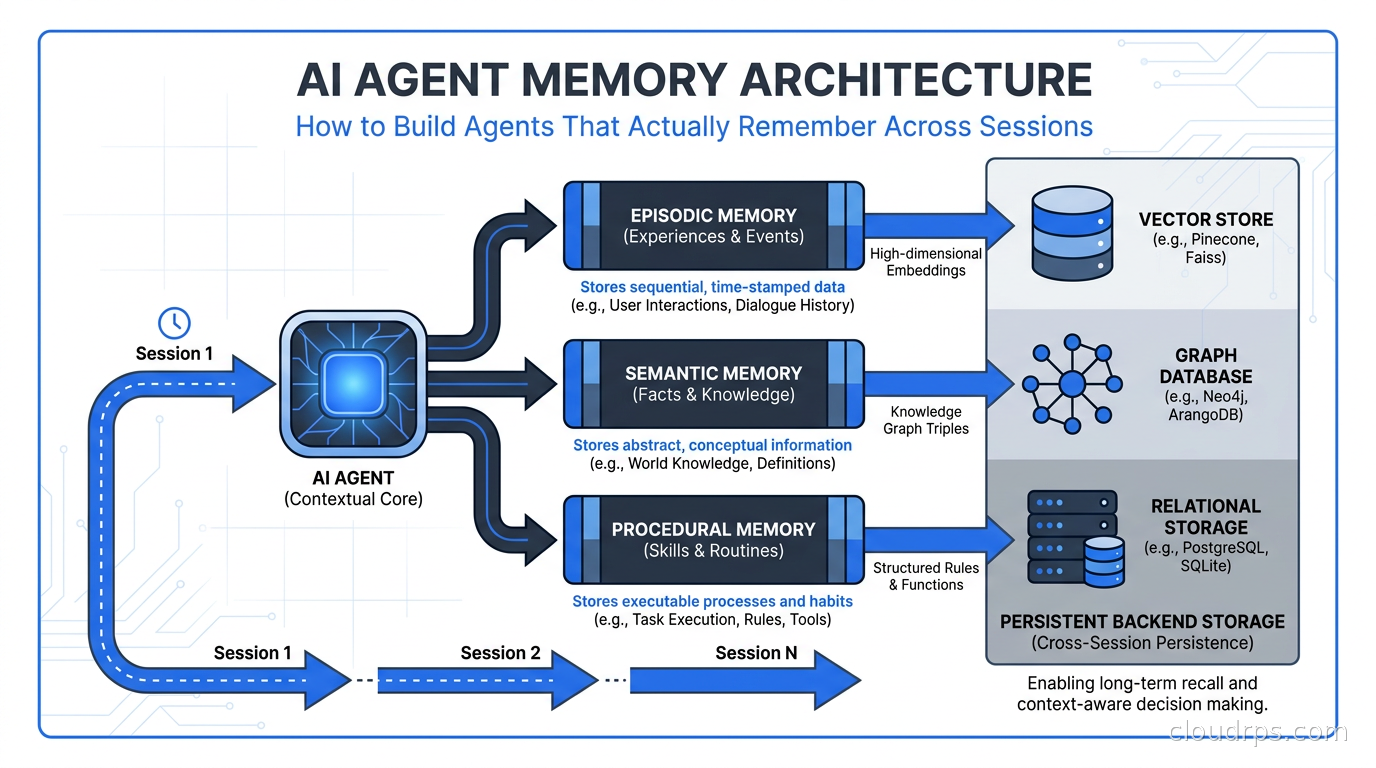
Before you can architect a memory system, you need a taxonomy. I use four types, each with different storage requirements and retrieval patterns.
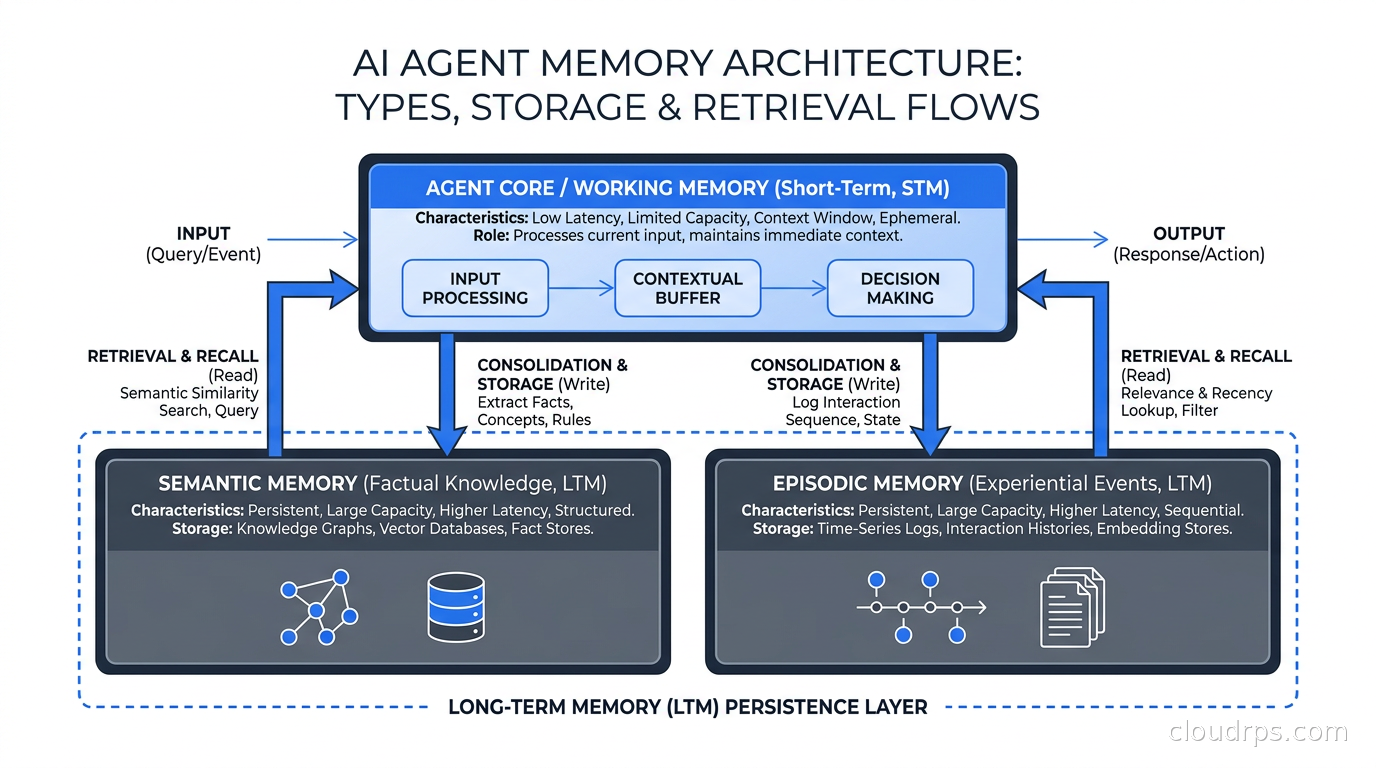
In-context memory is the agent’s working memory: the current conversation turn, tool results, and recent history packed directly into the prompt. Fast to access, but limited by context length and destroyed at session end. Every agent has this. Most agents have only this.
Episodic memory stores specific past events: past conversations, user interactions, decisions made, actions taken. “On March 3rd, the user asked about their Q1 budget and I recommended cutting the staging environment spend.” This is the memory humans use when they say “remember when we discussed this last month.” Episodic memory needs to be queryable by time range, user ID, topic, or semantic similarity.
Semantic memory (sometimes called factual or declarative memory) stores synthesized knowledge: user preferences, entity facts, learned patterns. Not raw events, but extracted insights. “This user prefers concise responses. Their database is PostgreSQL. They work in fintech and are subject to SOC 2 requirements.” This is higher-signal than episodic memory but requires a distillation step to produce.
Procedural memory captures workflows and skills: step-by-step processes the agent has learned, tool usage patterns that work well, recovery strategies for known failure modes. “When this user’s CI pipeline fails, check the flaky test list first before investigating code changes.” Most teams skip this type entirely and then wonder why their agent rediscovers the same solutions on every engagement.
Storage Backends: Matching Memory Type to Technology
Different memory types need different storage backends, and picking the wrong one creates real problems at scale.
Vector stores are the obvious choice for episodic and semantic memory because they support similarity search. You embed the memory as a vector and retrieve the top-K most relevant memories for a given query. This is the same technology underlying RAG architectures, and many teams initially try to use their RAG infrastructure for agent memory too.
That approach works up to a point. The problem is that agent memory has different access patterns than document retrieval. In RAG, you’re searching a relatively static document corpus. In agent memory, you’re constantly writing new records, querying across multiple metadata dimensions (user ID, recency, importance score), and often needing exact-match retrieval alongside semantic search. pgvector on PostgreSQL handles this well for smaller deployments. For higher write throughput, dedicated vector stores like Qdrant or Weaviate give you more control over indexing strategies and filterable metadata. I’ve written separately about vector database tradeoffs if you want the full comparison.
Relational databases are underused for agent memory. Semantic memory maps naturally to structured tables: a user_preferences table, an entity_facts table, a learned_patterns table. SQL gives you precise queries, transactional consistency, and the ability to update facts in place rather than accumulating stale vector entries. For a serious production agent, I run both: vector store for episodic retrieval, PostgreSQL for structured facts.
Key-value stores with TTL support are ideal for what I call “hot memory”: context that’s intensely relevant right now but should evaporate after a few hours or days. Redis works well here, and the distributed caching architecture tradeoffs apply directly. Examples: the current project the user is working on this sprint, the database they were debugging this morning, the deployment they were monitoring last night.
Graph databases are emerging as a serious option for complex entity relationships. Neo4j or Amazon Neptune can represent the web of relationships between users, projects, teams, services, and decisions in ways that flat vector search misses. If your agent needs to reason about how things relate to each other, not just what happened, graph memory is worth evaluating. The retrieval is more complex to implement, but the quality of the results for relationship-heavy queries is noticeably better.
The Memory Lifecycle: Write, Retrieve, Synthesize
Most teams focus on retrieval and completely neglect the write path. Both matter, and the write path is where most production problems originate.
Writing memories needs to happen without blocking the agent’s response. The agent answers the user, then asynchronously extracts and stores memories from the interaction. Doing this synchronously adds latency to every response, which is unacceptable.
What gets written is a design decision with real consequences. Write too little and the memory is useless. Write everything and you end up with a haystack of low-signal noise that degrades retrieval quality over time. I use a tiered approach:
- Always write: key decisions, user-stated preferences, errors and their resolutions, new facts about the user or their systems
- Write if significant: novel information, changes to prior understanding, important context that came up organically
- Never write: routine confirmations, repetitive procedural steps, information already present in semantic memory, filler turns
An LLM extraction step works well here. After each interaction, a small extraction prompt identifies what’s worth remembering: “Extract the key facts, preferences, and decisions from this conversation that would be useful context for future sessions.” The cost of this extraction call is negligible compared to the value of the resulting memories, and it runs asynchronously so it doesn’t add to the user-facing latency.
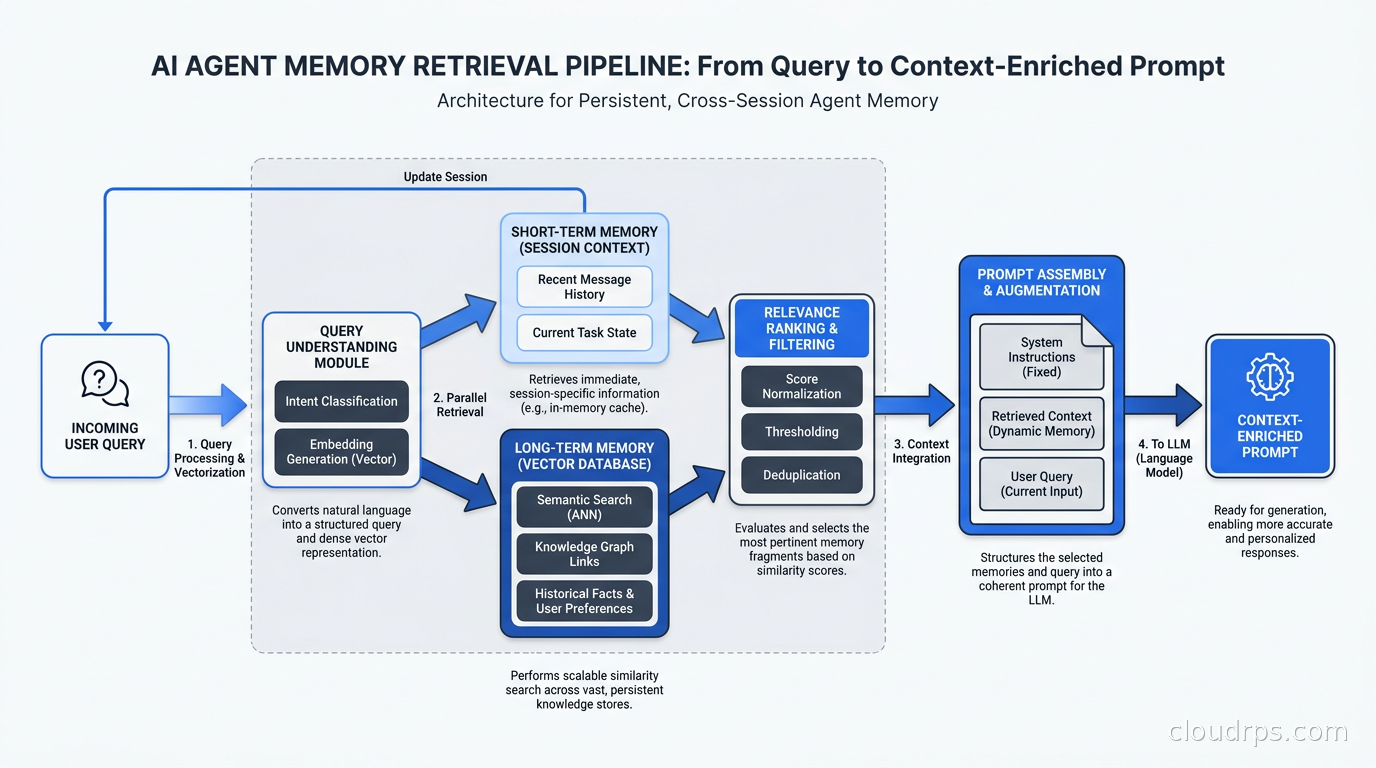
Retrieving memories efficiently requires a multi-stage pipeline. A naive implementation does a single vector search and hopes for the best. A production implementation layers multiple retrieval strategies:
- User profile injection: always pull the current user’s semantic profile (preferences, known facts, active projects) into the context
- Recency window: always include the last one or two sessions’ key memories, regardless of semantic relevance
- Hot memory lookup: exact-match retrieval from Redis for any active context with recent TTL hits
- Semantic search: retrieve episodic and semantic memories most similar to the current query, filtered by the current user’s namespace
- Entity recognition: for any named entities mentioned in the query, run exact-match lookups against the fact store
The retrieved memories get assembled into a memory context block that’s injected before the conversation history in the prompt. This memory context is curated, not dumped wholesale, because undiscriminating memory injection defeats the purpose.
Memory synthesis (sometimes called memory consolidation) runs periodically to compress episodic memories into semantic memory. Raw event records (“on Tuesday, the user said their database was slow and mentioned that they were seeing high CPU on the primary”) become structured facts (“this user manages a high-traffic PostgreSQL primary with CPU performance issues under load”). This prevents unbounded growth of the episodic store and makes retrieval progressively more efficient as the system accumulates history.
I run synthesis nightly as a background job, using a small LLM call to review the previous 24 hours of episodic memories per user and extract anything worth promoting to the semantic store. The cost is small; the quality improvement over time is significant.
Production Tooling: What I Actually Use
The memory tooling landscape matured fast in 2025 and 2026. You have real choices now.
mem0 is the most production-ready open-source option I’ve worked with. It handles the full memory lifecycle, supports multiple vector backends (Qdrant, Chroma, pgvector), and has a clean Python SDK that integrates well with LangGraph and CrewAI pipelines. The managed mem0 Platform handles hosting if you don’t want to operate your own vector store. Out of the box it does automatic memory extraction, deduplication, and retrieval. The defaults are reasonable; you can tune them as you understand your workload better.
Zep takes a different approach, focusing on graphical memory (entities and their relationships) rather than pure vector similarity. If your agents need to track complex relationships between users, organizations, and projects, Zep’s graph-based retrieval surfaces connections that vector search misses. I’ve used it successfully for enterprise agents that need to reason about org structures and cross-team dependencies.
AWS Bedrock AgentCore Memory became generally available in mid-2026 and is the obvious choice if you’re already running agents on AWS Bedrock. It integrates natively with the Bedrock agent runtime, handles persistence, retrieval, and TTL management automatically, and bills per memory operation. The tradeoff is vendor lock-in and less flexibility to customize the retrieval pipeline. For internal enterprise agents where you don’t want to manage vector infrastructure, it’s a reasonable call.
Google Vertex AI Memory Bank launched in early 2026 and offers similar managed capabilities for GCP-native agents. If you’re using Gemini models and Vertex AI Agent Builder, Memory Bank wires in without significant additional configuration.
For teams running their own stack, my current production setup for a multi-user enterprise agent is: pgvector on PostgreSQL for episodic and semantic memory, Redis with 24-hour TTL for hot memory, and a nightly consolidation job that uses a compact LLM call to compress episodic events into semantic facts. This is more infrastructure to operate than a managed offering, but it gives me full control over the retrieval pipeline and the data governance story.
LangGraph and Memory: The Integration Story
If you’re building with LangGraph, state persistence is built into the checkpointing system, but cross-session memory is your responsibility. LangGraph’s MemorySaver and Postgres-backed checkpointers handle within-session state beautifully. Cross-session memory requires explicit integration with an external memory store.
The pattern I use: at the start of each graph invocation, a memory_load node fetches relevant memories and injects them into the graph state. At the end of each invocation, a memory_save node runs asynchronously to extract and persist new memories. The middle of the graph doesn’t interact with memory infrastructure directly. This clean separation keeps the business logic readable and makes it straightforward to unit test the memory operations independently.
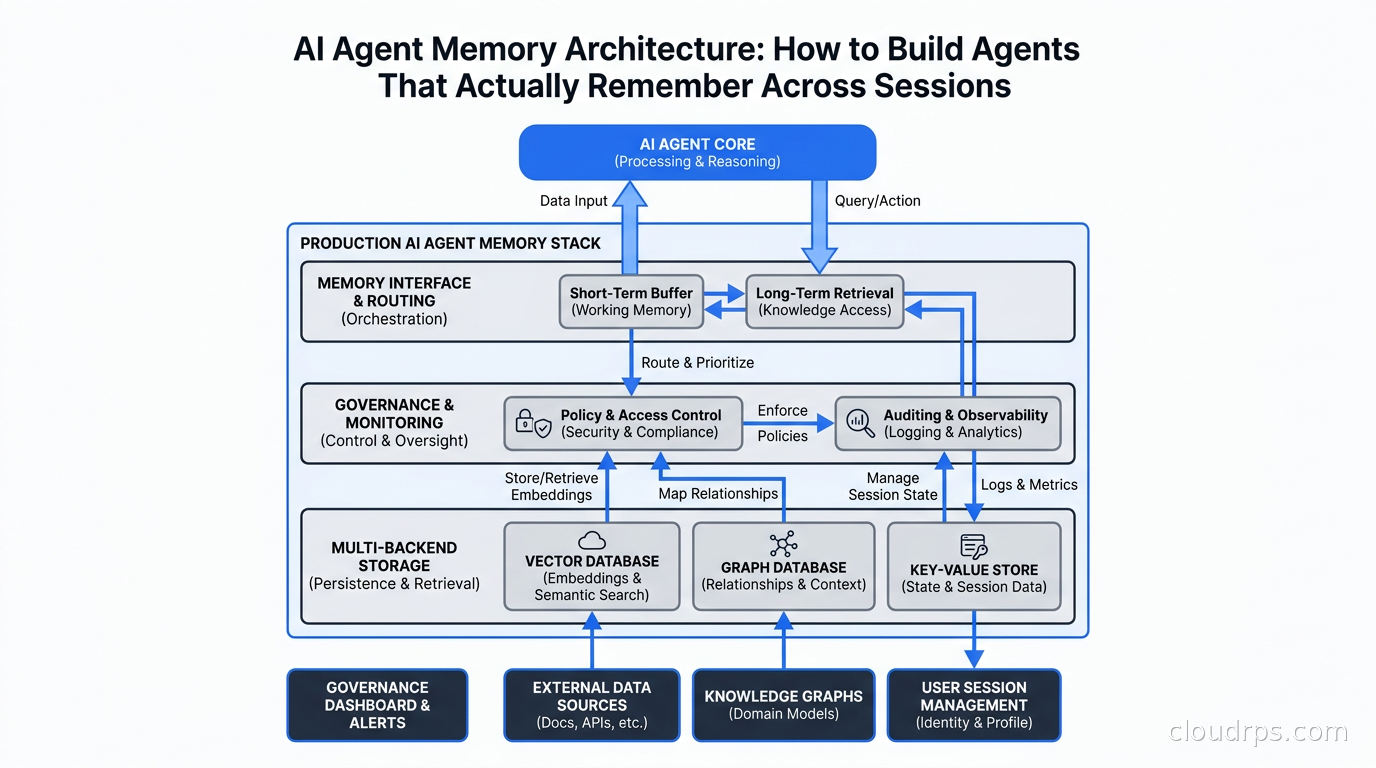
Tracing the memory pipeline is non-negotiable in production. You need to know what memories were retrieved for a given response, whether they were actually used, and whether stale or incorrect memories are causing wrong answers. Tag memory retrieval operations in your LLM observability pipeline and track memory hit rate, memory utilization per response, and memory write success rate as first-class metrics.
The Memory Privacy Problem
Memory is infrastructure, which means memory is a compliance concern. This blindsides teams that built the capability first and thought about data governance later.
Enterprise agents accumulate sensitive information: compensation discussions, performance issues, strategic plans, personal health information in healthcare domains. Your memory store becomes a high-value target. You need to think through several issues upfront.
Memory isolation: User A’s memories must never surface in User B’s context. This sounds obvious, but it fails in surprising ways when multi-tenant memory stores share embedding namespaces or when retrieval queries lack proper user-scoped filtering. Test for isolation failures explicitly before production launch, not after.
Retention policies: Memory that’s useful for 30 days may be a liability at 3 years. Build TTL policies from the start. Episodic memories that haven’t been referenced in 90 days often don’t need to live forever. Semantic facts about users should be explicitly clearable on request. Design the expiration logic before you have millions of memory records to migrate.
User audit access: Users should be able to see what the agent knows about them and correct or delete it. This is both a trust requirement and, in several jurisdictions, a legal requirement under privacy frameworks. Build the audit interface before you deploy to production. I’ve seen compliance teams freeze AI agent deployments that launched without memory governance, and the resulting remediation is far more expensive than building it right initially.
Encryption at rest: Memory stores containing PII or confidential business context need encryption at rest and in transit. Your vector store selection should account for this, and key management should tie into your existing secrets infrastructure rather than being bolted on after the fact.
Memory in Multi-Agent Systems
When you move from single agents to multi-agent architectures, memory design gets meaningfully more complicated. The scaling challenges for agentic systems apply to memory as well: write contention, retrieval latency at scale, and consistency across multiple concurrent agents all become real concerns.
You have three basic design choices for multi-agent memory.
Shared memory gives all agents access to a common memory store. This works well for a team of specialized agents collaborating on behalf of a single user: the research agent, the writing agent, and the review agent all see the same user context. The risk is memory pollution: one agent writing low-quality or incorrect memories that degrade all agents’ behavior.
Private memory per agent isolates each agent’s memories. The orchestrator agent knows about past orchestrations. The code-writing agent knows about past code it wrote. The tradeoff is that agents can’t learn from each other’s interactions without explicit memory-sharing protocols, which adds coordination overhead.
Hierarchical memory is what I recommend for most multi-agent deployments. User-level facts and preferences live in shared memory accessible to all agents. Agent-specific operational memories (tool usage patterns, common failure modes for that agent’s domain) live in per-agent stores. This mirrors how effective teams actually work: shared organizational knowledge, with each specialist also developing their own expertise.
Write conflicts deserve explicit handling. When multiple agents try to update the same memory record concurrently, you need either optimistic locking, last-writer-wins semantics with conflict logging, or a dedicated memory-write queue that serializes updates. Which approach you choose depends on how frequently write conflicts actually occur in your workload.
Measuring Whether Memory Actually Works
The hardest part of agent memory is not the infrastructure. It’s knowing whether it’s actually working.
The metrics I track for memory quality in production:
Recall accuracy: For a set of test queries, does memory retrieval surface the right memories? Sample conversations, run the retrieval pipeline, evaluate whether the retrieved memories are relevant using an LLM judge. Include this in your evaluation pipeline alongside response quality metrics.
Memory utilization: What percentage of retrieved memories does the agent actually reference in its response? If you’re pulling 10 memories and the agent references 1, your retrieval is returning noise and inflating prompt costs without adding value.
Session coherence: Does the agent’s behavior in session N+1 reflect what was established in session N? Run structured evaluations where you assert facts in one session and verify they’re available in the next. Automate these tests in CI before deploying changes to the memory pipeline.
False positive rate: Is the agent incorrectly using memories from irrelevant contexts, or surfacing stale memories that contradict current facts? This is harder to measure but critical to catch. A memory system that confidently provides wrong context is worse than no memory at all.
Track these metrics over time as your memory store grows. Retrieval quality often degrades as the memory store accumulates noise, and you want to catch that drift before users notice it.
The Direction This Is Heading
Twenty years of building distributed systems has taught me that the components that seem like minor plumbing details are usually the ones that make or break production systems. Agent memory has that character: the kind of thing that demo-level agents ignore and production agents depend on.
The managed offerings from AWS and Google are early signals that memory will become a first-class primitive in agent runtimes, managed by the platform rather than rebuilt by every application team. That consolidation is probably two to three years away from being fully settled. In the meantime, teams building serious production agents need to treat memory as infrastructure: design it upfront, test it explicitly, govern it carefully, and monitor it continuously.
The payoff is real. An agent that learns and remembers earns user trust in a way that stateless systems never can. That trust is what separates the agents that get abandoned after two weeks from the ones that become genuinely indispensable.
Get Cloud Architecture Insights
Practical deep dives on infrastructure, security, and scaling. No spam, no fluff.
By subscribing, you agree to receive emails. Unsubscribe anytime.