
About eight years into my career as a principal cloud architect, I was leading the migration of a mid-sized fintech platform from a monolith into microservices. We had done everything right on paper: solid domain boundaries, OpenAPI specs for every service, a CI/CD pipeline that ran thousands of unit tests on every push. We were proud of it.
Then we had a Monday morning incident that took three hours to diagnose. A payments team had renamed a JSON field from amount_cents to amount in what they called a “backwards-compatible cleanup.” The billing service, which consumed that field, had been tested in isolation with mocks that matched the old contract. The payments team had updated their own mocks. Neither team’s tests failed. The integration only broke in production.
That afternoon, I spent two hours reading about consumer-driven contract testing. I had known the theory for years. I had never felt the pain clearly enough to prioritize building the practice. That Monday changed that.
Twenty years in this industry teaches you that the most expensive bugs are the ones that require the most people to be in a room to diagnose. API contract violations are almost always that kind of bug: two teams, two code repositories, two CI pipelines, and no single place where the incompatibility was visible before it hit production.
What API Contract Testing Actually Is
Before going further, it is worth being precise about what contract testing is and what it is not.
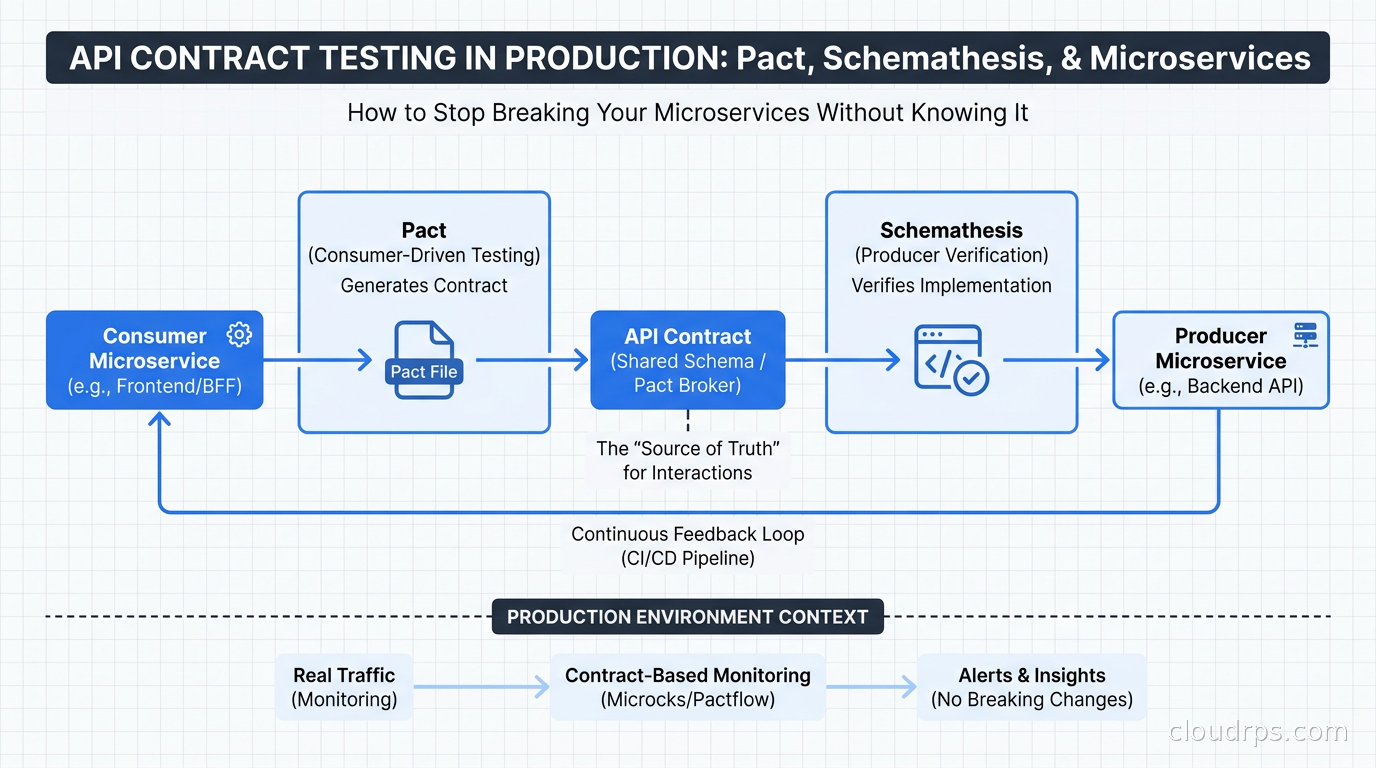
A contract is an agreement between a service consumer and a service provider about the shape of their interaction: which fields exist, what types they have, which are required, which HTTP status codes to expect. An API contract test verifies that this agreement holds, independently of whether either service is fully running.
This makes contract testing fundamentally different from end-to-end integration testing. End-to-end tests run both services together and test a specific user scenario. They are slow, flaky, and expensive to maintain. Contract tests run each service in isolation against the contract: the consumer verifies it can handle what the provider promises to send, and the provider verifies it actually sends what consumers expect. They are fast, deterministic, and can run in parallel with unit tests.
The distinction matters enormously in a microservices organization. If you have twenty services, end-to-end testing all possible interactions becomes combinatorially impossible. Contract testing gives you the integration coverage you need without the complexity.
There are two main flavors: consumer-driven contracts and provider contracts. They solve related but different problems, and in a mature system you want both.
Consumer-Driven Contract Testing with Pact
Pact is the dominant open-source framework for consumer-driven contract testing, and it has been for nearly a decade. The core idea is elegantly backwards from how most teams initially think about APIs.
Instead of the provider team writing a spec and consumers adapting to it, Pact inverts the relationship. The consumer writes a test that captures exactly what it needs from the provider: not the entire API, just the fields and responses its code actually uses. Pact captures this expectation as a JSON “pact” file, then replays it against the real provider to verify the provider actually fulfills the contract.
Here is what a Pact consumer test looks like in Python:
from pact import Consumer, Provider

pact = Consumer("billing-service").has_pact_with(Provider("payments-service"))

pact.given("a valid payment exists")
    .upon_receiving("a request for payment details")
    .with_request("GET", "/payments/123")
    .will_respond_with(200, body={
        "payment_id": "123",
        "amount": Like(1500),        # any integer
        "currency": Term(r"[A-Z]{3}", "USD"),
        "status": "completed"
    })
That test runs against a Pact mock provider during the consumer’s CI pipeline. It passes or fails based purely on whether the consumer code correctly handles the mocked response. But more importantly, it generates a pact file that describes the expectation.
The provider team then runs their own verification step, which replays that pact file against their real service. If the payments service renames amount to amount_cents, the provider verification fails immediately, before any code merges.
This is the key insight: the consumer tells the provider what it needs, and the provider must prove it can deliver. Breaking changes become visible at the source, in the team that owns the change, before the change ships.
The Pact Broker is the coordination layer that makes this work in a team environment. It stores pact files published by consumer pipelines, and provider pipelines pull from it during verification. It tracks which versions of each service are compatible with which versions of every other service.
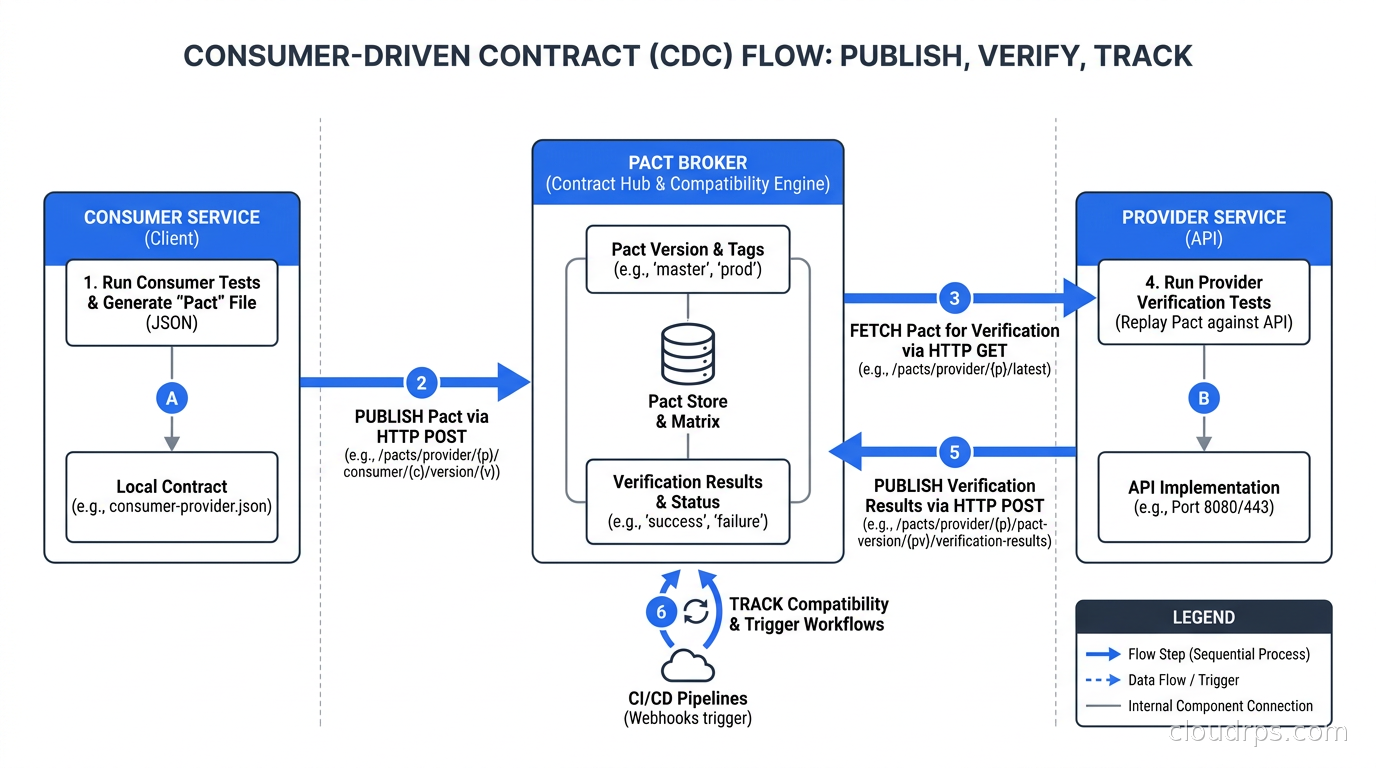
The most powerful feature of the Pact Broker is the can-i-deploy command. Before any service deploys to production, it asks the broker: “Is version X of my service compatible with the versions of all my dependencies that are currently deployed?” If any provider has not verified the consumer’s pact, or if verification failed, the deploy is blocked. That single gate has saved my teams from more incidents than I can count.
PactFlow, the commercial managed version of the Pact Broker, adds bi-directional contract testing. Instead of requiring both teams to use Pact, the provider team can publish an OpenAPI spec, and PactFlow automatically verifies the consumer pacts against it. This is enormously useful when you cannot change how the provider team runs their tests. It also works with tools like Dredd and Postman collections as the provider verification step.
The setup cost for Pact is real. You need to self-host or pay for PactFlow, integrate the CLI into your CI pipelines, and build the discipline of running can-i-deploy before every deployment. For a team of five working on three services, that overhead may not be worth it. For a platform with forty services owned by eight teams, it is not optional.
Provider Contract Testing with Schemathesis
Consumer-driven contracts tell you whether specific consumers’ expectations are met. They do not tell you whether your API as a whole is correct, internally consistent, or robust against unexpected inputs. That is where Schemathesis comes in.
Schemathesis is a property-based API testing tool that takes an OpenAPI spec and generates thousands of test cases to probe the actual behavior of a running service. It is not a fuzzer in the traditional security sense, though it does find security-adjacent bugs. It is closer to a generative test framework that systematically explores the space of valid and invalid inputs your API might receive.
schemathesis run https://api.payments.internal/openapi.json \
  --checks all \
  --stateful=links \
  --auth "Authorization: Bearer $CI_TOKEN"
That single command will:
- Generate valid requests from the spec and verify responses match declared schemas
- Inject edge cases: empty strings, very long strings, Unicode, null where non-nullable fields are expected
- Follow OpenAPI links to test stateful workflows
- Report any 5xx errors, schema mismatches, or response contract violations
The bugs Schemathesis finds are different from what consumer pacts catch. It finds cases where the provider’s own documentation lies: an endpoint that returns a 200 with a field marked as required but sometimes missing, or a filter parameter that crashes the service with a particularly formatted date string. I have run Schemathesis against services that had passing consumer contract verifications and found a half-dozen provider bugs in twenty minutes.
The combination is powerful. Pact tests specific consumer expectations. Schemathesis tests the provider’s contract with the world in general. Both are necessary.
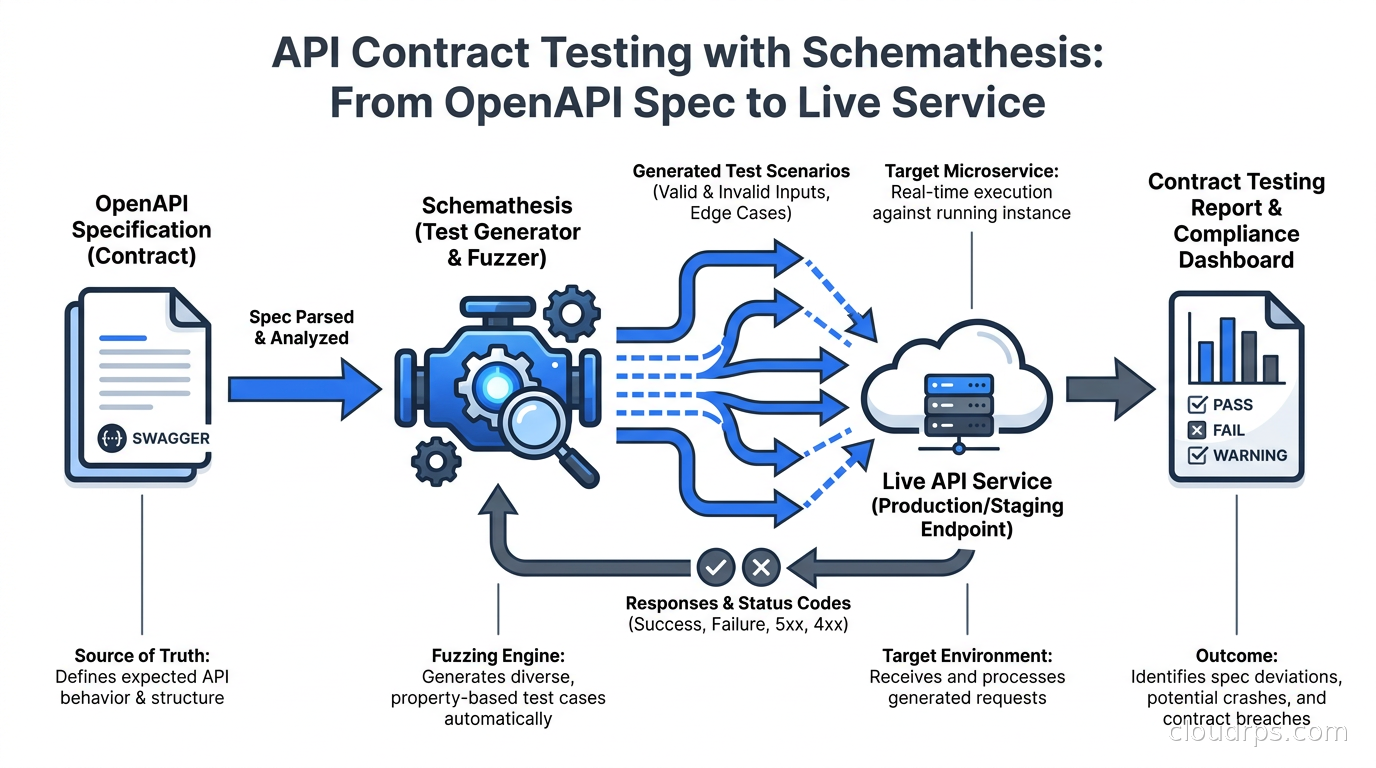
One practical detail: Schemathesis works best in a testing or staging environment, not against production. The generated requests can be malformed by design, which may trigger alerting in production environments or leave garbage in databases. Set up a dedicated CI environment with a fresh database state, and run Schemathesis as a nightly job or as part of the provider’s PR pipeline.
For OpenAPI specs that have not been kept up to date (which is most of them), Schemathesis will expose drift quickly. This is actually a useful forcing function. Running it in CI and treating violations as build failures creates natural pressure to keep specs accurate. I have seen teams whose OpenAPI specs were perpetually aspirational rather than descriptive. Schemathesis changed that culture within a month.
Microcks as Your Central API Mock Registry
The third tool in this stack is Microcks, and it solves a different but related problem: how do you share consistent mocks across many consumer teams without everyone maintaining their own?
In a microservices platform with twenty services, consumer teams need mocks of their dependencies to run local development and integration tests without spinning up the entire dependency graph. The naive approach is for each consumer team to write their own mocks. This creates a proliferation of inconsistent, often-stale mocks that each embed assumptions about provider behavior that may be wrong.
Microcks acts as a central mock server registry. It imports OpenAPI specs, gRPC protobufs, AsyncAPI specs for messaging, and Postman collections, then generates realistic mock servers from them. Consumers hit the Microcks-hosted mock instead of writing their own, and when the OpenAPI spec updates, all mocks update together.
# Import the payments service spec into Microcks
apiVersion: microcks.io/v1alpha1
kind: APISource
metadata:
  name: payments-service
spec:
  openapi:
    url: https://raw.githubusercontent.com/org/payments-service/main/openapi.yaml
  scheduling:
    cron: "0 * * * *"  # refresh every hour
Microcks also supports contract testing through its own verification mechanism: you can point it at a real running service and verify the responses match the spec. This is a lighter alternative to Schemathesis for teams that want spec-driven validation without the generative testing depth.
The Microcks Kubernetes operator makes deployment straightforward. Most teams run it in a shared infrastructure namespace and expose it to development environments. The mock URLs become stable environment variables that consumer services use in integration tests.
Where Microcks really shines is for event-driven APIs. If your platform uses Kafka or AsyncAPI-documented message schemas, Microcks can mock message producers and consumers, letting you test your message handling code in isolation. This is territory where Pact and Schemathesis do not operate well. For a platform that mixes REST and event-driven interfaces, Microcks fills in the gap.
Wiring It All Together in CI/CD
The value of these tools comes from integration into your deployment pipeline. A contract test suite that developers run occasionally and ignore when it fails is just a tax, not a safeguard.
The pipeline I build for most teams looks like this:
Consumer service PR pipeline:
- Run consumer Pact tests against the Pact mock
- Publish generated pacts to the Pact Broker, tagged with the branch name
- Run unit and integration tests against Microcks mocks
Provider service PR pipeline:
- Run unit tests
- Pull consumer pacts from the Pact Broker (all consumer versions currently deployed)
- Run Pact provider verification against the running service
- Run Schemathesis against the OpenAPI spec in a test environment
- Publish provider verification results to the Pact Broker
Before deployment to production (both consumer and provider):
pact-broker can-i-deploy \
  --pacticipant payments-service \
  --version $GIT_SHA \
  --to-environment production
If any dependent service has not verified compatibility, the deploy blocks. This is the critical gate. Without it, the entire contract testing investment is advisory rather than enforced.
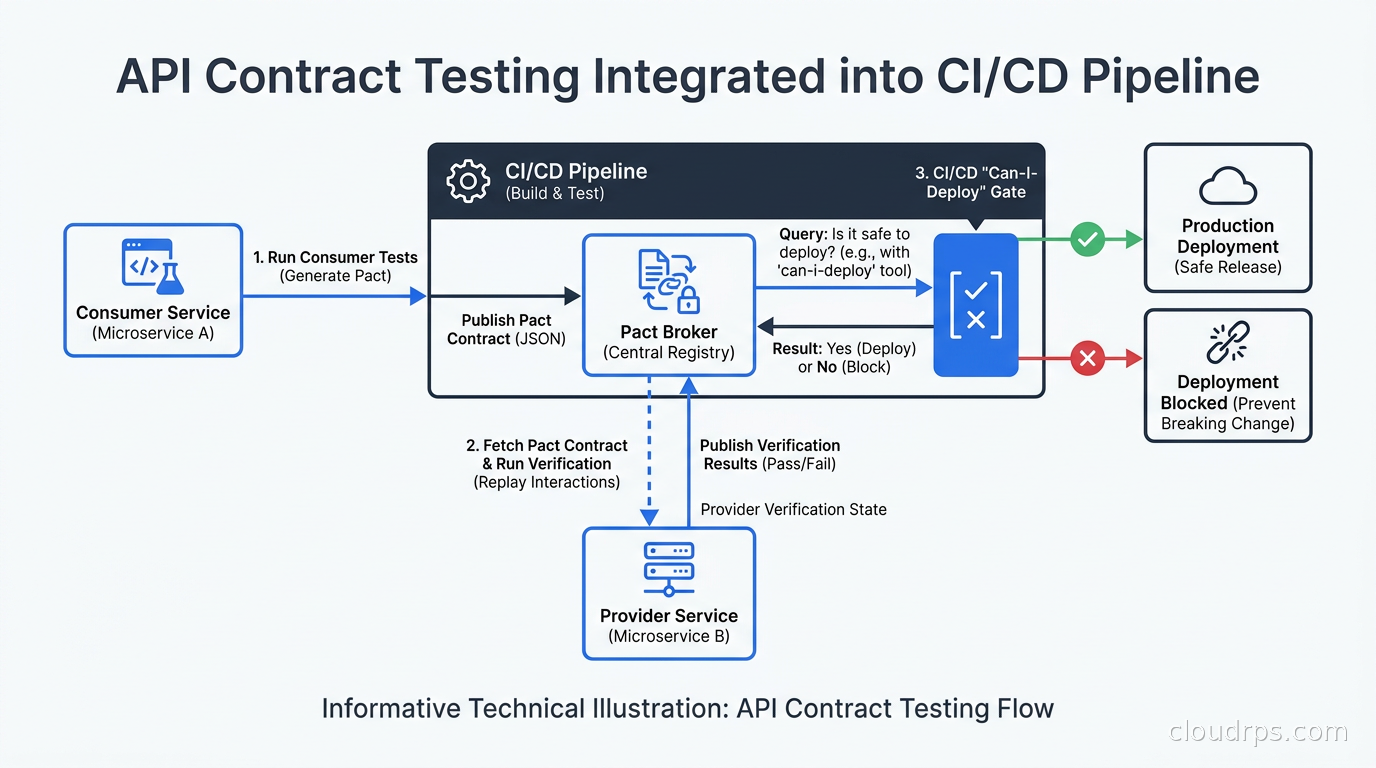
The can-i-deploy check needs to be meaningful for this to work. If teams can bypass it by force-merging or by marking verifications as optional, the cultural pressure evaporates quickly. Treat it the same way you treat a failing unit test: the answer is to fix the contract incompatibility, not to skip the check.
For teams using gRPC and Protocol Buffers, the contract testing story is slightly different. Protobuf’s schema evolution rules (adding fields is backwards compatible, removing or renaming is not) give you some natural protection that JSON does not. But Pact supports gRPC through its gRPC-specific consumer DSL, and the Pact Broker integration works the same way. Combined with the Kafka Schema Registry patterns for event-driven interfaces, you can build a unified contract testing strategy across REST, gRPC, and messaging within one Pact Broker deployment.
Handling API Versioning and Schema Evolution
Contract testing works best when you have a deliberate approach to API versioning. Without versioning discipline, contract evolution becomes a constant negotiation between teams.
The model I recommend is the expand-and-contract pattern, applied to API fields:
Expand phase: Add the new field alongside the old one. Publish updated consumer pacts that reference the new field. Verify that providers serve both.
Contract phase: After all consumers have deployed versions that use the new field, remove the old field. Publish updated pacts. Verify and deploy.
The Pact Broker makes this mechanical. When you want to deprecate amount_cents in favor of amount, you:
- Have the provider serve both fields in a minor release
- Update consumer pacts one at a time as each consumer migrates
- Monitor the Pact Broker’s network diagram until no consumer pact references
amount_cents - Remove the old field
This is fundamentally the same pattern as zero-downtime database migrations, applied to API surfaces. The mechanics are different but the discipline is identical: never delete something until you can prove nothing depends on it.
For GraphQL Federation, the schema registry in Apollo and similar tools provides some of this coordination natively through breaking change detection in the composition check. But the consumer-specific visibility that Pact provides, knowing which specific consuming services depend on a field, is not something that schema-level tools give you without additional work.
The Organizational Layer
The technical stack is the easy part. The hard part is the organizational discipline.
In my experience, the most common failure mode for contract testing adoption is not the tooling, it is accountability. Teams set up Pact, publish pacts, run provider verifications, and then find the first time a verification fails, the deploying team overrides the check because they are under deadline pressure. Once that happens once without consequence, the contract testing culture degrades.
The fix is simple and unpleasant: make can-i-deploy failures block deploys at the infrastructure level, not the honor system level. Use your CI/CD pipeline to enforce this. If you use ArgoCD or Flux for continuous delivery, add a pre-deploy hook that calls can-i-deploy and prevents the sync if it fails. If you use Jenkins or GitHub Actions, gate the deployment job on the result. Make the skip require explicit approval from an engineering leader, not a checkbox in a pull request.
The other organizational requirement is spec ownership. Schemathesis only works if your OpenAPI specs are accurate and up to date. That means the spec is generated from code annotations or is checked in alongside the service implementation, not maintained separately by a documentation team. Tools like FastAPI (which generates OpenAPI from Python type annotations) and Spring Doc (which generates from Java annotations) make this easier, but any approach that puts the spec in the service repository and requires it to be updated in the same PR as the API change will work.
One war story from a large enterprise client: they had excellent Pact adoption across about thirty services, but their Schemathesis runs kept timing out because the team had not allocated enough CPU to the testing environment. For six months, they ran Schemathesis with a five-minute timeout and assumed passes were real passes. We eventually discovered that the timeout was silently suppressing most of the generated test cases. The fix was straightforward once we identified it, but the lesson was clear: contract tests need the same infrastructure investment as any other critical CI step. Running them in an underpowered environment that causes them to silently skip is worse than not running them at all.
For teams integrating this with their API gateway, it is worth noting that some gateways now support contract-level validation in the data plane. AWS API Gateway with a model schema will reject requests that do not match the schema at the gateway layer, before the backend sees them. This is not a substitute for contract testing, since it only catches consumer-to-provider violations at runtime, but it is a useful defense-in-depth layer that complements what Pact catches in CI.
Measuring Contract Testing Maturity
You can assess where your organization sits on the contract testing maturity curve by asking a few questions:
Level 0: No contract tests. Breaking changes are discovered in production or in shared staging environments.
Level 1: OpenAPI specs exist for all services. Schemathesis runs in CI and prevents spec drift. No consumer-specific validation.
Level 2: Pact is in place for critical consumer-provider relationships. The Pact Broker tracks verification results. Some can-i-deploy gates are in place.
Level 3: All service interactions have consumer pacts. can-i-deploy gates block all production deployments. Microcks serves consistent mocks for local development. Schema evolution follows the expand-and-contract pattern.
Level 4: Contract compatibility is a release criteria visible to product management. Deprecation timelines are tracked in the Pact Broker. New services cannot go to production without establishing consumer pacts.
Most teams I consult with are at Level 0 or Level 1 and aspire to Level 3. Getting from 0 to 2 is a six-week project for a motivated platform team. Getting from 2 to 3 requires organization-wide buy-in that usually takes six months to a year. Level 4 is achievable, but it requires treating the contract testing infrastructure as a product, with an owner and a roadmap, not as a tool a single engineer set up and hopes other people use.
The platform engineering angle matters here. The most successful contract testing rollouts I have seen treated the Pact Broker and Microcks deployment as part of the internal developer platform, with the same UX care as any other internal tool. A contract testing workflow that is hard to understand or painful to debug will be abandoned under deadline pressure. A workflow that surfaces clear errors, links directly to the failing pact, and explains what changed in human-readable terms will be trusted and maintained.
Choosing Your Starting Point
If you are starting from scratch, the order of operations I recommend is:
Get Schemathesis running against your most critical external-facing API. Use it to find and fix spec drift. This delivers value immediately and requires no organizational coordination.
Deploy a Pact Broker (or sign up for PactFlow’s free tier). Start with one consumer-provider pair that has a history of breaking changes.
Add the
can-i-deploygate to that one pair’s deployment pipeline. Treat it as a proof of concept for six weeks.Expand to the five highest-traffic internal API relationships. Get all teams using the Pact Broker for those relationships before expanding further.
Deploy Microcks and migrate local development mocks to use it. This pays for itself in reduced mock maintenance time within a quarter.
The tools are mature. Pact has been production-ready for years and has client libraries for every major language. Schemathesis runs with a single command against any OpenAPI spec. Microcks has a Kubernetes operator and a straightforward Helm chart. The technical barrier to starting is lower than it has ever been.
What contract testing requires is not sophistication. It requires treating API boundaries as artifacts that belong to the platform, not to individual teams, and investing in the coordination infrastructure to enforce that. For any organization running more than ten microservices in production, that investment returns its cost within the first prevented incident.
The payments team that renamed amount_cents to amount on that Monday eight years ago was not being careless. They verified their own tests, updated their own mocks, and merged their own PR. They did everything right within their own boundary. The failure was architectural: we had no mechanism for them to know what other teams’ code depended on, and no mechanism for other teams to tell them. Pact is that mechanism. It takes about a day to set up and a week to tune. The incident it prevents can cost a day to recover from and months to fully understand.
For teams already thinking about testing strategy across distributed systems, the load testing and observability investments pair naturally with contract testing: load testing tells you how your APIs behave under stress, tracing tells you what happened when they did not, and contract testing prevents the class of failures that neither can catch before they reach users.
Start with Schemathesis this week. Add Pact next month. You will wonder, as I did, how you shipped microservices without it.
Get Cloud Architecture Insights
Practical deep dives on infrastructure, security, and scaling. No spam, no fluff.
By subscribing, you agree to receive emails. Unsubscribe anytime.