
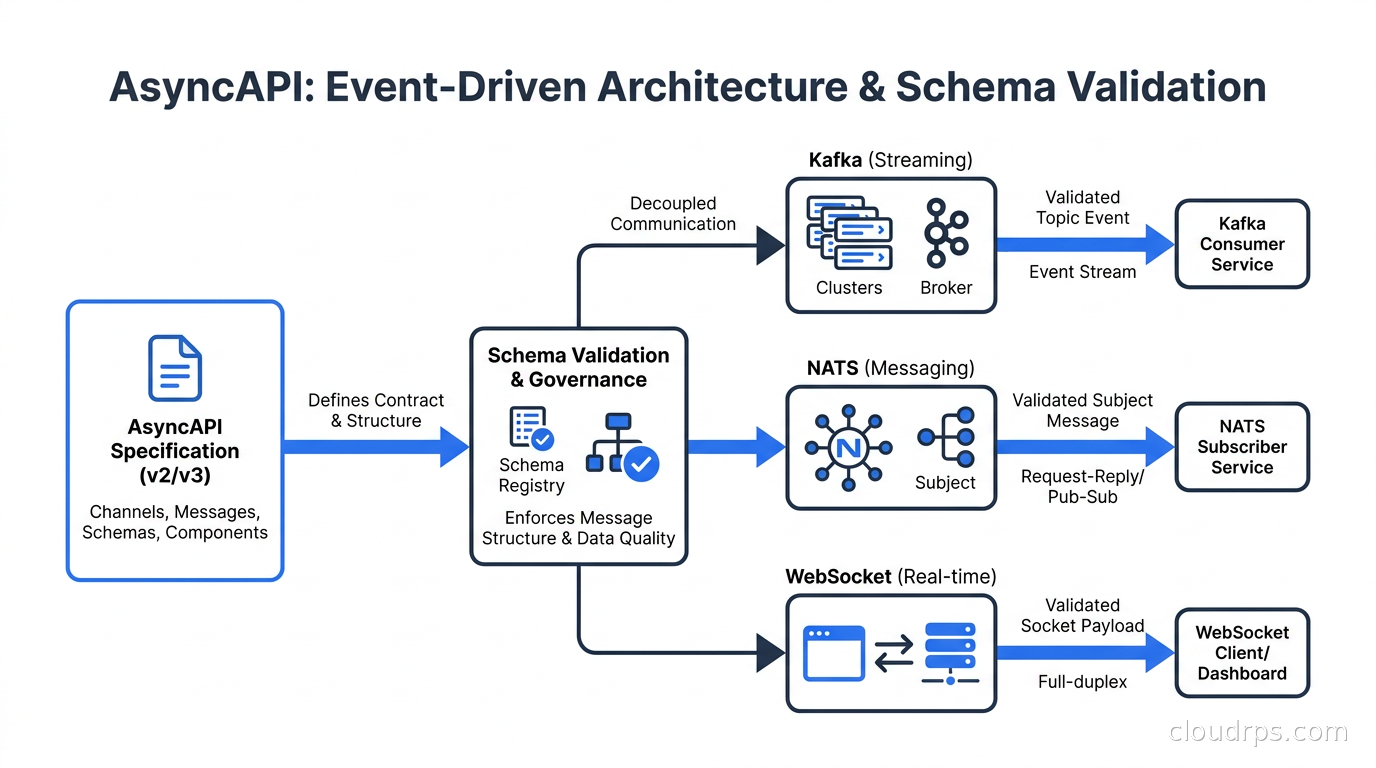
Every REST team has OpenAPI. Your frontend knows exactly what fields come back from /api/users. Your API gateway validates requests against the schema. Your mock servers generate test data from the spec. Your CI pipeline rejects breaking changes before they merge.
Now ask your event-driven team the same questions. How do you document what a user.created event looks like on your Kafka topic? How does the payments service know which fields the orders service guarantees? How do you catch a breaking schema change before it crashes a downstream consumer at 3 AM?
In twenty years of building distributed systems, I have watched teams solve this problem in every wrong way possible: Confluence wikis that go stale in a week, shared Slack channels for “event documentation,” READMEs in Kafka topic names, spreadsheets that nobody remembers to update. Meanwhile, the REST half of those same systems had perfectly maintained OpenAPI specs with generated clients, contract tests, and documentation portals.
AsyncAPI closes that gap. It is to event-driven and message-driven systems what OpenAPI is to REST. By 2026, it has real momentum: version 3.0 shipped, the tooling is production-ready, and I am starting to see it required in enterprise RFPs the same way OpenAPI has been for the past five years.
Here is everything you need to understand how AsyncAPI works and how to actually use it in production.
The Problem AsyncAPI Solves
Before AsyncAPI, the event-driven world had partial solutions. Kafka gave you schema registries for Avro and Protobuf schemas. CloudEvents gave you a standard envelope format for event metadata. But neither answered the architectural question: what topics exist, what events flow across each, who produces them, who consumes them, and what does each message look like?
REST teams often joke that API-first development is easy because you write the OpenAPI spec and generate everything else. Event-driven teams had no equivalent starting point. You would stand up Kafka, create topics, define schemas in a registry, and then write documentation somewhere completely separate. The spec and the implementation drift immediately, and there is no toolchain to catch it.
The deeper problem is discovery. When a new team wants to consume the order.fulfilled event, they need to find: which Kafka cluster, which topic, which consumer group to use, what schema version is current, whether there are any ordering guarantees, and who to call when something breaks. Without AsyncAPI, that information lives in six different places across your organization.
AsyncAPI creates a single machine-readable document that captures all of this. The document can live in your Git repository alongside your code, generate client libraries and documentation, power contract testing, and feed API portals.
AsyncAPI Core Concepts
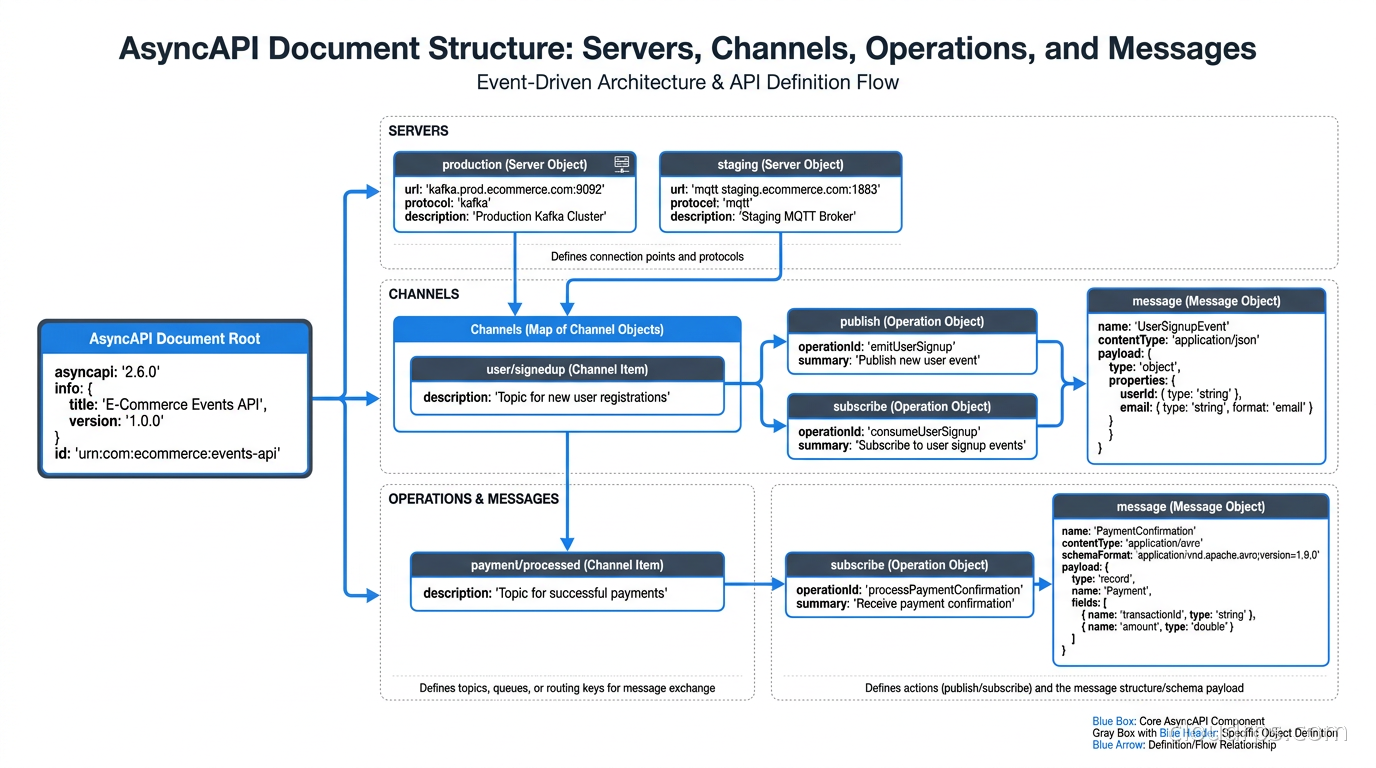
The spec is organized around four key ideas. Understanding them is essential before you write your first document.
Servers define the broker infrastructure: where your Kafka cluster lives, what protocol it uses, what security mechanism it requires. A single AsyncAPI document can describe multiple servers, which is useful for documenting different environments or broker types within the same system.
Channels map to the actual messaging primitives: a Kafka topic, a NATS subject, an AMQP exchange, an SQS queue, a WebSocket path. A channel has an address (the topic name or subject pattern) and describes what messages flow through it.
Operations describe what an application does on a channel: publish (produce) or subscribe (consume). This is where AsyncAPI 3.0 made the biggest breaking change from 2.x, and I will cover that in detail shortly.
Messages define the payload: the schema of the event data, the headers, the correlation ID pattern, the content type. Messages are where your schema definitions live, whether in JSON Schema, Avro, or Protobuf.
Here is a minimal AsyncAPI 3.0 document for a user registration event:
asyncapi: 3.0.0
info:
  title: User Events Service
  version: 1.4.2
  description: Events produced by the user registration flow

servers:
  production:
    host: kafka.internal.company.com:9092
    protocol: kafka
    security:
      - saslScram: []

channels:
  userCreated:
    address: user.created
    messages:
      userCreatedMessage:
        $ref: '#/components/messages/UserCreated'

operations:
  publishUserCreated:
    action: send
    channel:
      $ref: '#/channels/userCreated'
    messages:
      - $ref: '#/channels/userCreated/messages/userCreatedMessage'

components:
  messages:
    UserCreated:
      contentType: application/json
      payload:
        type: object
        required: [userId, email, createdAt]
        properties:
          userId:
            type: string
            format: uuid
          email:
            type: string
            format: email
          createdAt:
            type: string
            format: date-time
          plan:
            type: string
            enum: [free, pro, enterprise]
  securitySchemes:
    saslScram:
      type: scramSha512
That is the entire contract for a producer of user.created events. A consumer team can read this, understand exactly what the event looks like, and write their deserialization code against the schema. No Confluence required.
What Changed in AsyncAPI 3.0
If you have worked with AsyncAPI 2.x, the 3.0 migration requires some relearning. The core change is how operations relate to channels.
In 2.x, operations were nested inside channels, which created ambiguity: a channel could have both a publish and subscribe operation, and the spec was not clear about whose perspective “publish” referred to. Was the spec author describing what the application does, or what a consumer of the spec needs to do? Teams argued about this constantly.
In 3.0, operations are separated from channels entirely. The action field uses send (produce to) and receive (consume from), which is unambiguous. A channel is just an address; operations express what your specific application does with that address. This means two different AsyncAPI documents can reference the same channel: one for the producer, one for the consumer. The channel becomes a shared contract, and each application describes its relationship to it.
The 3.0 spec also introduced cleaner request/reply patterns, making it practical to document synchronous-ish workflows over Kafka where a producer sends to one topic and waits for a response on a reply-to topic.
If you are greenfield, start with 3.0. If you have existing 2.x documents, the AsyncAPI team provides a migration guide, but plan a few days to understand the conceptual changes before touching your YAML.
Protocol Bindings: Beyond Kafka
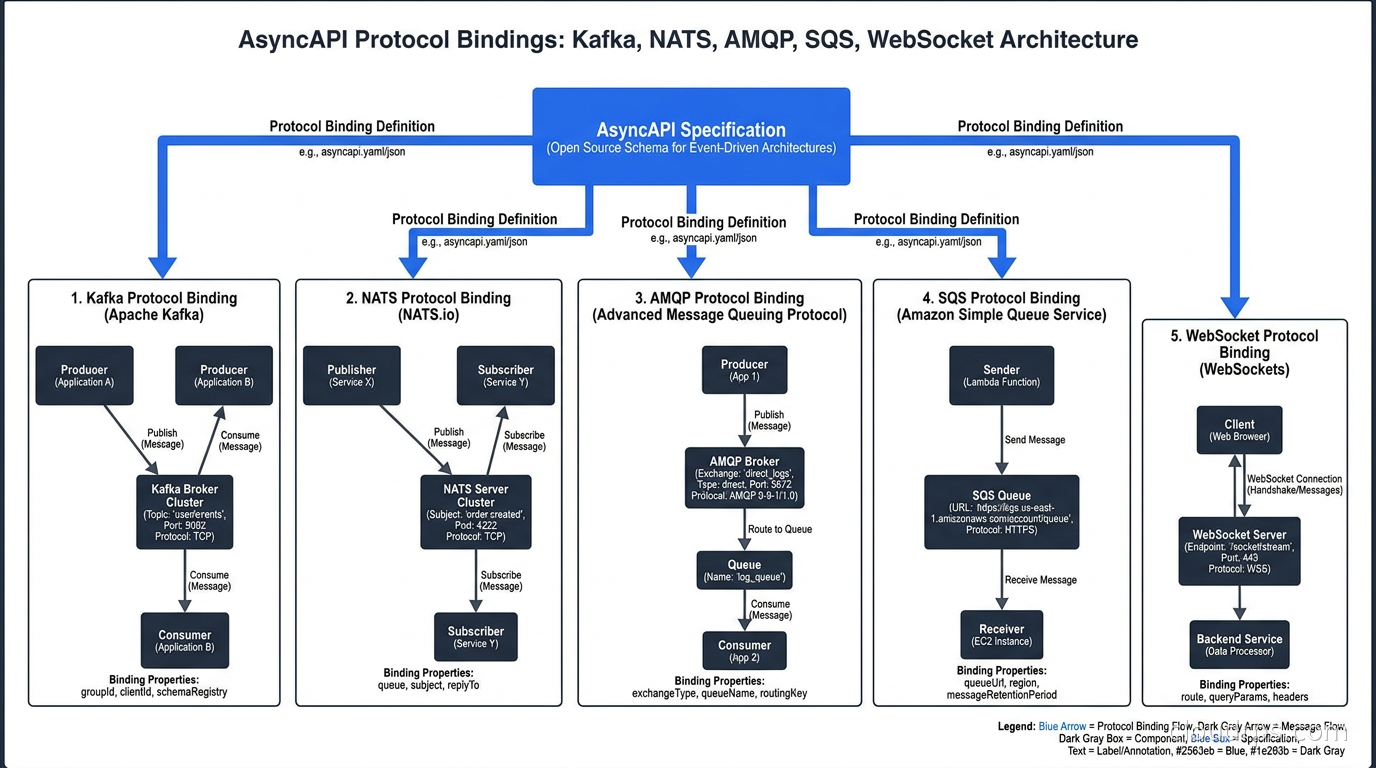
One of AsyncAPI’s strongest features is protocol-agnostic design. The same document structure works for Kafka, NATS, AMQP, MQTT, WebSockets, AWS SQS, and more. Protocol-specific behavior is captured through bindings, which extend channels, servers, and messages with protocol-specific metadata.
For teams using NATS for cloud-native messaging, the binding captures the subject name, whether to use JetStream, and queue group configuration. For Kafka topics, the binding captures partition count, retention policy, cleanup policy, and consumer group settings:
channels:
  orderFulfilled:
    address: order.fulfilled
    bindings:
      kafka:
        topic: order.fulfilled
        partitions: 24
        replicas: 3
        topicConfiguration:
          cleanup.policy:
            - delete
          retention.ms: 604800000
This matters because it turns your AsyncAPI document into a source of truth for both the schema and the infrastructure. Your Terraform module or Kafka admin tooling can theoretically read these specs to provision topics with the correct configuration. I have seen teams build exactly this: a GitHub Actions pipeline that reads AsyncAPI specs from service repositories, validates them against a central registry, and applies topic configuration changes through infrastructure automation.
For WebSocket-based services, the binding captures the path, method (for the HTTP upgrade), and query parameters. This is genuinely useful for real-time event streams where you need to document both the connection handshake and the message formats that flow over the connection.
Schema Formats: JSON Schema, Avro, and Protobuf
AsyncAPI supports multiple schema formats for message payloads, which gives teams flexibility without sacrificing tooling compatibility.
JSON Schema is the default and works well for teams that prioritize human readability and flexibility. You write the schema inline in the AsyncAPI document, and validators can enforce it at both design time and runtime.
Avro and Protobuf are where AsyncAPI’s integration with schema registries becomes critical. When your Kafka messages are serialized with Avro, your AsyncAPI document can reference the Avro schema directly rather than duplicating it in JSON Schema. The document becomes a pointer to your schema registry rather than a redundant copy:
components:
  messages:
    PaymentProcessed:
      schemaFormat: application/vnd.apache.avro+json;version=1.9.0
      payload:
        $ref: 'https://schema-registry.internal/subjects/payment.processed-value/versions/latest/schema'
This is the right pattern for production. The AsyncAPI document describes the messaging contract, and the schema registry is the authoritative source for the schema definition. You get the discoverability of AsyncAPI without maintaining two copies of the same schema.
The tension here is tooling support. Not every AsyncAPI tool handles Avro and Protobuf references as gracefully as JSON Schema. Check your specific generator or validator against your schema format before committing to an approach.
Tooling: Where AsyncAPI Actually Gets Useful
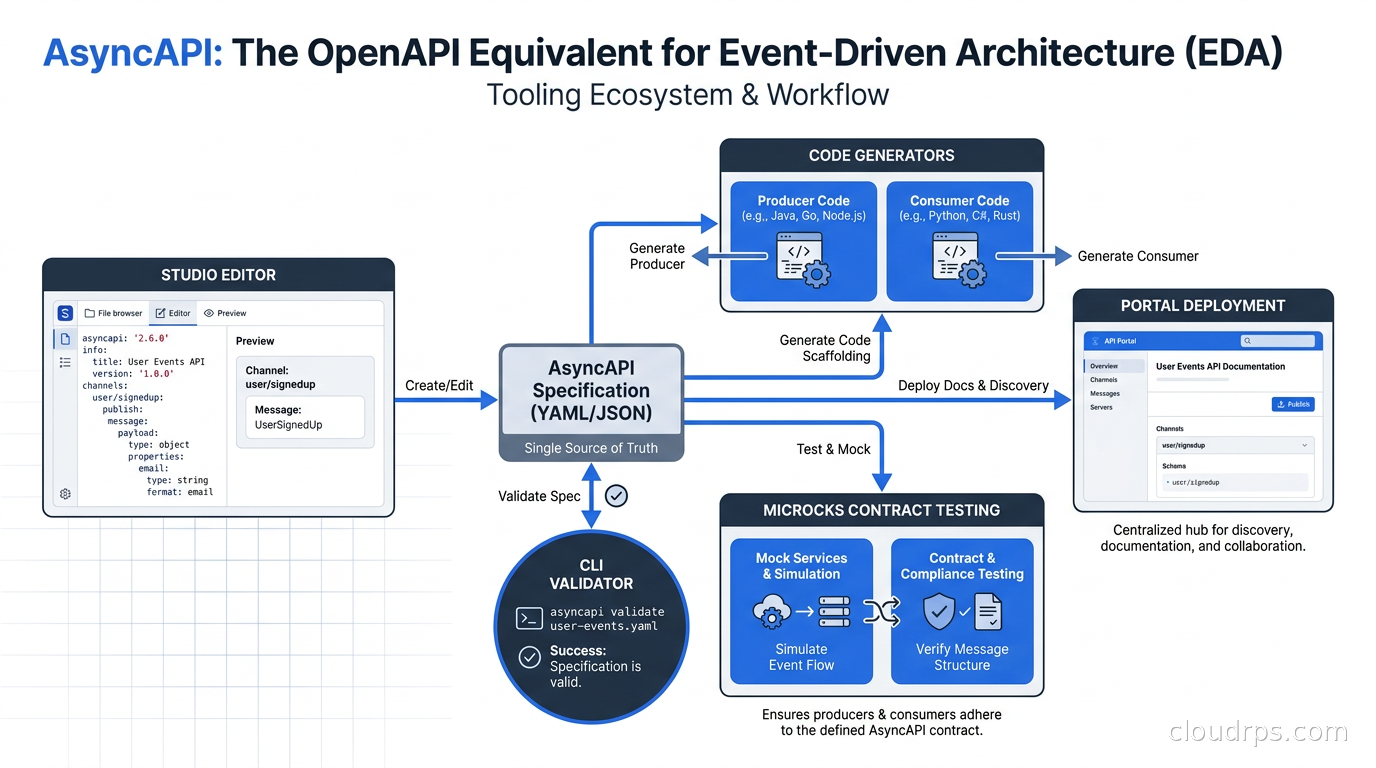
The spec itself is just YAML. The value comes from the tooling ecosystem.
AsyncAPI Studio is the browser-based editor at studio.asyncapi.com. It validates your spec, gives you real-time error checking, and renders a visual preview of the channels and message flows. I use it for initial document authoring because it catches common mistakes immediately.
AsyncAPI Generator is the code generation layer. From an AsyncAPI spec, you can generate client libraries in Node.js, Python, Java, and other languages, as well as documentation sites, HTML reports, and infrastructure configurations. The generator uses templates, and the community has published templates for most common use cases. For teams that want to work API-first, this is the path: write the spec, generate the client stub, implement against the interface.
AsyncAPI CLI is the command-line tool that handles validation, bundling, and generation locally. Run it in CI to catch spec violations before merge. I have a simple CI step that validates every AsyncAPI spec change against the 3.0 schema and blocks merges with invalid documents.
Microcks deserves special mention. It is an open-source mock and contract testing platform that supports OpenAPI, gRPC, GraphQL, and AsyncAPI. For event-driven teams, Microcks can generate mock messages based on your AsyncAPI spec and act as a Kafka producer or consumer for integration testing. If you are doing API contract testing for your REST services, Microcks extends the same discipline to your async services.
I have used Microcks in staging environments where the actual upstream Kafka producer is either unavailable or expensive to keep running. Microcks reads the spec and generates realistic mock events with randomized data that conforms to the schema. Tests can run without any real broker connection.
AsyncAPI and CloudEvents: Complementary, Not Competing
Teams sometimes confuse AsyncAPI with CloudEvents and wonder which to use. They solve different problems and work well together.
CloudEvents is an event envelope specification: a standard way to structure the metadata of an event (source, type, subject, time, data content type). CloudEvents does not describe what events exist in your system or what protocols they flow over. It describes how any individual event should be structured.
AsyncAPI is a discovery and documentation specification: it describes what events exist, on which channels, with what schemas, using what protocols. It does not dictate how individual events are structured.
The combination is powerful. Define your events using CloudEvents envelopes for consistent metadata. Document those events in AsyncAPI for discovery and contract enforcement. Your AsyncAPI message schema would include both the CloudEvents attributes and your domain-specific payload.
For event-driven architectures on AWS using SNS and EventBridge, CloudEvents-formatted events in an AsyncAPI spec gives you a vendor-neutral way to document event flows that happen to be deployed on AWS infrastructure. When you eventually want to mirror those events to a different broker or cloud, the AsyncAPI spec does not need to change.
Integrating AsyncAPI into Your Development Workflow
Spec-first development with AsyncAPI follows the same pattern that has worked for REST teams with OpenAPI.
Start with the spec in your Git repository, colocated with the service code that owns the channel. The producer service owns the AsyncAPI document for the events it produces. This makes ownership clear and keeps the spec close to the code that needs to stay in sync with it.
Add a CI check that validates the spec on every pull request. The AsyncAPI CLI makes this straightforward: one command validates the document against the spec version. This catches structural errors immediately.
For breaking change detection, the more interesting problem is whether a schema change is compatible with existing consumers. This is where schema compatibility modes from your Kafka schema registry matter. AsyncAPI documents what the schema looks like; the registry enforces compatibility rules between versions. Use both together: AsyncAPI for the human-readable contract and registry for the machine-enforced compatibility check.
Publish your AsyncAPI specs to a central portal. Several commercial API management platforms have added AsyncAPI support, including Apicurio Registry’s developer portal, Backstage plugins, and tools like Gravitee API Management. The goal is a single place where teams can discover all async APIs in your organization, the same way they would browse an OpenAPI catalog for REST services.
This solves the discovery problem I mentioned earlier. When a new team wants to consume order.fulfilled events, they go to the portal, find the spec, read the channel address and broker location, download the generated client library, and get started. No Slack messages required.
Production War Story: The Schema Drift Disaster
A few years into my career, I was working on a financial services platform that had about forty microservices talking to each other over a message broker. We had good REST API documentation. We had virtually no documentation for the event bus.
A team refactored the transaction.completed event, renaming the amount field to totalAmount and adding a currency field. They updated their service code, they updated the consumer code they owned, and they deployed. What they did not know was that three other services had also subscribed to that topic over the previous eighteen months. Two of those services failed silently: they read amount, got undefined, and passed a null value to their calculation logic. One of them sent incorrect settlement reports to a clearing house before anyone noticed.
The incident took three days to fully unwind. We spent weeks after that building a half-baked event documentation system in Confluence that decayed within a month.
If we had had AsyncAPI in that workflow, the breaking change would have been visible before merge. A CI job validating schema compatibility would have failed. The affected consumer teams would have been listed in the spec as known subscribers. The change would have been coordinated rather than accidentally deployed.
I do not tell this story because it is unique. I tell it because every team building event-driven systems has a version of this story. Data contracts solve part of the problem at the data engineering level. AsyncAPI solves it at the API design level, earlier in the process.
AsyncAPI for AI Agent Event Buses
One pattern I am watching closely in 2026 is using AsyncAPI to document event channels in AI agent architectures. Multi-agent systems increasingly communicate through message buses rather than direct RPC calls. An orchestrator publishes tasks to a channel; worker agents subscribe and publish results back.
These event flows have exactly the same documentation problem that microservices had a decade ago. What events does the planner agent produce? What schema does the research.completed event follow? Which channels does the synthesis agent consume?
AsyncAPI is the right tool for this. You can describe the full agent communication topology in a spec file, generate documentation for the event bus, and use Microcks to mock agent responses during testing. As the AI infrastructure space matures, I expect AsyncAPI to become as standard for agent communication contracts as OpenAPI is for REST APIs.
This connects naturally to infrastructure concerns around agentic AI in production. The observability, reliability, and governance challenges of agent systems are largely the same as microservices, and the same tools apply.
Getting Started: Practical First Steps
If you are starting fresh with AsyncAPI, here is the sequence that works in practice.
First, pick one service that produces events and write the AsyncAPI spec for it. Do not try to document your entire event bus at once. Pick a high-traffic, well-understood service and get comfortable with the spec format and tooling.
Second, add the AsyncAPI CLI to that service’s CI pipeline. Validate the spec on every PR. This creates the habit of keeping the spec current and prevents the drift that kills wiki-based documentation.
Third, set up Microcks or another mock framework for that service’s events. Run contract tests that use the spec to validate event structure. This is where AsyncAPI transitions from documentation to an executable artifact.
Fourth, expand to your highest-traffic topics one at a time. Prioritize topics where multiple teams consume the same events, because that is where undocumented schema changes cause the most damage.
Fifth, deploy a portal. Even a static site generated from your AsyncAPI specs and hosted on your internal network is dramatically better than Confluence. The AsyncAPI HTML template generates a clean documentation site that non-technical stakeholders can read.
Common Mistakes to Avoid
I have seen teams stumble in predictable ways with AsyncAPI adoption.
Starting too broad: Trying to document all events across all services before any spec is validated in CI is a recipe for inaccurate specs. Start narrow, get the toolchain right, then expand.
Duplicating schemas from the registry: If you already have Avro or Protobuf schemas in a registry, reference them from AsyncAPI rather than copying them. Two sources of truth become inconsistent immediately.
Treating it as documentation-only: AsyncAPI’s real value is in contract testing and code generation. If you stop at generating a documentation site, you have done the easy part and skipped the valuable part.
Ignoring the server definition: Teams sometimes skip the server block or fill it in lazily. The server definition is how consumers know where to actually connect. An incomplete server definition defeats the discovery purpose of the spec.
Not encoding breaking change policies: The spec lets you add semantic versioning and extension fields. Use x- extensions to document your compatibility guarantees and deprecation policy. Consumers need to know what you promise to preserve across versions.
Why This Matters Now
Event-driven architectures are no longer the domain of large-scale systems teams. They are the default pattern for microservices, AI agent infrastructure, data pipelines, and real-time applications of any significant size. Yet the discipline around documenting and governing those events has lagged years behind REST API practices.
AsyncAPI is catching up fast. The spec is mature, the tooling works, and the community is active. Enterprise adoption has reached the point where I am seeing it in architectural standards documents alongside OpenAPI and gRPC. If you are building distributed data pipelines or stream processing systems without an event API specification, you are accumulating technical debt that will cost you an incident to pay off.
The good news is the migration path is incremental. You do not need to retrofit all your existing topics at once. You pick the highest-value channels, write the specs, add tooling, and build the habit. Within a few months, event schema drift becomes a CI failure rather than a production incident.
That is a trade worth making every time.
Get Cloud Architecture Insights
Practical deep dives on infrastructure, security, and scaling. No spam, no fluff.
By subscribing, you agree to receive emails. Unsubscribe anytime.