
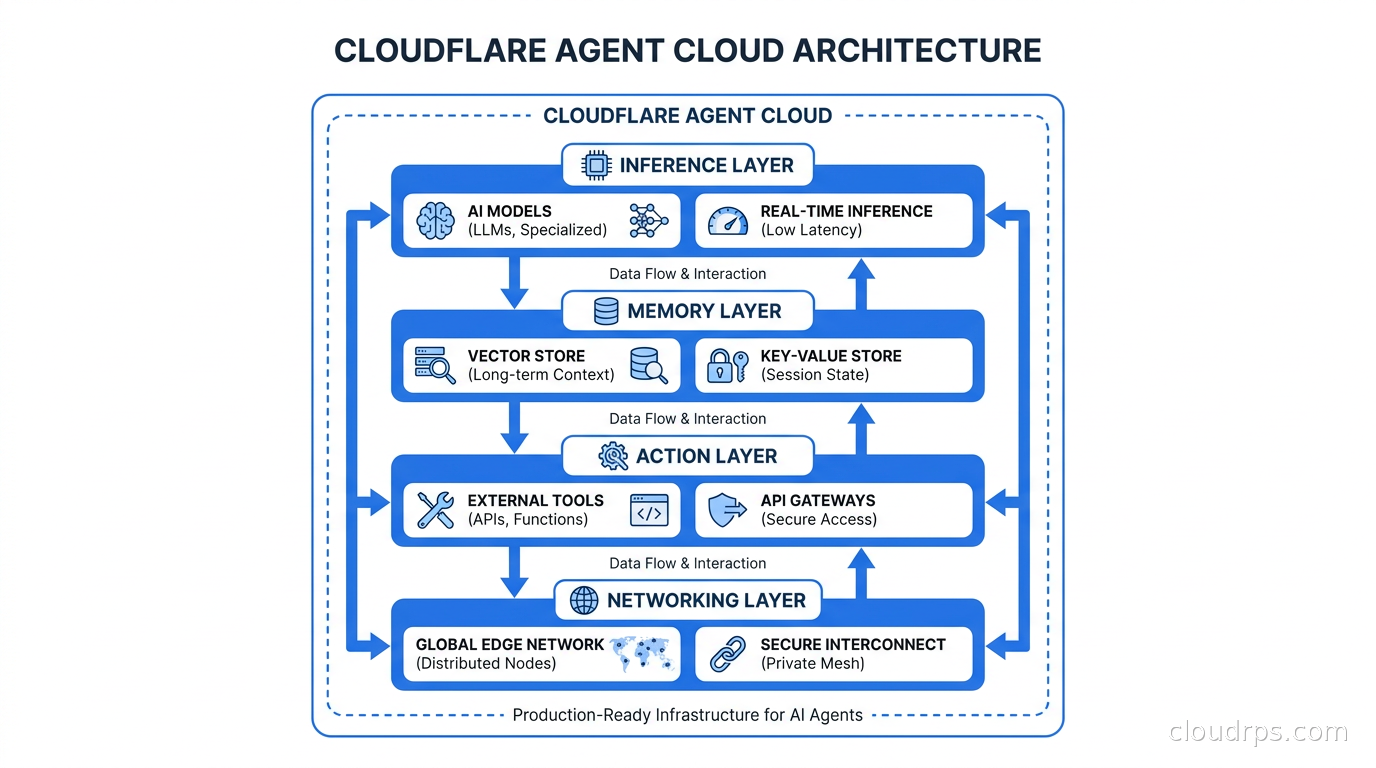
I have spent twenty years watching infrastructure platforms evolve, and I can count on one hand the moments where I stopped and thought: this genuinely changes the deployment surface for a whole class of applications. Cloudflare’s Agent Cloud is one of those moments. Not because it solves every problem, but because it moves the execution boundary in a way that matters specifically for latency-sensitive AI agents.
This is not a reworking of the Cloudflare Workers primitives that many cloud architects already know. The compute foundation covered in the Workers and Durable Objects article still applies, but Agent Cloud is a distinct product layer: a purpose-built stack for running autonomous software agents at Cloudflare’s global network edge, covering inference, memory, code execution, networking, and tool connectivity in an integrated platform. Cloudflare expanded this platform substantially during Agents Week in April 2026, shipping more than 20 features across five pillars: compute, memory, networking, security, and developer tooling.
The question every cloud architect should ask is not whether Cloudflare’s Agent Cloud is impressive, but whether it is the right substrate for your agent workload.
Why the Deployment Substrate Matters for Agents
When you deploy an AI agent on a traditional cloud stack, the architecture looks something like this: an orchestration layer on Kubernetes, an inference endpoint hosted in a central region, a vector database or Redis instance for memory, an MCP server or custom tool integration running as a separate service, and a browser automation pool for web interactions. Each of those components has its own latency budget, its own failure modes, and its own cost model.
For agents that execute long-horizon tasks on behalf of users, that latency stacks up. The first tool call waits for the network round-trip. The second waits again. For synchronous, user-facing agents, the experience degrades quickly. I have worked with teams building customer-facing voice and document agents where the cumulative latency of central-region inference plus distributed tool calls killed adoption before the product ever launched.
Cloudflare’s response is to collapse that stack. Run inference, memory lookups, tool execution, and agent coordination all within a few milliseconds of the nearest end user, using a compute network spanning over 300 cities globally (as Cloudflare claims in their infrastructure documentation, as of mid-2026). That is the core premise of Agent Cloud.
Whether the promise holds depends heavily on the specific models you need and the type of agent work you are doing. I will come back to the tradeoffs, but first, let me walk through what the platform actually contains.
The Agent Cloud Stack
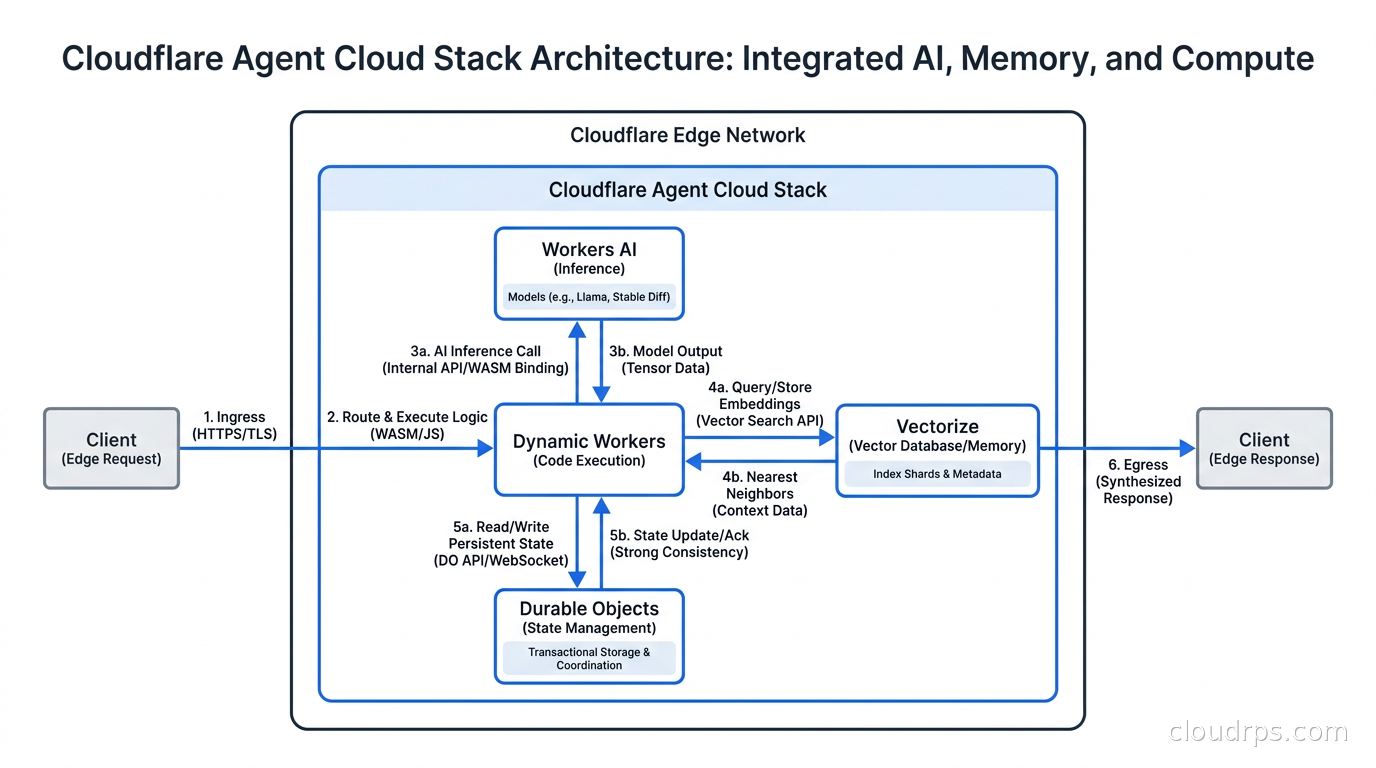
Workers AI: Edge Inference for Open Models
Workers AI is Cloudflare’s inference layer, running open-weight models on GPU hardware distributed across its edge network. As of late 2026, the catalog covers text generation, embeddings, image generation, and audio transcription. The model catalog is primarily open-weight models. You will not find GPT-4o or Claude 3.5 Sonnet here through Workers AI directly - for frontier proprietary models, you route through AI Gateway to external providers.
What Workers AI is good at is embedding generation, classification, smaller open-weight models for structured extraction, and running efficient models like quantized versions of Llama and Mistral variants close to the user. For agents that need to process user documents, generate embeddings, or run lightweight classification as part of a larger workflow, Workers AI avoids the round-trip to a central inference endpoint.
Cloudflare has claimed sub-100ms inference latency for smaller models at the edge, though real-world latency depends heavily on which data centers have the specific GPU capacity for your model. Larger models are typically served from a subset of edge locations, which can increase latency for those models specifically. I always recommend benchmarking against your actual model and target geography before treating edge inference latency as a given.
Pricing has changed multiple times in 2026 (Cloudflare cut prices in May and adjusted again in August), so I will not publish specific numbers here - check Cloudflare’s official pricing page for current rates. The pricing model uses “Neurons,” a Cloudflare-specific unit that maps to compute consumed during inference.
AI Gateway: Routing and Observability
Before Agent Cloud, AI Gateway as a concept was primarily about putting a proxy in front of your LLM calls to get logging, rate limiting, and cost control. Cloudflare’s AI Gateway goes further by being embedded in the same execution environment as your Workers.
AI Gateway routes across 14 or more model providers as of the Agents Week announcements, including Cloudflare’s own Workers AI catalog. It adds semantic caching, which is worth understanding properly: rather than caching by exact prompt match, semantic caching identifies requests that are semantically similar and returns a cached response when appropriate. For agents making repeated queries over similar documents or similar user questions, the cache hit rate can be substantial.
The observability side matters as much as the routing. AI Gateway captures token usage, latency, provider responses, and cost per request, all accessible from the same Cloudflare dashboard where you manage your Workers. For teams used to cobbling together LangSmith or Langfuse with a separate API gateway, having those signals in one place reduces operational overhead.
One limitation: AI Gateway on Cloudflare runs in the same V8 isolate environment as Workers, which is excellent for latency but means you are working within Cloudflare’s abstractions. If you need deep integration with frameworks like LangGraph or CrewAI, you will need to either port your orchestration logic to Workers, run a hybrid architecture, or accept that some framework features do not map cleanly to the edge runtime model.
Dynamic Workers: Executing AI-Generated Code
This is the feature from Agents Week 2026 that I find most architecturally interesting, and also the one I would apply the most scrutiny to in production.
Dynamic Workers is a runtime that lets AI agents write and execute Workers code at runtime, using the same V8 isolate model as regular Workers. The stated use case is coding agents: an agent generates code, Dynamic Workers executes it in an isolated context, and results flow back to the agent. Each Dynamic Worker can get its own isolated SQLite database via what Cloudflare calls Durable Object Facets, so agent-generated apps have per-instance state.
The security story matters here. V8 isolates provide memory isolation between tenants - this is the same model that powers Lambda’s execution environment. AI-generated code running in an isolate cannot access the memory of other isolates. The Outbound Workers for Sandboxes feature adds a zero-trust egress proxy: network calls from AI-generated code flow through a Cloudflare-controlled egress point that can inject credentials without exposing them to the agent-generated code itself.
This is a meaningfully different security boundary than spinning up a Docker container for each agent code execution run. It is not a full VM boundary, so if your threat model includes vulnerability in the V8 engine itself, you need to evaluate accordingly. For most enterprise agent use cases, the V8 isolate model provides adequate isolation with dramatically better cold start and density characteristics.
Dynamic Workers was in open beta as of the Agents Week announcements in April 2026. Confirm current GA status before building production dependencies on it.
Sandboxes: Persistent Linux Environments for Agents
Sandboxes are the other compute primitive in Agent Cloud, and they serve a different use case than Dynamic Workers. Where Dynamic Workers runs short-lived JavaScript in an isolate, Sandboxes provide persistent Linux environments - full containers where agents can install packages, run arbitrary processes, maintain filesystem state between steps, and work with tools that require a standard POSIX environment.
This is the substrate for agents that need to: clone a Git repository, run test suites, modify files across multiple steps, execute long-running processes, or interact with tools that were not built for the serverless execution model.
Sandboxes went GA during Agents Week 2026. The Outbound Workers for Sandboxes egress proxy applies here too, which is important: an agent operating in a Sandbox can make network calls, and you want those calls to flow through a controlled proxy rather than going directly to arbitrary internet endpoints. The security patterns from cloud browser infrastructure apply here - untrusted agent code running in a persistent environment needs careful credential injection, network egress controls, and execution time limits.
A note on operational cost: Sandboxes are priced differently than Workers (which are priced by request and CPU time). Persistent environments with long-running agents accumulate cost based on runtime. Right-size your Sandbox usage to avoid the equivalent of leaving EC2 instances running indefinitely.
Vectorize: Vector Database for Agent Memory
Agent memory is one of the foundational problems in production AI systems. The vector database landscape has matured, but most vector databases require a separate service endpoint and a network hop from wherever your agent is executing.
Vectorize is Cloudflare’s native vector database, available as a Workers binding. Because it runs as part of the same infrastructure layer as Workers, vector lookups from an agent’s context window management or RAG retrieval path avoid a separate network round-trip. For agents that perform many retrieval operations per session - which is most sophisticated agents doing proper context engineering - this matters.
Vectorize supports standard operations: upsert, query by vector similarity, and metadata filtering. The data model is straightforward and pairs well with Workers AI embeddings: generate embeddings for your documents using Workers AI’s embedding models, store them in Vectorize, and retrieve them in your agent’s reasoning loop without leaving the edge.
The capacity limits and performance characteristics at high scale are worth understanding before committing. For very large vector indexes (hundreds of millions of vectors) or extremely high query throughput, you may still need a purpose-built vector database like Pinecone or a self-managed solution. Vectorize is optimized for the latency-sensitive, medium-scale use case that most production agents operate in.
MCP Remote Servers: Tools Without the Infrastructure Tax
The Model Context Protocol has become the de facto standard for connecting AI agents to tools. Most teams run their own MCP servers - a Node.js process or Python service that agents connect to for database lookups, API calls, file operations, and other tool use.
Running your own MCP servers means managing another service, handling its deployment, scaling it, and securing it against tool poisoning and injection attacks. Cloudflare’s response is remote MCP servers: Cloudflare hosts MCP servers on its infrastructure, accessible from any agent via standard MCP transport protocols, without you operating the underlying service.
This is a meaningful operational simplification for teams building agents that need common tool integrations. Rather than standing up and maintaining your own MCP server for web search, document retrieval, or API integrations, you configure access to Cloudflare-hosted MCP servers. Your agents connect over standard MCP transports and get tool use results with the same low-latency profile as the rest of the Agent Cloud stack.
The security implications are worth thinking through carefully. Remote MCP servers handle tool calls that may include sensitive data - search queries, document contents, API request bodies. Understand what data leaves your execution environment when you use a remote MCP server and what Cloudflare’s data handling policies are for those calls. For regulated industries, you may still need to run your own MCP infrastructure for certain tools even if you use remote MCP for others.
Cloudflare Mesh: Private Networking for Agents
One of the more interesting architectural additions in Agents Week 2026 was Cloudflare Mesh, which provides private networking across users, nodes, agents, and Workers. For multi-agent architectures where agents need to communicate with each other or with internal services without traffic traversing the public internet, Mesh provides a Cloudflare-native overlay network.
This fills a gap that previously required either building your own service mesh or accepting that inter-agent communication went over the public internet. For agents that handle sensitive operations or need strict network isolation between agent instances, Mesh provides a cleaner architecture than the alternatives.
The integration with Cloudflare Access and Zero Trust policies means you can apply the same identity-based access controls to your agent-to-agent communication that you use for human users accessing internal services. That is a meaningful security property for enterprise deployments.
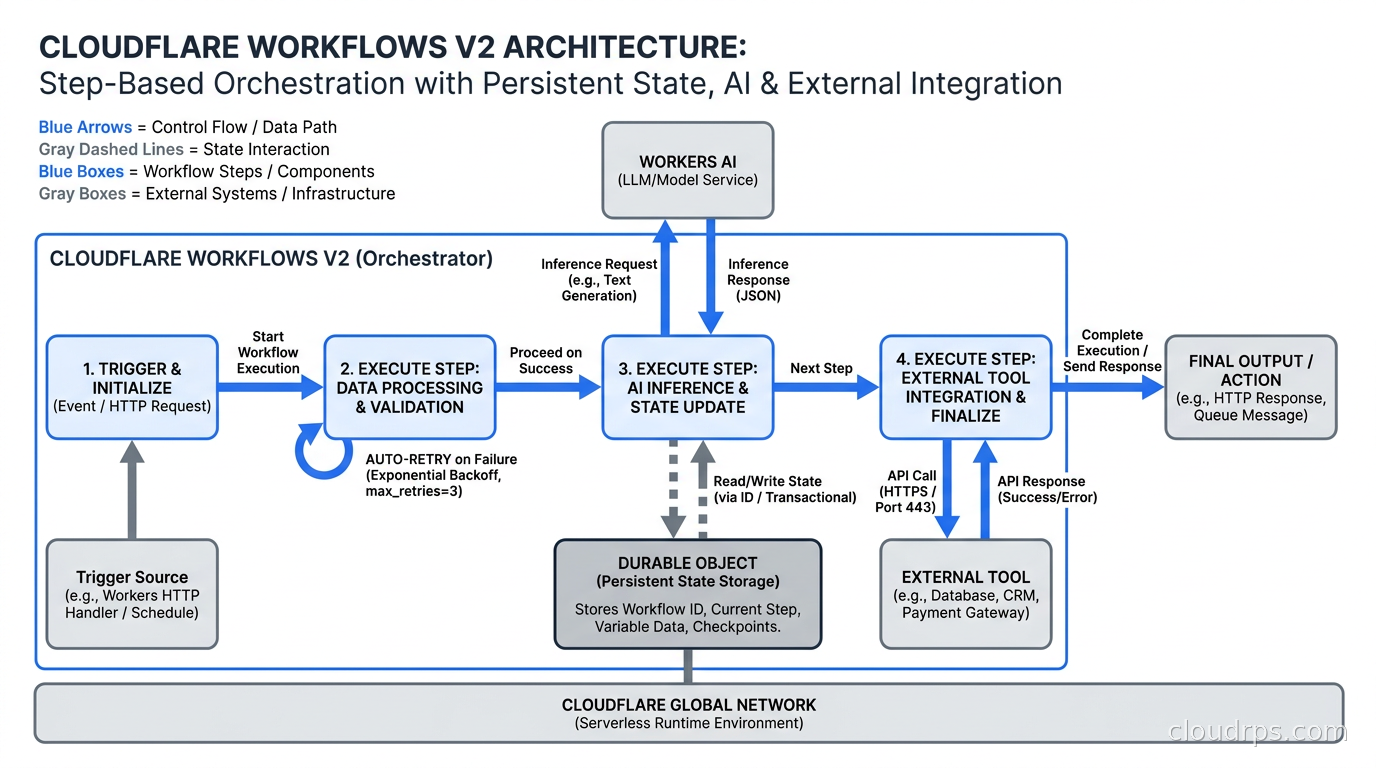
Workflows V2: Durable Orchestration at the Edge
Agents doing meaningful work are not single-shot inference calls. They involve sequences of steps, retries on failure, waiting for external events, and long-running operations that need to survive infrastructure failures. Cloudflare’s Workflows V2 provides durable execution semantics within the Workers environment.
This positions Cloudflare Workflows against solutions like Temporal, Restate, and DBOS for the specific use case of edge-deployed agents. The tradeoff: you get the latency and integration benefits of running within Cloudflare’s platform, but you work within Cloudflare’s orchestration primitives rather than the more feature-rich workflow engines that have emerged in the durable execution space.
For many agent workloads, Workflows V2 is sufficient and the operational simplicity of staying within the Cloudflare platform is valuable. For agents doing complex multi-step orchestration with sophisticated branching, compensation patterns, or tight framework integration requirements, evaluate whether Workflows V2 covers your needs before committing.
When Agent Cloud Makes Sense
After walking through the platform, here is my honest assessment of where it wins and where it does not.
Agent Cloud is the right choice when:
You need globally consistent low latency for user-facing agents. If you are building a customer service agent, a document assistant, or an interactive coding helper where the user is waiting for each response, the edge deployment model reduces the latency budget for inference and tool calls in a way that central-region cloud deployments cannot match without significant architectural complexity.
Your model requirements fit the open-weight catalog. Workers AI’s model catalog covers a solid range of open-weight models for embeddings, classification, and generation with smaller models. If your production agents run Llama, Mistral variants, or other open-weight models, the catalog may serve you well. If you are routing all production inference to GPT-4o or Claude Sonnet via AI Gateway anyway, you are largely paying for the routing and observability layer rather than the inference advantage.
You want operational simplicity over maximum flexibility. The integrated nature of the platform means less infrastructure to manage. Workers + Vectorize + AI Gateway + Sandboxes + MCP remote servers as a coherent unit has genuine operational advantages over managing five separate services with separate deployment pipelines, monitoring setups, and billing relationships.
Agent Cloud is not the right choice when:
You need frontier model inference at the edge. Models like Claude 3.5 Sonnet or GPT-4o are not in the Workers AI catalog. You route those through AI Gateway to external providers, which means you are back to central-region inference latency for your most capable models. For many agents, this is the correct architecture anyway - use Workers AI for fast, cheap embedding and classification work, and route the expensive reasoning calls to frontier models. But if your use case requires frontier model inference at every step and latency is critical, the edge advantage largely disappears.
You have invested heavily in Kubernetes-native orchestration. If your team has a mature Kubernetes platform with LangGraph workflows, ArgoCD-managed deployments, Prometheus/Grafana observability, and a clear path to GPU-accelerated inference with vLLM or SGLang, Agent Cloud adds a migration cost and platform divergence that may not be justified. Cloudflare’s platform is excellent at what it does, but it is not Kubernetes and porting complex orchestration patterns to Workers can require significant re-architecture.
Your agent needs capabilities that require persistent heavy compute. Training fine-tuned models, running large batch jobs, or executing workloads that need dedicated GPU time do not fit the Workers execution model. Those workloads belong on GPU cloud infrastructure, with Agent Cloud potentially handling the latency-sensitive user-facing layer while heavier compute runs elsewhere.
Production Architecture Patterns
The architectures I have seen work well on Agent Cloud in 2026 tend to follow a few patterns.
Edge-first with central fallback: Use Workers AI for embeddings, classification, and lightweight open-model inference at the edge. Route complex reasoning calls through AI Gateway to frontier model providers in central regions. Vectorize handles the memory layer for context retrieval. This architecture gets the latency benefit for the high-frequency operations (embeddings, retrieval, structured extraction) while still using frontier models where they matter.
Sandbox-based execution with edge orchestration: The agent coordination logic runs in Workers, managing state through Durable Objects. When the agent needs to execute code, run tests, or interact with file systems, it spins up a Sandbox with controlled egress. The Sandbox lifecycle is managed by the orchestrating Worker, with Workflows V2 handling the durable state between steps.
Multi-agent with Mesh networking: For agents that spawn subagents or coordinate with specialized agents, Cloudflare Mesh provides the private network fabric. The coordinating agent runs in Workers, dispatches work to Sandbox-based execution agents for heavy tasks, and uses Mesh to communicate results back without public internet exposure.
One critical operational consideration: logging and observability. AI Gateway captures model interaction data, but you still need application-level logging for agent reasoning steps, tool call inputs and outputs, and session state. Cloudflare Workers Logpush can stream logs to your existing observability stack (Grafana, Datadog, Splunk). Do not operate production agents without that pipeline in place.
The Competitive Landscape
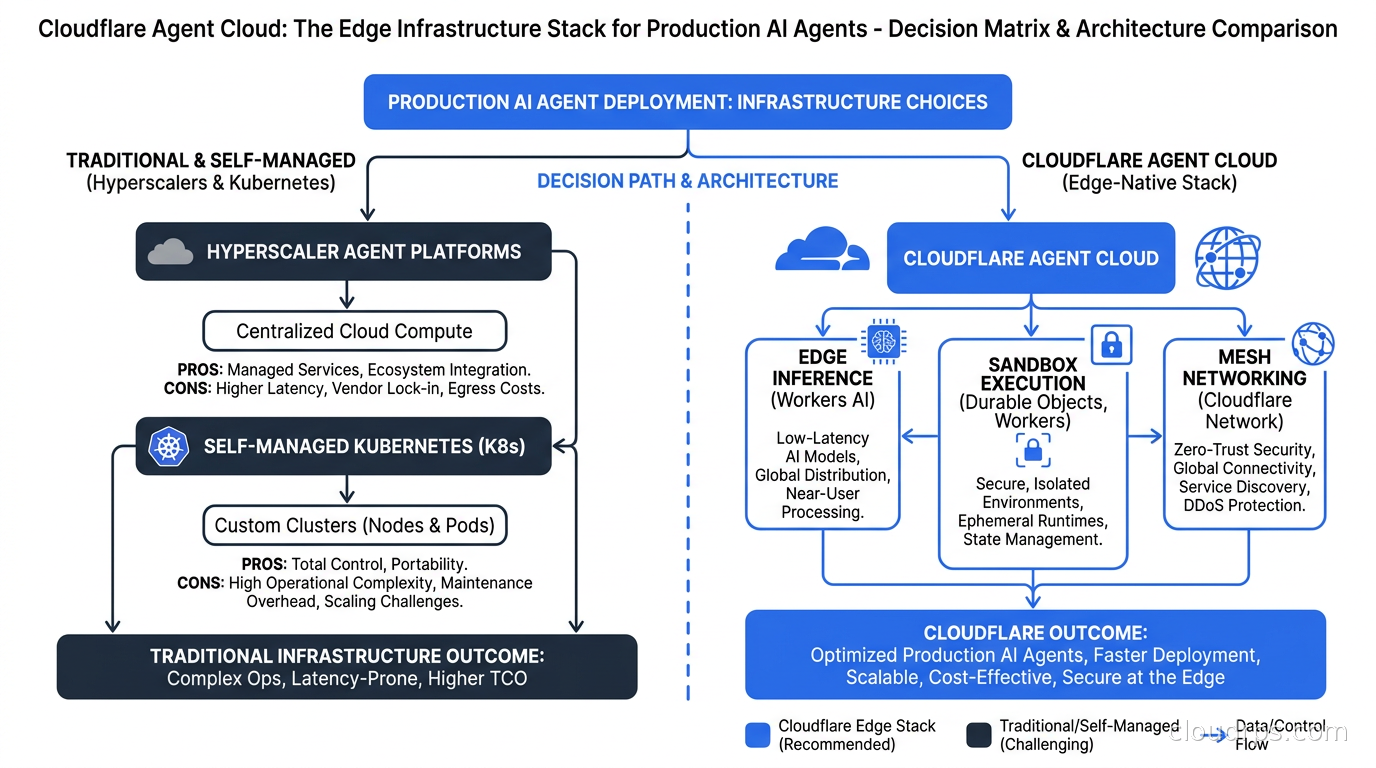
Cloudflare is not alone in trying to own the agent execution substrate. AWS has Bedrock AgentCore, Google has Vertex AI Agent Builder, and Azure has AI Foundry. All three hyperscalers offer managed agent platforms, but none of them have Cloudflare’s global edge footprint for user-facing latency.
The more interesting comparison is Cloudflare versus a self-managed agent stack on Kubernetes. The Kubernetes approach gives you maximum flexibility, proven operational patterns, and the ability to run any model, any framework, and any tool. The tradeoff is operational complexity: you own the platform, the GPU procurement, the inference serving layer, and the observability stack. For teams with a mature Kubernetes platform, the control is worth it. For teams earlier in their platform journey, or for workloads where edge latency genuinely matters, Agent Cloud’s integrated approach reduces time to production substantially.
Getting Serious About Agent Cloud
If you are evaluating Agent Cloud for a production use case, here is how I would structure the investigation.
Start with AI Gateway regardless of whether you use the rest of the stack. Putting AI Gateway in front of your existing LLM API calls costs little, gives you immediate visibility into model usage and cost, and positions you to route specific call types to Workers AI as you benchmark the model catalog against your quality requirements.
Benchmark Workers AI on your actual use cases before assuming edge inference wins. Test embedding quality, classify accuracy, and generation quality for your specific workload. Workers AI models are open-weight models with Cloudflare’s serving infrastructure - the quality is determined by the base model, and latency advantage depends on where your users are relative to Cloudflare’s GPU capacity locations.
Evaluate the Dynamic Workers and Sandboxes features carefully for your security requirements. The V8 isolate model is well understood for multi-tenant JavaScript execution. The Sandbox model is container-based with egress controls. Neither is a hardware VM boundary. If your regulatory environment requires VM-level isolation for agent code execution, that constraint may push you toward alternatives even if the rest of the platform fits.
Closing Thoughts
Cloudflare has built something genuinely useful here. The integration of inference, memory, code execution, MCP connectivity, and networking into a single operational unit with Cloudflare’s global distribution model is not trivially replicated on any other platform.
The honest limitations are real: the model catalog is open-weight models, Dynamic Workers is newer infrastructure with the operational maturity that implies, and teams deeply invested in Kubernetes-native orchestration face migration friction. But for the right workloads - user-facing agents where latency matters, teams earlier in their platform journey, or organizations that want an integrated stack they did not build themselves - Agent Cloud is a credible production platform in 2026 in a way that it was not 18 months ago.
The edge compute model Cloudflare has refined over years for static assets and security products is finally at a point where it can credibly host the full execution surface for production AI agents. That is worth taking seriously.
Sources: Cloudflare blog (blog.cloudflare.com), Cloudflare press release on Agent Cloud expansion (April 2026), Cloudflare Agents Week 2026 announcements, Cloudflare Workers AI and pricing documentation.
Get Cloud Architecture Insights
Practical deep dives on infrastructure, security, and scaling. No spam, no fluff.
By subscribing, you agree to receive emails. Unsubscribe anytime.