
In the spring of 2019, a payments processing pipeline I had built started quietly losing money. Not crashing, not alerting, just losing it. A distributed workflow that moved funds between systems would occasionally die mid-flight, leaving the debit applied but the credit in limbo. The bug was not in the business logic. It was in the gap between the “trigger the next step” message being sent and the receiving worker actually committing its work. A restart window of about thirty seconds, maybe once a week, was enough to corrupt state without leaving a trace.
That experience pushed me hard toward Temporal, which was already proving itself at Uber. I spent the next few years recommending it to anyone who had long-running, multi-step distributed processes. For most of that time, Temporal was essentially the only serious answer to durable execution in open-source infrastructure.
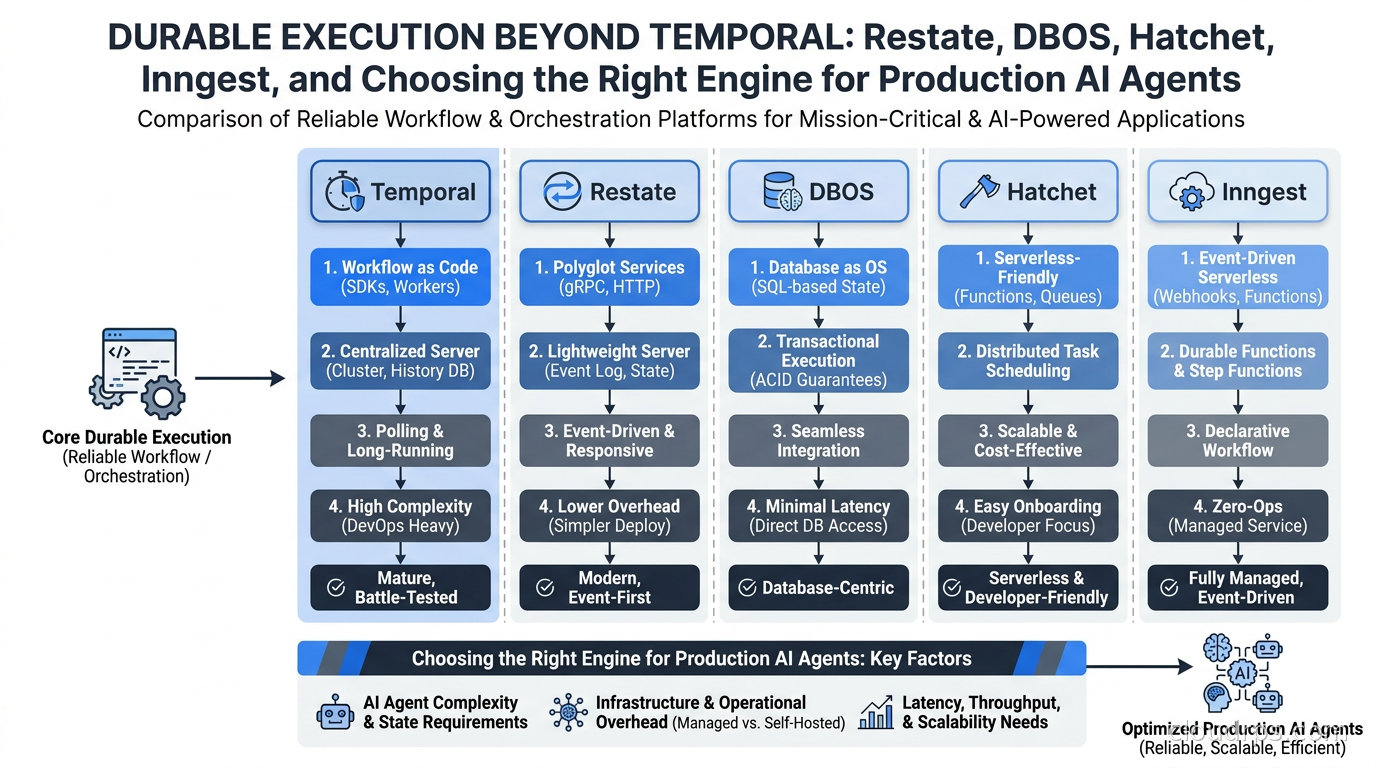
That is no longer true. In 2026, there are at least four credible challengers, each with a genuinely different architectural position. The right choice depends on your team, your stack, and what class of work you are making durable.
What Durable Execution Actually Means
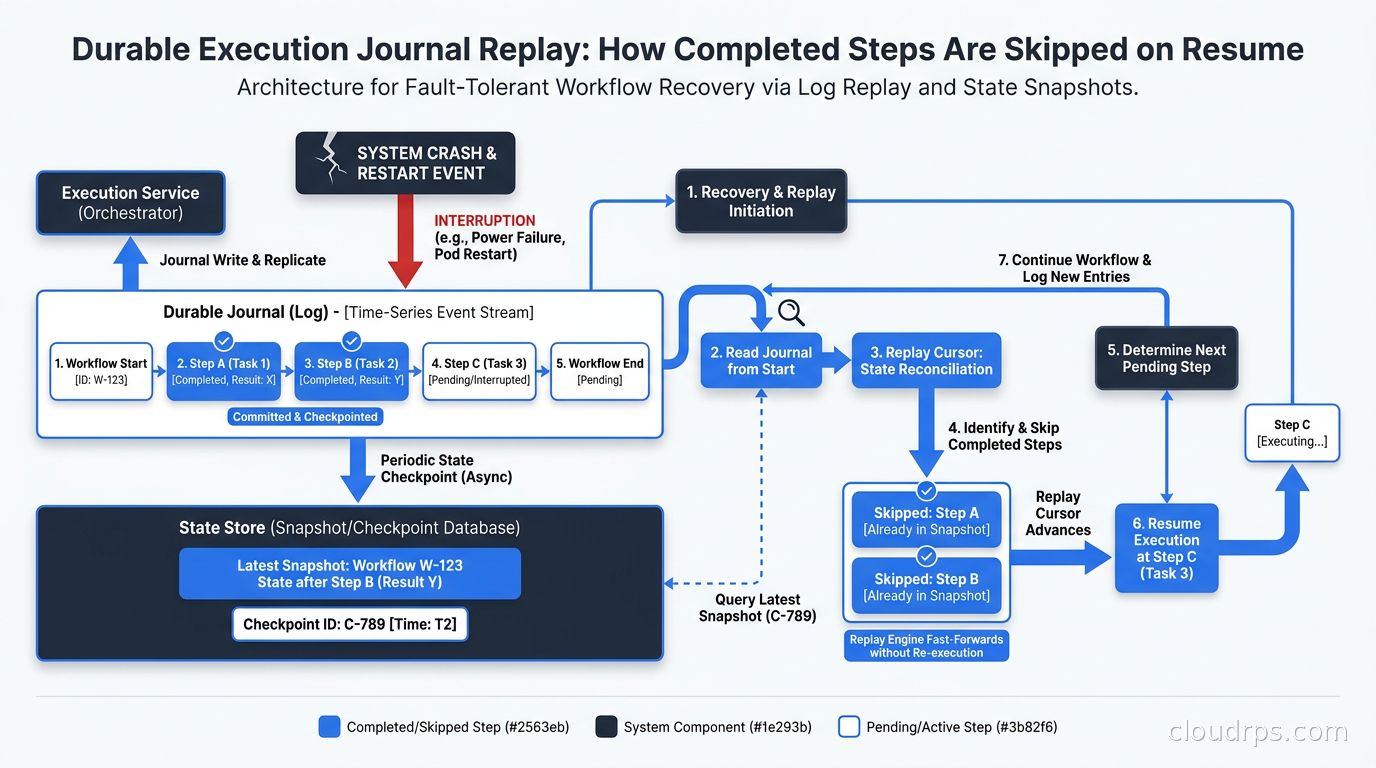
Before comparing engines, it is worth being precise about the problem. A durable execution engine guarantees that a function, once started, will run to completion, even across crashes, restarts, network failures, and deployments. It does this by recording each completed step into a durable journal. If the process dies, the engine replays the journal on restart, skipping already-completed steps and resuming from the last safe point.
This is different from simple retry logic. Retries re-run the whole function. Durable execution resumes from the last checkpoint without re-running side effects that already succeeded. Sending an email, charging a credit card, writing to a downstream service: these happen exactly once even if the surrounding process crashes ten times.
The core primitive is a journaled step function. Everything else, timers that survive for days, human approval gates, waiting on external events, compensating transactions when something fails downstream, is built on top of that foundation.
This is also why durable execution has become the critical infrastructure layer for long-running AI agents. An agent that calls tools, waits for external APIs, loops on LLM reasoning, and executes multi-step plans over minutes or hours is exactly the shape of workload that falls apart without it. I cover the agent connection in more detail below, but it is the main reason the market expanded so fast in 2025 and 2026.
Why Temporal No Longer Has the Field to Itself
Temporal is excellent and I still deploy it for teams that have the operational capacity for a cluster. But it carries real costs that drive teams toward alternatives.
The worker model requires long-running processes that poll the Temporal server for tasks. This is not a natural fit for serverless compute. If your application already runs on Cloud Run, Lambda, or Fargate, you now have to maintain a separate fleet of Temporal workers, which is additional cost and operational surface area.
The cluster itself is non-trivial. Temporal in production typically runs on a dedicated database (Postgres or MySQL for smaller installations, Cassandra at scale), a history service, a matching service, a frontend service, and a worker service. That is not the end of the world for a mature platform team, but it is a meaningful commitment for a startup trying to move fast. I wrote a full breakdown of how Temporal works and when it shines in the Temporal workflow engine guide.
The SDK experience has also become a competitive advantage for the newer entrants. Temporal’s Go and Java SDKs are mature. The Python and TypeScript SDKs have historically lagged. For teams building AI agents in Python (which is most teams in 2026), this matters.
The challengers each address a different one of these pain points.
Restate: A Log-Centric Runtime That Makes Systems Durable
Restate takes the most architecturally ambitious position. Rather than making individual workflows durable, Restate’s design goal is to make entire systems of interacting services durable. That is a meaningful distinction.
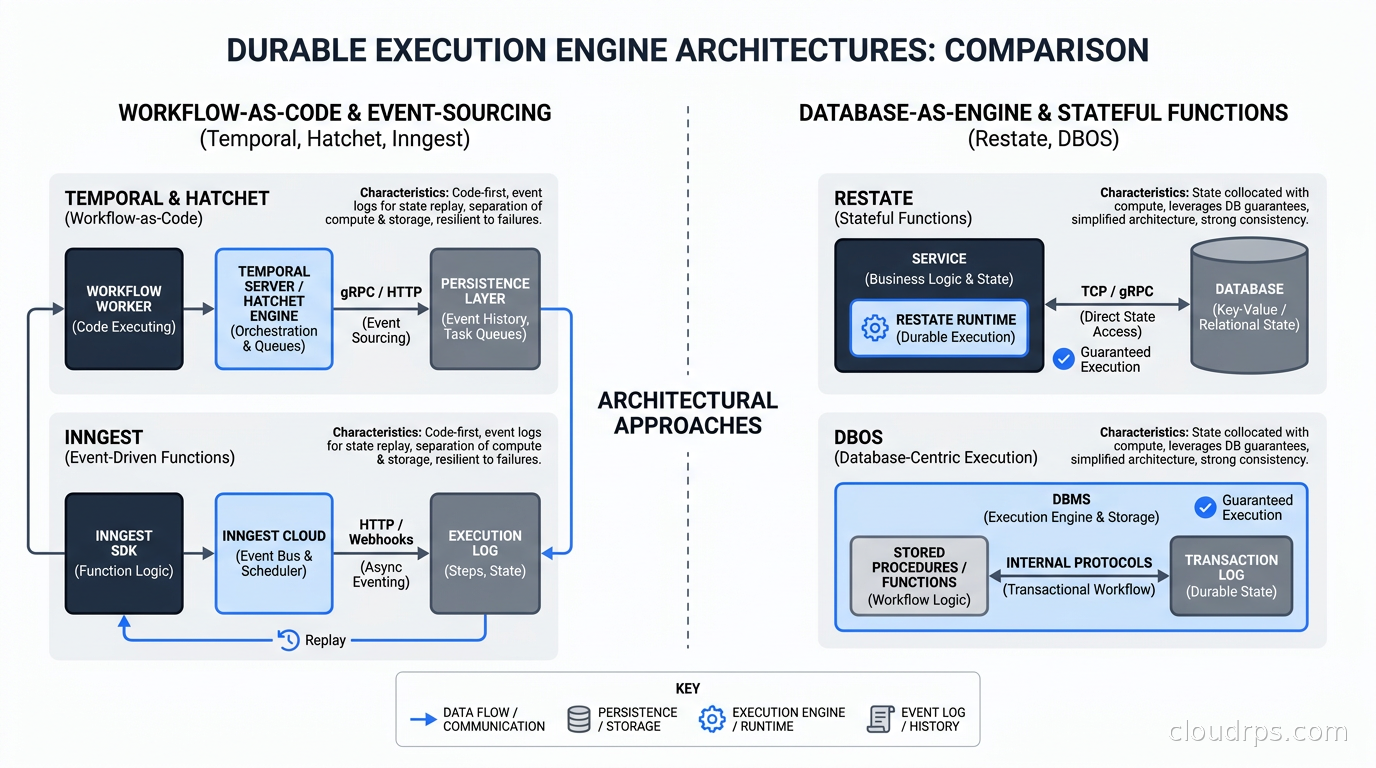
Restate is built as a single Rust binary with a distributed log at its core, using a partitioned, log-centric approach where events are synchronously replicated between nodes. The server can run as a single instance during development or as a high-availability cluster in production. State is snapshotted periodically to object storage for fast recovery. There is no separate database to provision.
The interaction model is fundamentally different from Temporal. Instead of workers polling for tasks, Restate pushes invocations to your services over HTTP or gRPC. This means it works naturally with serverless functions: your handler suspends when waiting on a downstream call, external promise, or human approval, and is only reinvoked when the awaited result arrives. You pay only when the handler is actually running. For serverless-native teams, this is a genuinely better fit than Temporal.
Restate’s programming model is also more flexible. Temporal forces everything into the workflow-plus-activity shape. Restate lets you compose durable functions, durable RPC, keyed virtual objects (stateful actors with strong consistency guarantees), messaging, and queuing into any topology. If your problem does not naturally fit a DAG of activities, Restate does not fight you.
The tradeoff is operational novelty. Restate is newer, the community is smaller than Temporal’s, and the operational runbooks are still being written by early adopters. I would not put this on a critical payment path without solid load testing first. But for teams building event-driven AI pipelines, real-time agent backends, or complex multi-service workflows where Temporal’s worker topology creates friction, Restate is the most interesting architectural bet in the space.
DBOS: Postgres Is the Orchestrator
DBOS takes the opposite philosophy. Instead of building new infrastructure, it uses your existing Postgres database as the durable execution substrate. DBOS is a library, not a service. You import it into your application, and it stores all workflow checkpoints, step outputs, queues, and schedule state in Postgres tables alongside your own business data.
The founding team came from MIT and Stanford, including Turing Award winner Michael Stonebraker, and the core insight is that Postgres already provides the transactionality and durability guarantees that durable execution engines are reimplementing in custom storage. Why build another distributed system when you already trust Postgres with your money?
This translates to a deployment story that is almost frictionless. No cluster, no separate workers, no new infrastructure. Every application instance that connects to the same Postgres database participates in the same execution fabric. When an execution fails, recovery is handled by polling the checkpoint tables; the optional Conductor control plane adds high-availability recovery coordination and an operational UI for production deployments.
The August 2026 release added a Go SDK alongside the existing TypeScript and Python libraries, broadening the language coverage significantly.
DBOS is strongest when your workflows are relatively bounded in duration (hours to days rather than weeks to months), your team is small and does not want new infrastructure to manage, and your workload does not require the horizontal scale that Temporal’s separate matching and history services provide. If you are a TypeScript or Python shop running on Postgres already, DBOS is the closest thing to zero-cost durable execution that currently exists.
The constraint is scale ceiling. Postgres under heavy checkpoint writes will saturate before a purpose-built log system. DBOS works around this with partitioned queues (a significant performance improvement in recent releases), but if you are routing thousands of concurrent long-running workflows, you will feel the limit eventually.
Hatchet: Developer-First, DAG-Focused
Hatchet occupies the space between “simple task queue” and “full Temporal cluster.” It is Postgres-backed like DBOS, but it deploys as a service rather than a library: an Engine process, an API server, and your workers. The managed cloud option removes the operational burden entirely.
Hatchet’s strength is explicit DAG-based workflow definition. If your work naturally decomposes into directed acyclic graphs, steps with clear dependencies, fan-out and fan-in patterns, Hatchet expresses this more naturally than Temporal and with less ceremony than Restate. The DAG DSL is clean in Python and TypeScript, and the UI for visualizing workflow runs is one of the best in the category.
Durable tasks in Hatchet use a step-level checkpoint model: each completed step writes to an event log, and retries replay from the last checkpoint. The exactly-once semantics on step execution are solid, and the API for defining idempotency is straightforward enough that junior engineers on my teams have picked it up without extended training.
Hatchet also handles fair-share scheduling across tenants natively, which matters if you are building a platform where multiple customers submit jobs. I have deployed it in two multi-tenant SaaS contexts where the workload was clearly DAG-shaped and the team did not want to operate a Temporal cluster. Both deployments are still running cleanly.
The operational simplicity is real, but the tradeoff is feature depth at the edges. Restate’s actor model, Temporal’s battle-tested decade of production deployments, and DBOS’s transactional integration with your business database are all things Hatchet does not have equivalent answers to. For a clean 80 percent of use cases, Hatchet is the fastest path from zero to production durable execution.
Inngest: Serverless-Native and No New Infrastructure
Inngest approaches the problem from the serverless end. Your existing HTTP server, whether that is a Next.js app, a FastAPI service, or a Lambda function, becomes the compute layer. Inngest pushes events to your application via HTTP, and your functions declare their steps using the step.run() primitive. Completed steps are memoized: on retry, Inngest skips finished work and resumes exactly where execution left off.
There is no separate worker fleet. There is no cluster to operate. You point Inngest at your existing HTTP endpoint, define your functions in code, and the durability layer lives in Inngest’s infrastructure. The self-hosted option is available for teams with data residency requirements, but the managed cloud experience is the primary path.
Inngest is particularly good at event-driven workflows triggered by webhooks, user actions, or scheduled jobs. The sleep primitive is elegant: you can pause a function for minutes or months, and Inngest will resume it when the time comes without holding a process or connection open.
The pricing model is consumption-based on function steps, which is genuinely attractive at low volumes but requires careful cost modeling at high step counts. Teams running high-throughput processing pipelines should benchmark before committing. The self-hosted option exists if costs become a concern.
Inngest’s main limitation is the HTTP-push model’s latency floor. If you need sub-ten-millisecond step transitions, Inngest’s round-trip through its infrastructure adds latency that Restate’s native model avoids. For background jobs, human-in-the-loop approvals, and agent pipelines where steps take seconds to minutes, this does not matter. For high-frequency real-time systems, it does.
The AI Agent Connection
This is where the whole category becomes strategically important in 2026, not just operationally useful.
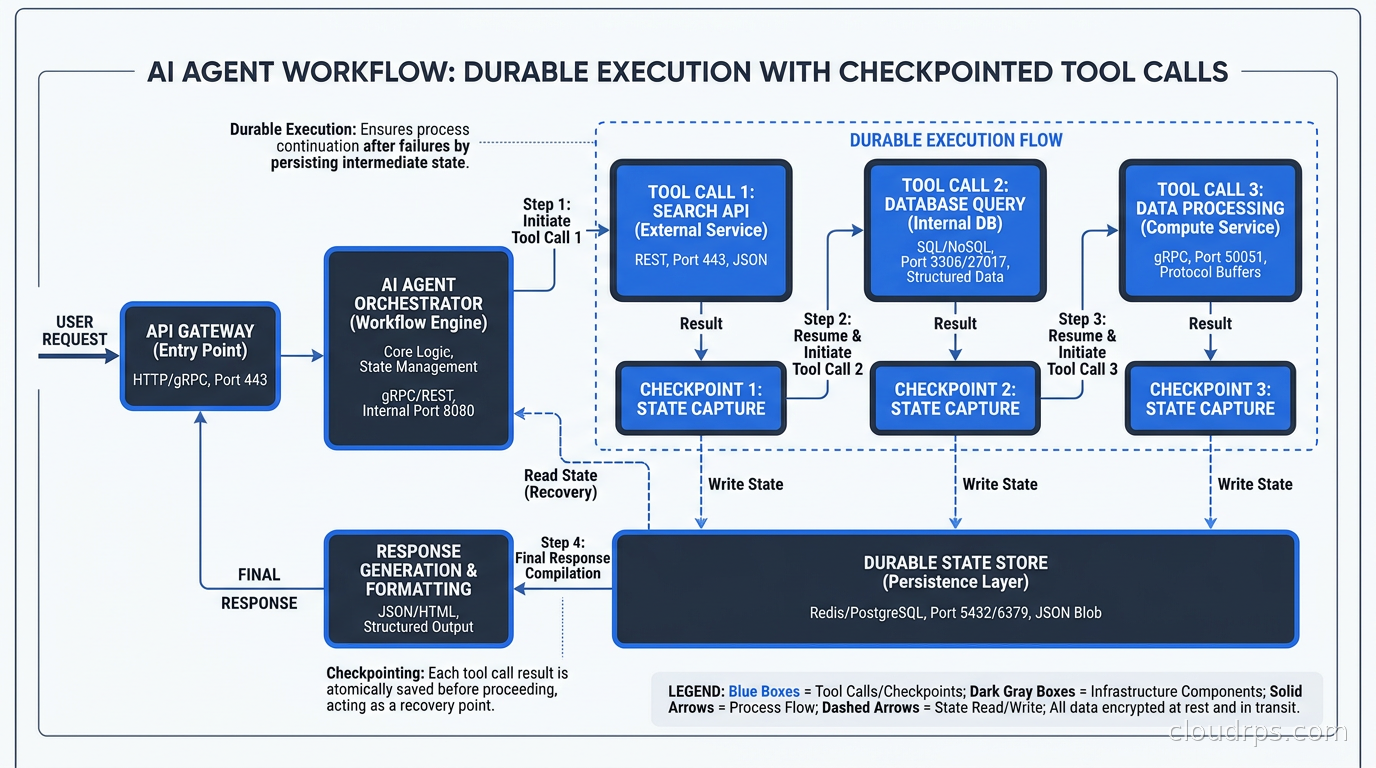
An AI agent that coordinates multi-step plans, executes tool calls, waits on external APIs, loops on reasoning, and handles approval gates is structurally identical to a long-running distributed workflow. The agent loop is a workflow. Each tool call is a durable step. The wait-for-human-approval pattern is a durable timer with a callback.
Without durable execution, a production AI agent has a reliability problem that is difficult to paper over. If the agent crashes after calling a tool that wrote data but before confirming success, the next retry re-runs the tool and causes a duplicate write. If the agent is waiting on an external event and the process restarts, the whole task starts over from scratch. If you are running agents that take thirty minutes to complete a research task, losing that work on a random instance restart is not acceptable.
Durable execution solves this at the infrastructure level without requiring the application code to implement its own checkpointing. The agent framework (whether LangGraph, CrewAI, or a custom loop) calls durable steps for tool invocations, and the execution engine guarantees exactly-once semantics across restarts. I have seen this pattern used in production AI research agents, document processing pipelines, and automated code review systems, all of which have step-level I/O that cannot be safely retried without coordination.
For the AI agent use case specifically, Restate’s push model and virtual object support are a strong fit for stateful agents. DBOS’s transactional integration is compelling for agents that need to write business data atomically alongside their checkpoint state. Hatchet’s DAG model works well for structured multi-stage agent pipelines. Inngest is excellent for event-triggered agent workflows where the trigger comes from a user action or webhook.
You can see how this connects to the broader AI agent orchestration framework and agentic AI production scaling problems: the orchestration layer tells the agent what to do, and the durable execution engine makes sure it happens reliably. These are complementary layers, not competing ones.
For teams building agents that run for multiple minutes or that coordinate across multiple tools and services, durable execution is not optional infrastructure. It is the layer that makes the difference between “demo mode” and production reliability. The context engineering for production AI agents problem is hard enough without also worrying about whether the execution survived a deployment.
How to Choose
I use a decision framework that starts with three questions.
What is your operational budget? If you have a dedicated platform team and existing experience running distributed systems, Temporal’s cluster model is manageable and the maturity dividend is real. If you have a team of five engineers who cannot afford to become Temporal operators, DBOS or Hatchet are the pragmatic choices.
What is your compute model? Serverless-heavy shops (Lambda, Cloud Run, Fargate) should look at Restate or Inngest first. The Temporal polling-worker model requires a separate compute fleet that works against serverless economics. If you are running long-lived containers or VMs and already have a worker pool, Temporal or Hatchet are comfortable fits.
What is the shape of your workflows? DAG-heavy work with clear step dependencies: Hatchet. Actor-model patterns and system-wide durability: Restate. Postgres-first teams that want minimal new infrastructure: DBOS. Event-triggered background processing with a serverless frontend: Inngest. Large-scale, multi-tenant, proven-at-Stripe workflows: Temporal.
There is also a language factor. For TypeScript-first teams, all five have solid SDKs. For Python teams building AI agents, DBOS and Inngest have strong Python support, Restate’s Python SDK is maturing, Hatchet’s Python SDK is functional, and Temporal’s Python SDK has historically required more care. The landscape is improving across the board, but check the SDK maturity for your language before committing.
One additional factor that should be on your evaluation checklist: workflow versioning. Long-running executions will outlive multiple deployments. When you change the code of a running workflow, can the new version safely replay or resume the old state? Temporal has a mature determinism constraint system to handle this. Restate and DBOS have their own approaches. Hatchet and Inngest handle versioning primarily through task name versioning rather than code-level replay. Test your versioning strategy before your first production incident, not during it.
Operational Considerations That Do Not Make It into the Demos
The comparison articles and vendor pages emphasize the happy path. Let me add the things that matter in production.
Observability. Temporal has a mature ecosystem: metrics for every queue depth and task latency, Grafana dashboards, and years of community-contributed runbooks. The newer engines are improving fast but require more DIY when something goes wrong. Plan for instrumentation work during adoption.
Execution cost at scale. Every durable execution engine introduces storage I/O proportional to the number of steps and the journal size. At moderate scale this is invisible. At high step counts with many concurrent workflows, the checkpoint write amplification becomes visible in database metrics. Profile your actual workloads, not just the demos.
Poisoned workflows. A workflow that hits an unhandled exception loops on retry. Without a dead-letter queue or max-retry ceiling, a single bad input can saturate your worker pool. All five engines support this configuration, but none have sensible defaults for the AI agent case where LLM tool responses are unpredictable. Always configure retry limits and dead-letter handling explicitly before launch.
The distributed systems relationship. Durable execution solves a different problem from the transactional outbox pattern. The outbox pattern ensures that database writes and event publishes happen atomically. Durable execution ensures that a multi-step process completes reliably. In many architectures you need both: the outbox pattern to trigger the workflow reliably, and the workflow engine to carry it through to completion.
The Honest Assessment
Temporal still wins for teams that have operated it before, run workflows at very high scale, or need the depth of a production ecosystem that has had years to mature. Stripe and Netflix are not running on Temporal by mistake.
For everyone else, the decision is more nuanced. DBOS has the lowest barrier to entry if you are already on Postgres. Restate is the most architecturally interesting if you are building event-driven AI infrastructure and want to avoid the worker-cluster model. Hatchet sits in a sweet spot for teams that want something more structured than a task queue but less complex than a full Temporal deployment. Inngest is the fastest path for serverless teams that want durability without any infrastructure.
The common thread is that all of these exist because the problem they solve, making distributed work survive failures, has become more important as workloads grow longer-running, more AI-driven, and less tolerant of restarts from scratch. Twenty years of building cloud infrastructure has taught me that reliability at the execution level is not something you retrofit. The teams that bake it in early spend their time debugging product problems instead of chasing ghost failures in distributed systems logs.
If you are building production AI agents today, the question is not whether you need durable execution. It is which engine fits your stack. The good news is that in 2026, you have real choices.
See also:
- A2A Protocol: Agent-to-Agent Communication Infrastructure for how agents coordinate across services
- Context Engineering for Production AI Agents for managing the token window alongside execution
- Temporal Workflow Engine Guide for a deep dive on Temporal specifically
Get Cloud Architecture Insights
Practical deep dives on infrastructure, security, and scaling. No spam, no fluff.
By subscribing, you agree to receive emails. Unsubscribe anytime.