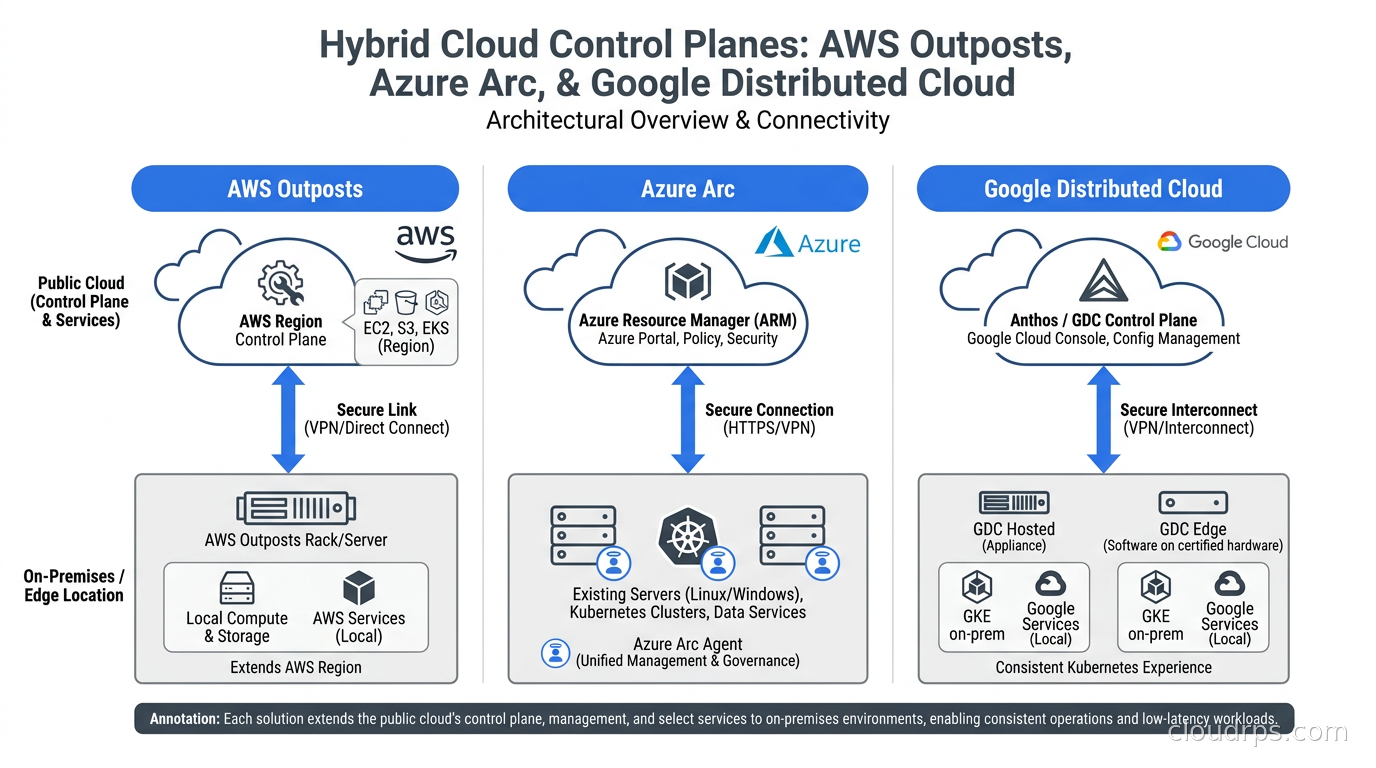
The pitch sounds clean: bring the public cloud experience into your own data center, run AWS or Azure or Google services on-premises, and satisfy compliance requirements without redesigning your applications. I have heard this pitch delivered by account executives at every major cloud vendor over the past decade, and I have watched enterprises sign contracts based on it and then spend the next eighteen months discovering how much complexity was hiding inside the word “experience.”
I am not here to call hybrid cloud control planes a scam. They are genuinely useful in specific situations, and after twenty years of building infrastructure I have seen them work well. I have also seen them create new categories of operational burden that the original business case never modeled. This article is my attempt to cut through the marketing and give you an honest, architectural view of what AWS Outposts, Azure Arc, and Google Distributed Cloud actually are, how they differ, when each makes sense, and what you will regret if you do not think hard before signing.
Why Hybrid Cloud Control Planes Exist
The fundamental problem is that some workloads cannot go to the public cloud, at least not fully. The reasons vary: data residency laws require certain data to remain in a specific jurisdiction, latency-sensitive processing cannot tolerate a round-trip to a distant region, air-gapped environments (defense, critical infrastructure, regulated manufacturing) have no internet path at all, or the organization has existing capital investment in data center space and hardware that makes full cloud migration economically poor.
The traditional answer was to run separate stacks. Cloud workloads on AWS, on-premises workloads on VMware or bare metal, and a custom integration layer connecting them. This creates the operational split-brain that hybrid cloud control planes are designed to close: you manage cloud-native services through one console and tooling, and on-premises through another, and your teams have to context-switch constantly.
The promise of products like Outposts, Arc, and Google Distributed Cloud is to collapse that split. The reality is they collapse it in different ways, to different degrees, and at very different costs. Understanding those differences is what separates a good architecture decision from an expensive mistake.
AWS Outposts: Cloud Hardware in Your Rack
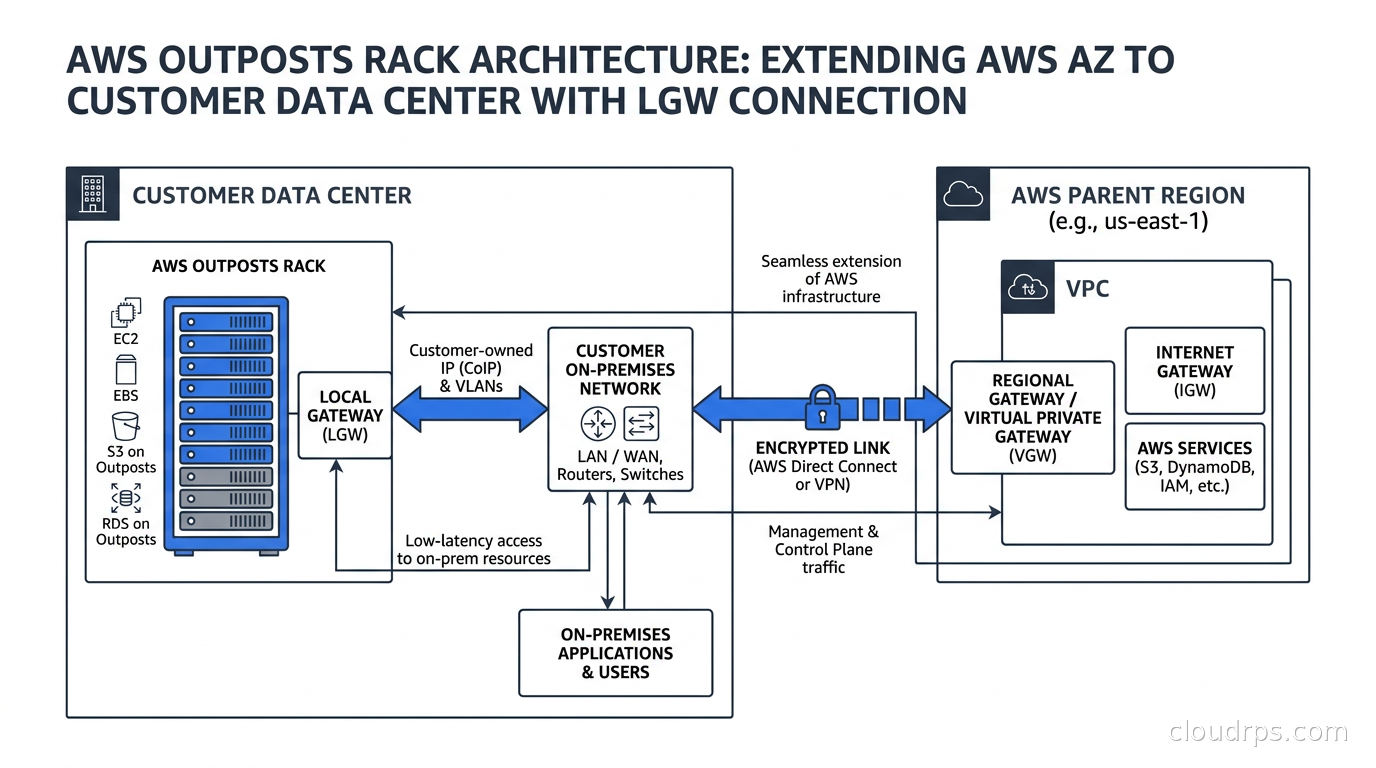
AWS Outposts is the most hardware-intensive of the three options. When you order Outposts, AWS ships physical equipment to your facility. The rack form factor is a standard 42U enterprise rack that includes servers, switches, a network patch panel, a power shelf, and blank panels. AWS owns and manages this hardware. You provide the power, the floor space, the network uplinks, and the access for AWS field engineers when hardware needs servicing.
There is also a smaller form factor: Outposts servers, which are 1U or 2U appliances designed for smaller deployments where a full rack is impractical. The server form factor supports EC2 and ECS but not EKS, RDS, or ElastiCache. If your use case depends on managed Kubernetes or managed databases running locally, you need the rack.
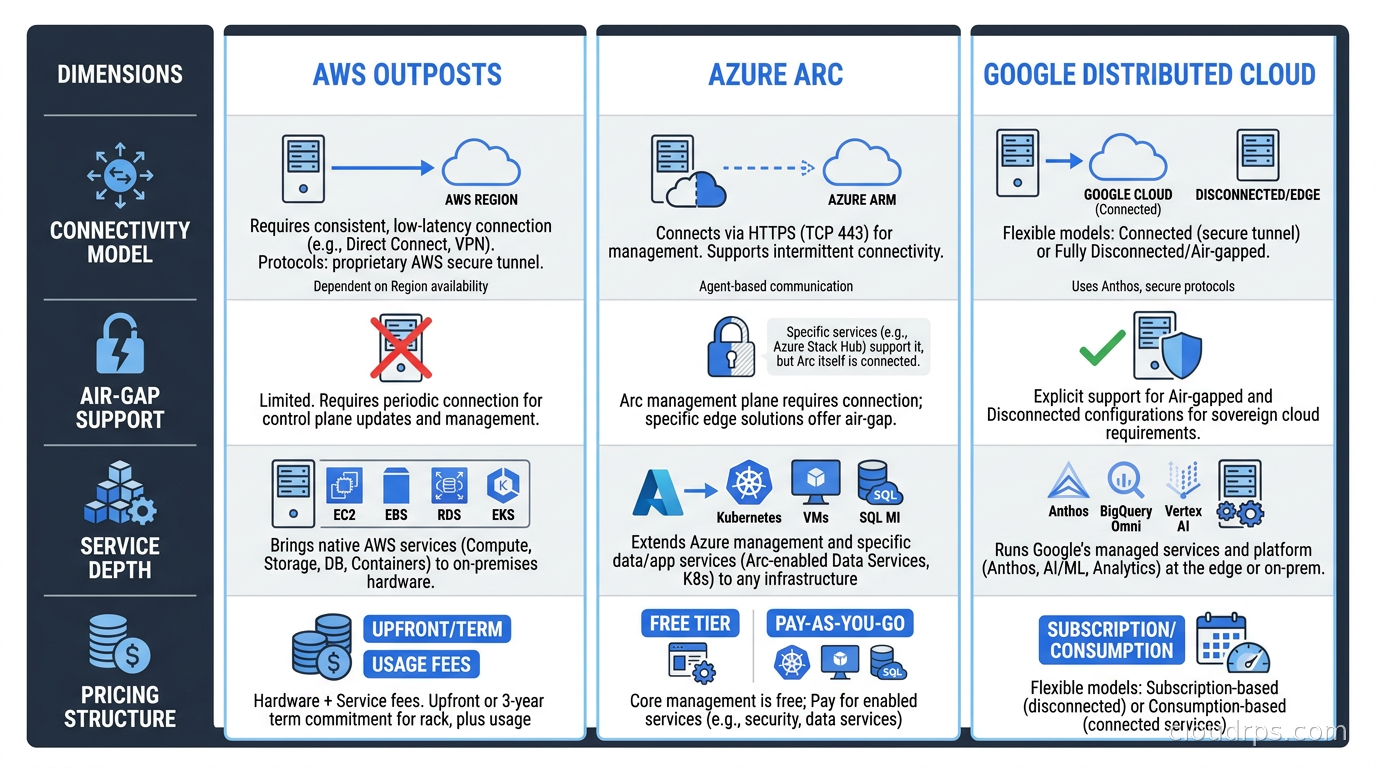
The architectural model is straightforward. An Outposts rack is an extension of a specific AWS Availability Zone. It runs the same hypervisor stack as AWS regions, the same EC2 instance types (a subset of the current generation), and the same APIs. When you launch an EC2 instance on Outposts, it looks like any other EC2 instance from the control plane perspective. The local AWS infrastructure handles data plane operations so that your application does not need a live connection to the parent region to stay running. The control plane still lives in the region, however. For administrative operations, IAM authorization, and service API calls, you need connectivity.
This architecture has a critical implication: Outposts is not a fully disconnected option. The local gateway (LGW) keeps an active connection to the parent region. If that connection is severed, existing workloads continue running but you cannot launch new instances, modify security groups, or perform most management operations. For true air-gapped requirements, Outposts racks are not the right tool.
The services that run on-premises through Outposts are a meaningful but limited subset of what AWS offers in regions. EC2, ECS, EKS, RDS (MySQL and PostgreSQL), ElastiCache (Redis), EMR, and several other services have Outposts support. Many services do not, which means your architecture still depends on the parent region for things like S3 (Outposts has S3 on Outposts as a separate product but it is different from standard S3), Lambda, and most managed services. This distinction matters enormously when you are evaluating whether Outposts actually solves your problem. I have seen teams discover six months in that the specific service they needed locally was not on the supported list.
The pricing model is a multi-year commitment, quoted by configuration and location. This is capital-and-contract territory, not the pay-as-you-go flexibility cloud is famous for. You pay for the hardware capacity regardless of utilization, which shifts the economics toward high-utilization workloads and makes Outposts unattractive for spiky or unpredictable loads.
For teams already running substantial EC2 and EKS workloads in AWS who face a data residency requirement that cannot be solved by an AWS region in the right geography, Outposts makes genuine sense. The operational model is familiar and the API surface is the same as the cloud. The cost and hardware commitment are real, but so is the value if the alternative is maintaining a separate on-premises stack. The cloud sovereignty and data residency challenges Outposts is designed to address are real constraints with significant compliance implications.
Azure Arc: The Multicloud Management Plane
Azure Arc takes a fundamentally different approach. Rather than shipping hardware to your facility, Arc is a software agent that you install on existing infrastructure, whether that infrastructure is on-premises servers, VMs, Kubernetes clusters, or even resources running in AWS or Google Cloud. Once onboarded, those resources appear in the Azure portal and are managed through Azure tooling.
This matters because Arc is primarily a management and governance layer, not a service delivery layer. You are not running Azure compute or Azure databases on-premises in the same way Outposts runs AWS services. What you are doing is extending Azure’s control plane: Azure Policy, Azure Monitor, Microsoft Defender for Cloud, Update Manager, Desired State Configuration, and Azure RBAC apply to your on-premises and multicloud resources through the same tooling you use for Azure-native resources.
There are two main scenarios where Arc delivers clear value. The first is governance at scale across heterogeneous environments. If you have a mix of on-premises VMs, Kubernetes clusters in multiple clouds, and Azure resources, Arc gives you a single pane of glass for policy enforcement and security monitoring. Azure Policy propagates to your on-premises Kubernetes clusters. Defender for Cloud surfaces security recommendations for your on-premises SQL Server instances. For large enterprises where compliance and security reporting require consistent coverage regardless of where infrastructure runs, this is genuinely powerful.
The second scenario is Arc-enabled data services, which is where Arc gets closer to what Outposts does. Arc-enabled SQL Managed Instance and Arc-enabled PostgreSQL let you run cloud-managed database experiences on your existing on-premises hardware. Your hardware, your data never leaving, but Azure’s managed database capabilities including automated patching, high availability configuration, and monitoring available through Azure tooling.
A recent addition worth watching is Arc’s Multicloud Connector, which allows onboarding of Amazon EKS and Google GKE clusters into Arc management. This positions Arc as a genuine multicloud control plane rather than just an Azure extension. As of late 2026, Microsoft described this feature as being in public preview, so verify the current GA status before building a production architecture on it.
The pricing model differs significantly from Outposts. Arc’s core control plane (inventory, management, VM self-service) carries no additional charge per Microsoft’s current documentation. The costs come from the services you layer on top: Defender for Cloud, Azure Monitor, Update Manager, SQL Server licensing, and similar add-ons are each billed per their own pricing models. The variable cost structure makes Arc more economically flexible than Outposts, but it also means the total cost grows with the services you enable, and modeling total cost of ownership requires careful enumeration of every Arc-enabled capability you plan to use.
If your team is already Azure-centric, the existing cloud landing zone design likely maps reasonably well to Arc governance. The Azure Policy and RBAC model extends naturally to Arc-managed resources.
Google Distributed Cloud: Air-Gap and Edge
Google Distributed Cloud (GDC) addresses a different set of constraints than either Outposts or Arc. It comes in two distinct deployment models with meaningfully different characteristics.
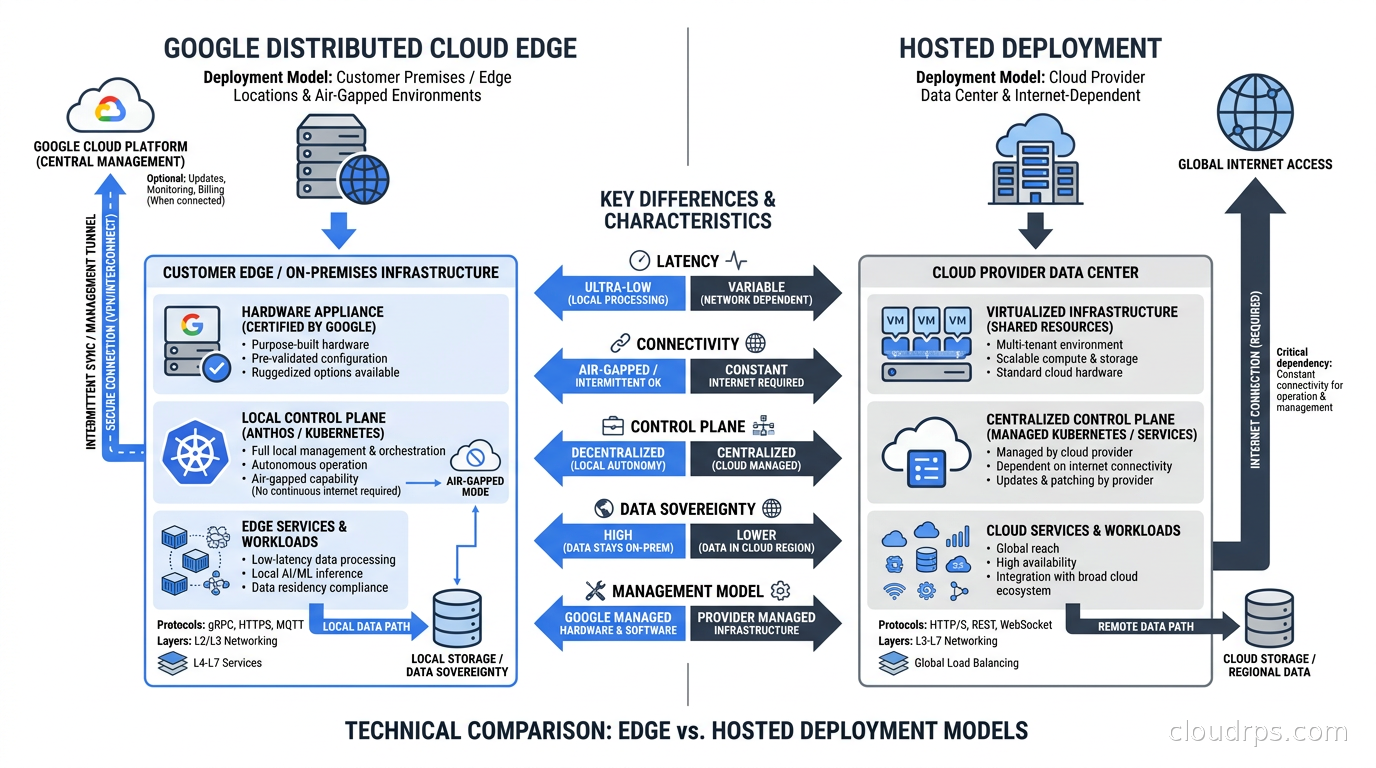
GDC Edge is designed for latency-sensitive edge deployments: retail locations, manufacturing floors, telco edge, and similar use cases where you need compute close to the point of data generation. It is a fully managed hardware and software package, similar in concept to Outposts, running Google Cloud services at the edge with connectivity back to Google Cloud.
GDC Hosted, also called GDC Air-Gapped or GDC for Sovereign Clouds, is for environments where there is no live internet connection to Google Cloud at any time. This is the product designed for defense, national security, regulated government, and highly sensitive enterprise deployments. The local control plane is self-contained. You can operate GDC Hosted indefinitely without connectivity, then sync when connectivity is available, or never sync at all. This makes GDC Hosted genuinely differentiated from Outposts for air-gapped requirements.
The core technology of both GDC deployments is Kubernetes-native. Google’s cloud services run on GKE at the foundation, and the management surface reflects that: you are managing Kubernetes clusters and workloads with Google Cloud tooling. This is an advantage for teams that already operate Kubernetes in production and want consistency between their cloud and on-premises Kubernetes environments.
GDC Edge has seen adoption in government and defense scenarios beyond what many cloud architects realize. The U.S. Air Force used GDC Edge for a mobility exercise in 2025 as a documented deployment. The air-gapped capability makes GDC Hosted the most credible option of the three for the most restricted environments.
The limitation is that GDC is a less mature commercial product than Outposts or Arc. The service catalog available on GDC is narrower. Pricing is not publicly listed; it is a custom enterprise engagement. And the sales cycle reflects that: GDC Hosted deployments involve significant professional services and are not a quick purchase.
Choosing Between Them: An Honest Framework
After seeing organizations evaluate all three, I have come to think the decision is less about which product is better and more about which constraint you are actually trying to solve.
If your constraint is running specific AWS services locally because you are deep in the AWS ecosystem and face data residency requirements where no suitable AWS region exists, Outposts is the natural fit. The API compatibility and operational familiarity are worth the hardware commitment when the alternative is managing a parallel non-AWS stack.
If your constraint is governance and policy consistency across a heterogeneous environment, particularly one that includes on-premises infrastructure you cannot or will not move to cloud, Arc is the stronger choice. The ability to apply Azure Policy and Defender for Cloud across AWS, GCP, and on-premises resources through one plane is something the other products do not offer at the same level.
If your constraint is true air-gap, or if you are working in defense, national security, or highly regulated government contexts, GDC Hosted warrants serious evaluation alongside the specialized options like AWS GovCloud and Azure Government. For edge deployments where latency to a cloud region is the problem, Outposts servers, GDC Edge, and AWS Wavelength (for telco edge) are all worth comparing.
There is a fourth option that often does not get enough consideration: nothing. Sometimes the right answer is to run a well-architected VMware or OpenShift cluster on-premises for the constrained workloads, connect it to the public cloud over Direct Connect or ExpressRoute (see the guide to dedicated interconnects for how those work), and maintain a clear boundary between cloud-native and on-premises workloads. This is less exciting than a unified hybrid platform, but it is often operationally simpler and more cost-effective for organizations with stable on-premises workloads.
The Operational Reality
There are shared operational considerations across all three products that deserve direct treatment.
Networking is the first thing that gets complicated. AWS Outposts requires the local gateway to connect back to the parent region, which means your on-premises network must support reliable, low-latency connectivity to that region. Azure Arc requires outbound HTTPS from the Arc agent to Azure endpoints. GDC Edge requires connectivity back to Google Cloud. Getting network paths right, with appropriate redundancy and monitoring, requires the same care as any VPC connectivity architecture in the cloud. For teams with mature network operations, this is familiar. For teams accustomed to the simplicity of pure cloud networking, it introduces operational complexity they did not anticipate.
Hardware lifecycle is the second surprise. With Outposts and GDC hardware deployments, you are committing to specific hardware generations on multi-year terms. Cloud software evolves faster than hardware refresh cycles. Features that arrive in a public cloud region may not arrive on your Outposts rack for some time. I have seen teams discover that the new EC2 instance family they wanted was available in us-east-1 but not on their Outposts configuration, and changing configurations mid-term involves contract negotiations.
Egress costs follow you on-premises. The assumption that bringing cloud infrastructure on-premises eliminates egress costs is wrong. Data moving between your Outposts rack and the parent AWS region is still subject to data transfer charges. Designing your data flow to minimize traffic that crosses the LGW is as important as designing to minimize cloud egress costs in a pure cloud architecture. This is not specific to Outposts; GDC Edge has the same consideration.
Identity and secrets management require careful extension. Each of these products extends the cloud vendor’s IAM to cover on-premises resources, but that extension has limits. AWS IAM policies that work in the region mostly work on Outposts, but some service-linked roles and permission boundaries behave differently. Azure Arc’s RBAC extension works for Arc-managed resources but requires careful policy design for the edge cases. Organizations that have invested in workload identity federation (see this guide on how that works) will find that extending those patterns to hybrid deployments takes non-trivial configuration.
FinOps Implications
Hybrid cloud control planes are not FinOps-friendly by nature. Each product obscures costs in a different way.
Outposts hides the cost in the hardware commitment. You pay for rack capacity regardless of how efficiently you use it, which inverts the core cloud FinOps principle of paying for what you use. Teams that apply cloud resource optimization practices (rightsizing, spot instances for interruptible workloads) find that most of these techniques have limited or no applicability to Outposts. The cost is largely fixed by the configuration you ordered.
Arc hides the cost in the services you enable. The core control plane may cost nothing, but each additional Arc capability (Defender for Cloud, Monitor, Arc-enabled data services) adds per-resource billing. Because Arc makes it easy to onboard large numbers of on-premises resources into Azure management, the total bill can grow faster than expected as the team enables more capabilities across a large fleet.
GDC hides the cost in the engagement model. There is no public price list to estimate from. The total cost of a GDC deployment includes hardware, software licensing, professional services for deployment, and ongoing support. The organization is essentially entering a custom enterprise contract, which makes budget modeling difficult and shifts negotiating power significantly toward Google.
When Hybrid Control Planes Are Not the Answer
I want to be direct about the cases where I have watched organizations over-engineer toward hybrid control planes when simpler approaches would have served them better.
If the driver is “our auditors want data to stay on-premises” but you are willing to use a cloud provider’s data center in a local region, purpose-built compliance offerings (AWS GovCloud, AWS European Sovereign Cloud, Azure Sovereign Landing Zones, Google Cloud Sovereign Controls) often satisfy the requirement without the complexity of on-premises hardware. These are not perfect matches for every regulatory scenario, but they address a broader set of data residency needs than is commonly assumed.
If the driver is latency, model the actual numbers before committing. AWS regions in Europe and Asia have multiplied over the past five years, and the assumption that your users require sub-5ms round-trips to application backends is often untrue. Many “latency-sensitive” use cases turn out to require sub-50ms, which is achievable from a nearby cloud region.
If the driver is cost, run the full TCO comparison including hardware, facilities overhead, operational staffing, and software licensing before concluding that on-premises is cheaper. Cloud repatriation decisions sometimes pencil out, but the full analysis is rarely as favorable as the initial estimate. The cloud repatriation guide walks through how to run that analysis honestly.
What I Would Actually Build Today
If someone handed me a greenfield enterprise hybrid architecture to design in late 2026, here is my instinct.
For governance and security posture visibility, I would use Azure Arc or a cloud-agnostic alternative like Wiz or Prisma Cloud, depending on what the organization already uses. The ability to apply consistent policy and security monitoring across heterogeneous environments has real value, and Arc’s pricing model makes it reasonable to explore.
For workloads with genuine data residency or latency requirements, I would evaluate cloud regions in the target geography before defaulting to on-premises hardware. If no suitable region exists, I would choose Outposts for AWS-native workloads or GDC Hosted for air-gapped requirements, based on which cloud ecosystem the application already lives in.
For the organization’s core cloud strategy, I would avoid designing around hybrid control planes as the primary architecture. They work best as extensions for specific constrained workloads, not as the foundation for a cloud program. The managed Kubernetes platform comparison still applies: pick the platform your team can operate well, and treat hybrid extensions as the exception rather than the rule.
The underlying tension in hybrid cloud control planes is that they exist because public cloud has not solved every problem. Data sovereignty, air-gap requirements, and legacy infrastructure constraints are real, and vendors are right to offer solutions for them. But those solutions come with real operational complexity, real financial commitments, and real limits on what services run where. Understanding the full architecture before you commit is not optional. I have been part of enough post-mortem conversations after poorly scoped hybrid deployments to know that the discovery phase is where the value is.
Take the time to get specific about what constraint you are actually solving. Map the services you need to what each product actually delivers on-premises. Model the full multi-year cost including staffing. And make sure the person who signs the contract and the team that operates the result are having the same conversation before anything is ordered.
Sources: AWS Outposts documentation, Azure Arc overview, Azure Arc pricing, Google Distributed Cloud coverage
Get Cloud Architecture Insights
Practical deep dives on infrastructure, security, and scaling. No spam, no fluff.
By subscribing, you agree to receive emails. Unsubscribe anytime.