
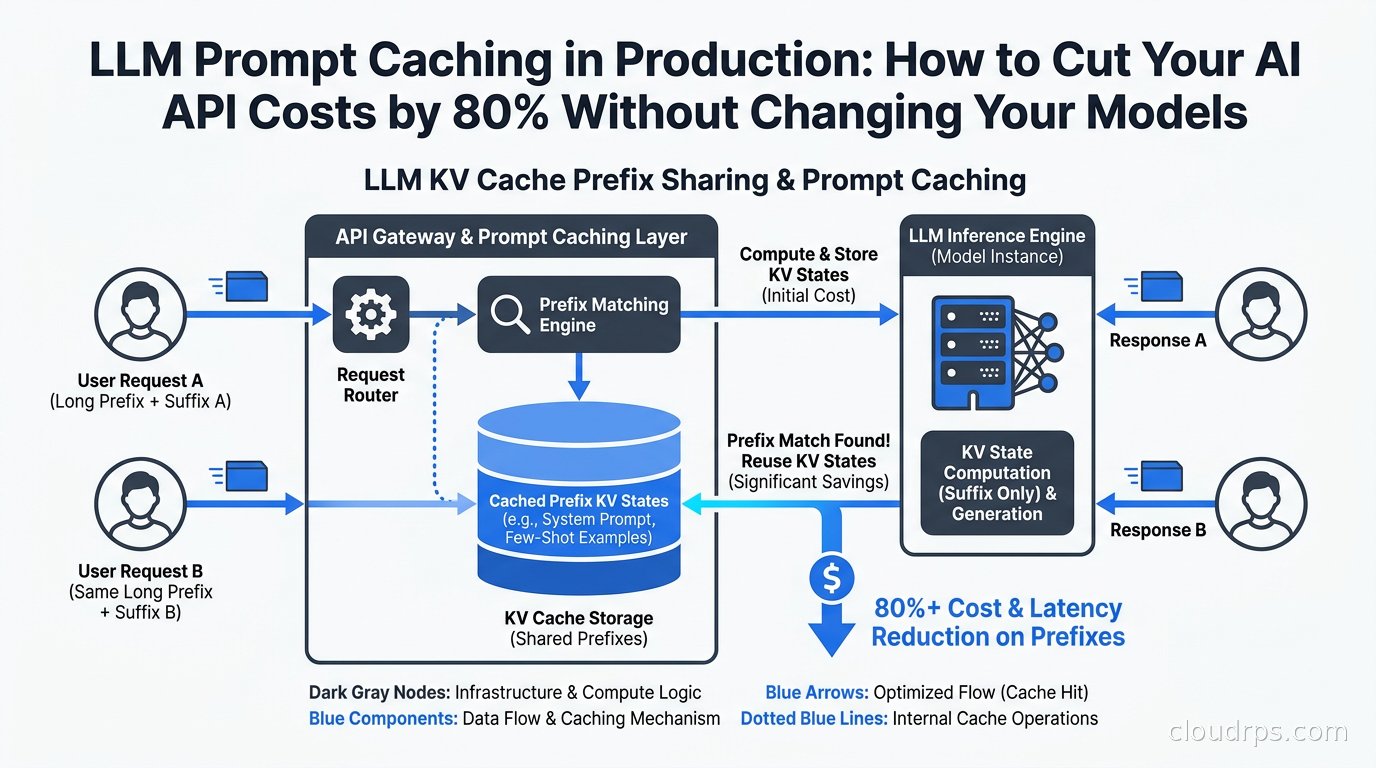
I have spent twenty years designing infrastructure for compute-heavy systems, and the pattern is always the same: teams obsess over the workload itself and ignore the reuse opportunities sitting right in front of them. In the LLM era, that blind spot costs real money.
Last year I reviewed an AI API bill for a customer using Claude to power a legal document analysis product. Their monthly spend was substantial and, frankly, embarrassing once we dug in. When I looked at their request traces, the first 4,000 tokens of every single API call were identical: the same system prompt describing their data extraction format, the same 50 pages of compliance guidelines, the same set of output schema examples. They were paying to process those 4,000 tokens fresh on every request, thousands of times a day. A couple hours of implementation later, their bill dropped dramatically. No model change. No prompt engineering. Just caching the prefix.
That is the power of prompt caching, and most teams building on LLM APIs are leaving it on the table.
What Prompt Caching Actually Is
Prompt caching, also called prefix caching, is the ability for an LLM serving infrastructure to reuse computation it already performed for a shared prefix of tokens. To understand why this is such a big deal, you need to understand what happens inside a transformer when you make an API call.
For every token in your prompt, the model computes key-value pairs as part of the attention mechanism. This computation is what makes transformers expensive: it scales quadratically with sequence length. When you have 4,000 tokens of static context, you are paying for those 4,000 quadratic attention operations on every single request, even when you sent the exact same 4,000 tokens five minutes ago.
Prefix caching breaks that cycle. When you make a request whose first N tokens exactly match a recently cached prefix, the model provider skips recomputing those KV pairs and reads them from cache instead. The result arrives faster and costs significantly less.
This is fundamentally different from semantic caching, which I will cover later. Prefix caching works at the token level and is mathematically exact: it requires the prefix to match character-for-character. Semantic caching works at the meaning level and requires an embedding lookup. Both are useful, but they solve different problems.
How the KV Cache Works Under the Hood
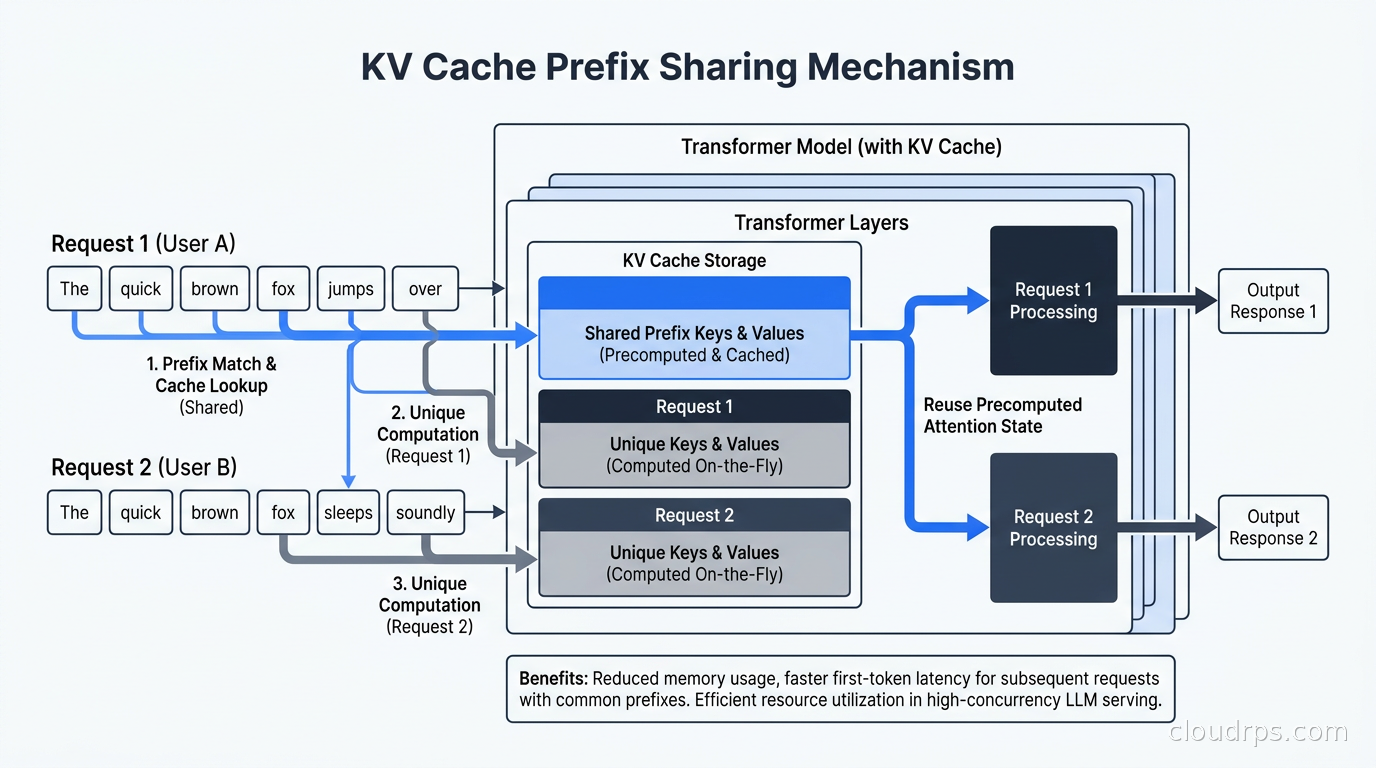
The attention mechanism in a transformer computes Query, Key, and Value matrices for every token in your prompt. The keys and values from earlier tokens get attended to by later tokens, which is how the model understands context. These key-value pairs are the KV cache.
When processing a prompt, a model normally computes KV pairs sequentially from the first token to the last. Prefix caching exploits the fact that if the first 2,000 tokens are identical across requests, the KV pairs for those 2,000 tokens are also identical. The server can store those precomputed matrices and skip that computation for subsequent requests with the same prefix.
The tricky part is that this only works for an exact prefix match. A single token difference anywhere in the cached portion invalidates the cache from that point forward. This is why prompt structure matters so much in practice. If you put a timestamp, request ID, or user-specific data anywhere in your system prompt, you are poisoning your cache hit rate for every request that follows it.
The cache has a TTL, typically 5 to 10 minutes for most providers, though this varies by provider and configuration. If the same prefix is not seen again within the window, the cached KV pairs get evicted. High request volume is your friend here: dense traffic patterns keep the cache warm.
Provider Behavior and Pricing: What Actually Differs
Every major provider supports some form of prefix caching in 2025, but the implementation details differ enough to matter for production architecture decisions.
Anthropic gives you explicit control via cache breakpoints in the request body. You mark content blocks with cache_control: {type: "ephemeral"} to tell the model exactly where to create cache checkpoints. Reads from cache cost 10% of the normal input token price. Cache writes (the first time you populate a cache slot) cost 1.25x normal input price. The minimum cacheable prefix is 1,024 tokens. Cache TTL is 5 minutes, extendable to 1 hour for large documents with repeated access. You pay slightly more to write the cache, then dramatically less on every cache read. If your cache hit rate is above roughly 15%, you are already ahead financially.
OpenAI handles prefix caching automatically with no API changes required. Any prompt prefix of 1,024 tokens or more that appears in multiple requests within a time window gets cached automatically. Cache hits are billed at 50% of the normal input token rate. You do not get explicit control over cache breakpoints, which means you are relying on OpenAI’s internal heuristics to determine what gets cached. In practice this works well, but you lose the ability to force a cache write or inspect hit rates directly through the API response metadata.
Google Gemini with their Context Caching feature (available on Gemini 1.5 and 2.x) takes yet another approach: you explicitly create a cache object via a separate API call, pay a small storage fee per hour, and then reference the cache ID in subsequent requests. Cached tokens are billed at 25% of the normal input price. The minimum is 32,768 tokens, which means this feature targets long-context use cases like large codebases, legal documents, or video transcripts rather than typical chat workloads. The explicit cache management is more operationally complex but gives you exact control over what is cached and for how long.
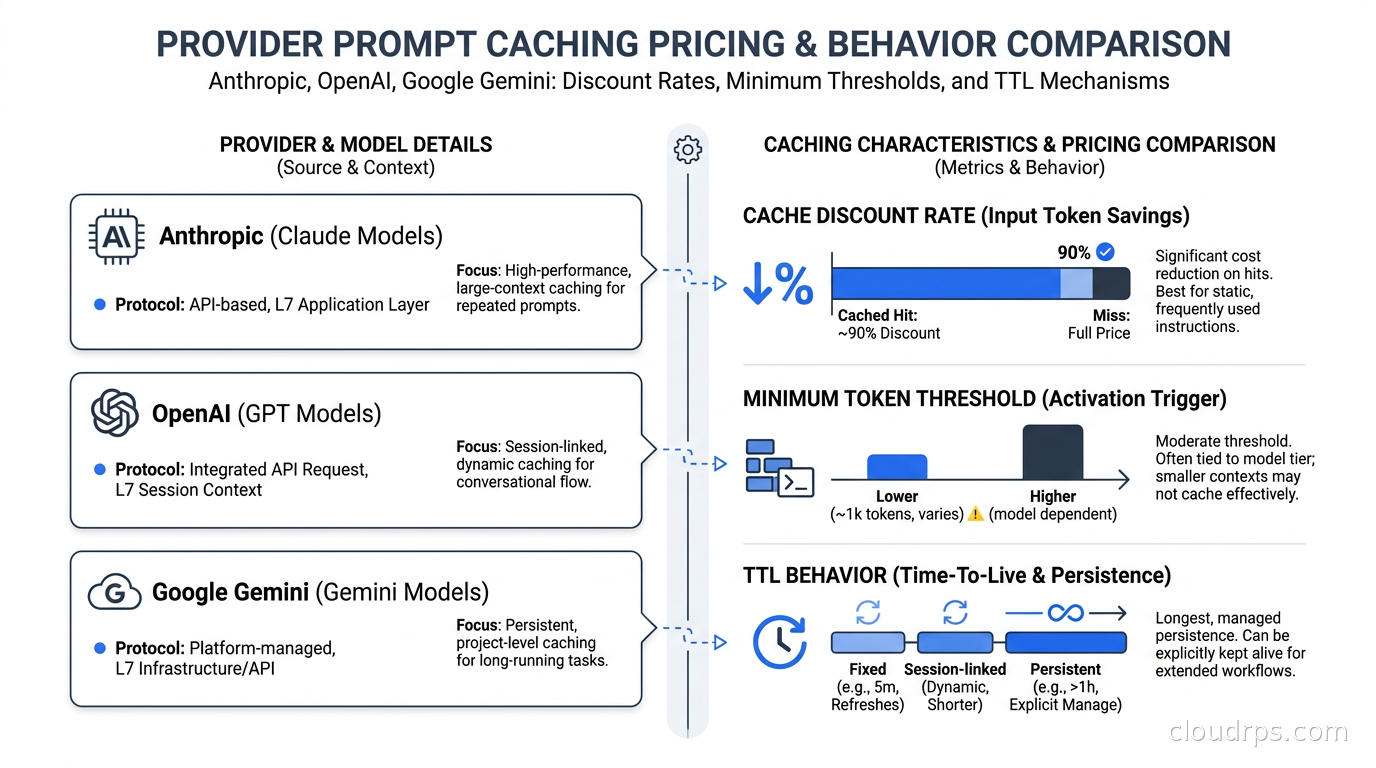
For most teams building production applications on top of LLM APIs, Anthropic’s approach gives the best combination of cost savings and observability. The cache hit and miss data surfaces directly in API responses, letting you measure efficiency per request. OpenAI’s automatic caching is convenient but opaque. Gemini’s explicit caching is powerful for very long contexts but adds operational overhead that only pays off at scale.
If you are evaluating which managed AI platform to build on from a broader perspective, the AWS Bedrock vs Vertex AI vs Azure AI Foundry comparison covers the full picture beyond just caching.
How to Structure Prompts for Maximum Cache Hits
The single most important principle: stable content goes first, dynamic content goes last.
A well-structured cacheable prompt looks like this, ordered from top to bottom:
- System prompt: role, persona, behavioral instructions. Completely static.
- Static context: knowledge base excerpts, compliance policies, output schema. Rarely changes.
- Conversation history: rolling window of prior turns. Grows over time but accumulates predictably.
- Current user message or task: unique per request.
Every token that appears before the first dynamic token can potentially be cached. As soon as you hit a dynamic token, nothing after it can be served from cache.
I have seen teams make this mistake repeatedly: they embed the current timestamp, a user’s account tier, or a dynamic session ID in the system prompt. That single dynamic field forces the model to recompute everything that follows it, including all the expensive static context they added afterwards. Move any user-specific or request-specific data to the end of the prompt, after all static content.
Here is a concrete example of the wrong structure:
System: You are a helpful assistant. Today is 2025-07-07T10:32:15Z.
[50 pages of compliance documentation...]
Every request generates a unique cache key because the timestamp changes. Every request pays to re-process all 50 pages of compliance docs. The fix:
System: You are a helpful assistant.
[50 pages of compliance documentation...]

User: [Current date: 2025-07-07] {actual user question}
Now the compliance docs get cached. The date moves to the user message where it belongs conceptually anyway.
For RAG applications, retrieved documents create a structural challenge because each request retrieves different chunks, so the dynamic retrieval results cannot be cached. The practical approach is to cache your system prompt aggressively: role definition, output format instructions, any fixed reference material. Put retrieved chunks in a separate user message at the end of the context. The static prefix still gets cached; only the dynamic retrieved portion computes fresh each time. Our RAG architecture production guide covers chunking and retrieval strategies in depth; layering prompt caching on top of a well-designed retrieval pipeline is where the real cost savings compound.
What Kills Your Cache Hit Rate Without You Realizing It
Several patterns silently destroy cache performance without any obvious error signal.
Prompt template bugs: If your template rendering inserts a trailing space or newline inconsistently, you break the cache. Tokenizers are deterministic, but text formatting code is not always. One team I worked with had a cache hit rate of 3% despite careful prompt structuring. The culprit was a Python string formatting edge case that sometimes included a trailing newline in the system prompt depending on which code path rendered it.
Shuffled few-shot examples: Some teams randomize the order of few-shot examples in their prompts to improve model diversity or prevent position bias. This is reasonable for quality reasons but guarantees a 0% cache hit rate for the shuffled section. If you need diversity in few-shot examples, put the examples after the static knowledge base sections so at least the expensive knowledge base prefix gets cached even if the examples portion does not.
Version strings in prompts: Every time you deploy a new version of your application, if you embed a version string or git SHA in the prompt for debugging purposes, you invalidate the cache for every in-flight request. Use structured logging in your observability stack for versioning; keep prompts clean of deployment metadata.
Multi-model A/B testing with different system prompts: If you are simultaneously routing a percentage of traffic to an alternative system prompt, you effectively have two separate cache buckets. Each individual variant may have a low hit rate even if aggregate traffic is high. This is expected behavior, but teams sometimes look at blended hit rates and miss that neither variant is building cache efficiently.
Low traffic volume: The cache needs both warm-up time and minimum request density to hit meaningful savings. If you have fewer than a few dozen requests per minute hitting the same prompt prefix, the cache will frequently be cold. At low volume, focus optimization efforts on your architecture and retrieval quality before worrying about caching. Volume will make caching worthwhile later.
Semantic Caching vs Prefix Caching: Different Problems, Different Tools
Semantic caching is often discussed in the same breath as prefix caching, but they solve different problems and live at different layers of the stack. Our AI gateway architecture guide covers semantic caching in detail as one of the key capabilities of an LLM proxy layer.
Prefix caching is handled by the model provider, requires exact token matches, and applies to the input computation. If the first 2,000 tokens of a request match a cached prefix, you get a discount on computing those tokens.
Semantic caching is handled by your application or gateway layer, works on embedding similarity, and applies to the response. If a user asks “what is the capital of France” and you have a cached response from a previous “what’s the capital city of France” query, semantic caching returns the cached output without making any API call at all.
Use both, not one or the other. Prefix caching optimizes the cost of requests that must reach the model. Semantic caching eliminates requests entirely for near-duplicate questions. Together, they can meaningfully reduce LLM API costs in applications with high query repetition and stable user intent patterns.
Measuring Cache Efficiency in Production
You cannot optimize what you do not measure. Here is what to track and how.
Cache hit rate: The percentage of input tokens served from cache vs computed fresh. Anthropic surfaces this per-request in the usage field: cache_read_input_tokens and cache_creation_input_tokens. OpenAI includes prompt_tokens_details.cached_tokens in the response. Build dashboards that aggregate these fields daily and weekly so you see trends rather than per-request noise.
Effective input token price: Your blended cost per input token, accounting for cache discounts. If you are paying $3 per million input tokens normally and hitting an 80% cache read rate (at 10% price), your effective blended rate is well below $1 per million. Track this weekly to quantify optimization progress and communicate savings to stakeholders.
Cache warming latency: After a deployment that changes your system prompt, or after a provider cache eviction, how long until your hit rate recovers to steady state? If warming takes too long, it signals either low traffic volume or a prompt structure issue preventing the cache from building efficiently.
Latency reduction from cache hits: Cache hits are not just cheaper, they are faster. The model skips KV recomputation for cached tokens, reducing time-to-first-token measurably. Track TTFT separately for cache-hit vs cache-miss requests. This data is useful both for product performance goals and for building the business case for caching investment.
I recommend a simple weekly cache efficiency report: total input tokens processed, tokens served from cache, effective blended token price, and estimated savings vs a no-cache baseline at list pricing. This makes ROI visible without requiring engineering effort on every reporting cycle.
Architecture Patterns That Work in Production
Three patterns that generate consistently high cache hit rates across different application types.
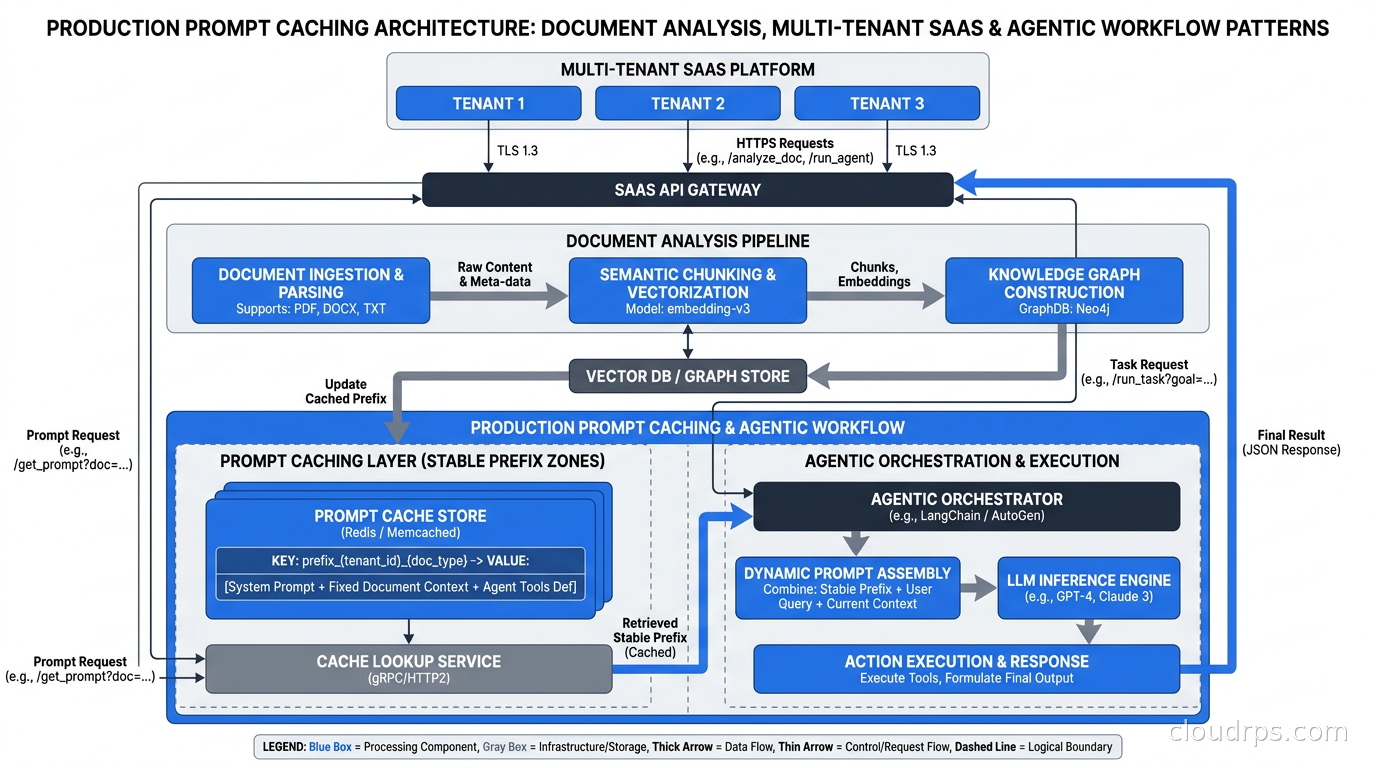
Document analysis pipelines are the highest-impact use case. If your application analyzes documents against a fixed set of instructions (compliance checks, contract review, data extraction schemas), put the complete instruction set in a cached prefix and stream different documents through the dynamic user message. I have seen consistently high hit rates in these workloads because the static instruction prefix dominates prompt length while the documents themselves vary freely. The cache earns back its cost within the first hour of traffic.
Agentic workflows require more careful design. An AI agent iterating through multiple tool calls accumulates conversation history, which becomes increasingly dynamic. The key is to cache the initial context, specifically the agent persona, available tool definitions, and static knowledge base, separately from the rolling conversation. In frameworks like LangGraph, this means explicitly separating system configuration from the messages array and marking the system block as cacheable. Our guide on agentic AI in production covers the broader architecture patterns; caching is a critical cost control layer within them.
Multi-tenant SaaS applications often combine per-tenant configuration (customer-specific instructions, brand voice, domain knowledge) with a shared base system prompt. Structure this as a two-layer approach: a shared base prefix that all tenants reuse, followed by tenant-specific configuration, followed by user content. The shared base accumulates cache hits across all tenants. The tenant-specific layer accumulates hits from that tenant’s repeated requests. Tenants with high individual request volume will see strong hit rates on their tenant-specific prefix too.
When Prompt Caching Does Not Help
Caching is not a universal win. Recognize when to skip it or deprioritize it.
Short prompts: If your prompts average 500 tokens, the 1,024-token minimum threshold for most providers means there is nothing substantial to cache. Caching only helps when you have a meaningful shared prefix.
Highly creative applications: If your system prompt itself changes frequently, such as in generative storytelling, dynamic persona switching, or experimental products where prompt iteration is ongoing, the cache will be cold most of the time. Stabilize your prompts first, then implement caching.
Very low request rates: A research tool with 100 requests per day will see a cold cache on most requests. The TTL evicts before traffic repopulates it. This is not a reason to skip implementation entirely, but do not expect meaningful savings until volume grows.
Purely self-hosted inference: If you run your own models on vLLM or SGLang, you own the KV cache entirely. Prefix caching is built into those engines natively, and the economics are different because you are paying for GPU time rather than per-token API fees. Our article on LLM inference engines covers how PagedAttention and RadixAttention implement prefix reuse inside self-hosted serving infrastructure.
The Cost Math at Scale
Let me give you a concrete calculation so the ROI is clear before you have to argue for prioritization.
Suppose you run a customer support AI using a frontier model, with a system prompt of 3,000 tokens and an average user message of 500 tokens per turn. You handle 1 million conversations per month averaging 5 turns each. That is 5 million requests per month.
Without caching: 5 million requests times 3,500 average input tokens equals 17.5 billion input tokens. At typical frontier model pricing, input costs run roughly $1,000/month in this simplified example at discount pricing. At list pricing for a premium model it is often 5 to 10 times higher.
With prompt caching and an 80% cache hit rate, you are computing 3,500 tokens fresh on the first request for each unique prefix, then reading 3,000 of those tokens at 10% cost on subsequent hits. The blended effective input token price drops by 60% to 75% depending on provider and actual hit rate.
This is why I push every team to implement prompt caching before considering model downgrades. Downsizing from a premium model to a cheaper one usually hurts quality and requires substantial evaluation effort before you trust it in production. Caching a static prefix costs an afternoon of engineering time and delivers comparable or greater savings without touching quality.
For teams managing the broader picture of AI infrastructure economics, the AI FinOps guide covers the framework for measuring, allocating, and reducing costs across the full AI stack. Prompt caching is one lever; model routing, quantization, and batch inference are others. They compound. On the decode side, speculative decoding is a complementary technique that accelerates token generation for low-concurrency workloads without touching the prefix reuse benefits you get from caching.
Getting This Into Production
The implementation is simpler than the ROI would suggest. For Anthropic: add cache_control markers to your system prompt content blocks. For OpenAI: do nothing, caching is automatic. For Gemini: make one extra API call to create a cache object, then reference its ID in subsequent requests. Log the cache usage fields from the response. Build a dashboard around weekly hit rate and effective token price. Iterate on prompt structure when you see hit rates below 50% on a workload with significant static prefix content.
Twenty years of building compute systems has taught me that the most profitable performance work is usually the thing nobody thought to measure. Token reuse is this generation’s version of query caching, compiled bytecode, and memory page deduplication. The underlying principle has not changed: computation you can avoid is always cheaper than computation you must perform.
Start with your highest-volume, most repetitive prompts. Measure the hit rate. Let the savings make the case for the next round of optimization.
Updated September 1, 2026: removed unsourced statistics as part of an accuracy review.
Get Cloud Architecture Insights
Practical deep dives on infrastructure, security, and scaling. No spam, no fluff.
By subscribing, you agree to receive emails. Unsubscribe anytime.