
Twenty years into this industry, I thought I had seen every category of production failure that a distributed system could hand me. Silent data corruption from a misconfigured replication lag. A Kafka consumer group quietly falling behind by hours before any alert fired. An S3 lifecycle rule deleting objects twelve months before the retention policy intended. What I did not fully appreciate until I started building LLM-powered applications was the particular cruelty of an AI pipeline that returns valid JSON eighty percent of the time and something subtly wrong the other twenty percent, with zero indication in the logs that anything broke.
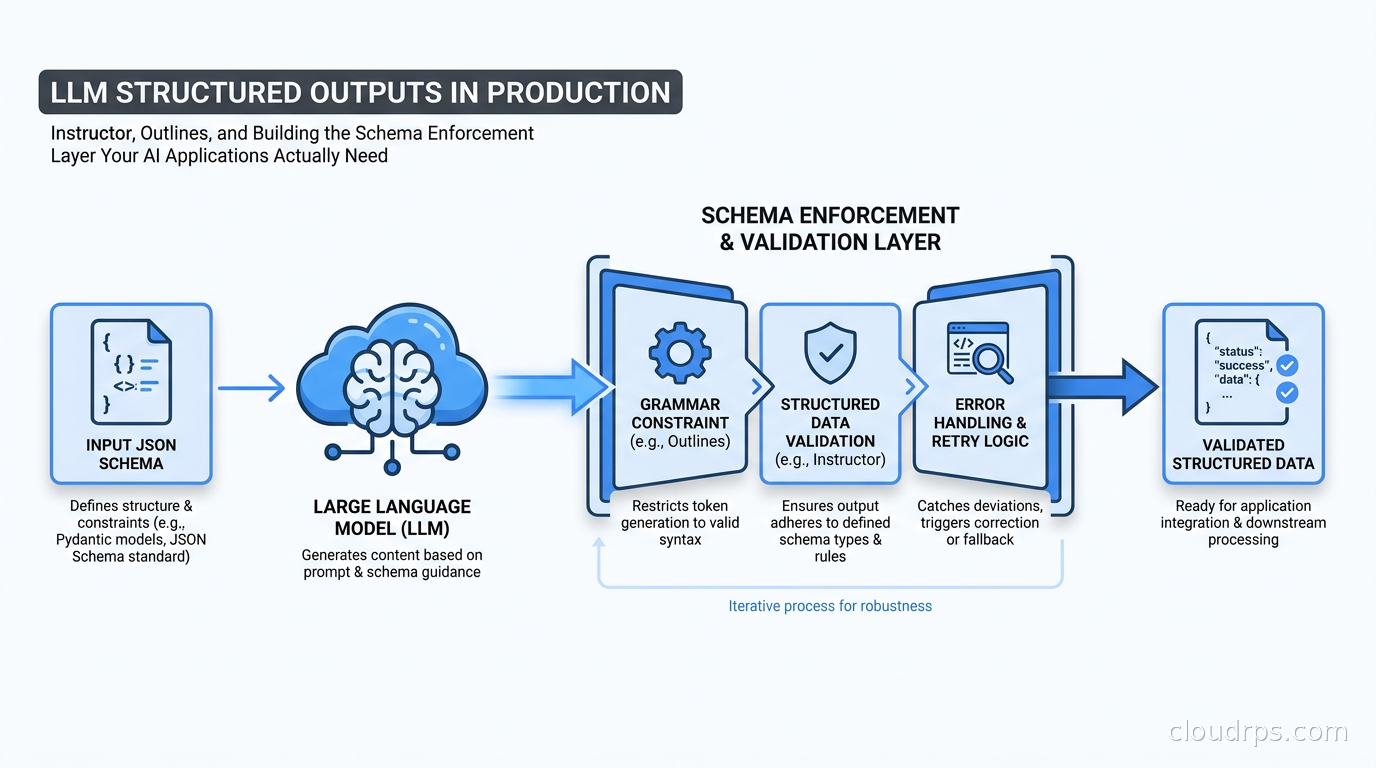
That is the core problem that structured output enforcement solves. Not “make the model smarter.” Not “improve the prompt.” Give the model a grammar it cannot violate, enforce that grammar at decode time or validate at parse time, and treat every schema mismatch as an infrastructure failure rather than a model quirk. The tools to do this have matured significantly. The architecture around them has not always kept up.
This article covers the full structured output stack: where enforcement happens, how Instructor works as the dominant library for API-based LLMs, how Outlines and its newer companion XGrammar handle constrained generation on self-hosted models, what schema designs actually work in production, and how to build the monitoring and fallback layers that prevent a schema change from silently corrupting your data pipeline.
Why “Just Ask for JSON” Fails
The naive approach, which I have been guilty of myself in early LLM projects, is to write a prompt that says “respond only with valid JSON in this format” and then call json.loads(). It works in the demo. It fails in production at precisely the frequency that matters, which is not often enough to catch in QA but often enough to corrupt a meaningful fraction of your data.
Three failure modes appear repeatedly. First, the model returns valid JSON that does not match your schema. An expected integer field arrives as a string. A required key is missing. An enum field contains a value outside the defined set. Second, the model returns almost-valid JSON with a trailing comment or markdown fence that breaks the parser. Third, under high load or with longer context windows, model behavior drifts and schema adherence degrades silently.
The traditional response is a retry loop: catch the exception, put the raw output and validation error back into the prompt, and ask again. This works, but naive implementations add latency in the happy path (checking schema after the fact), leak token costs to retries, and still give up after N attempts with no record of what failed.
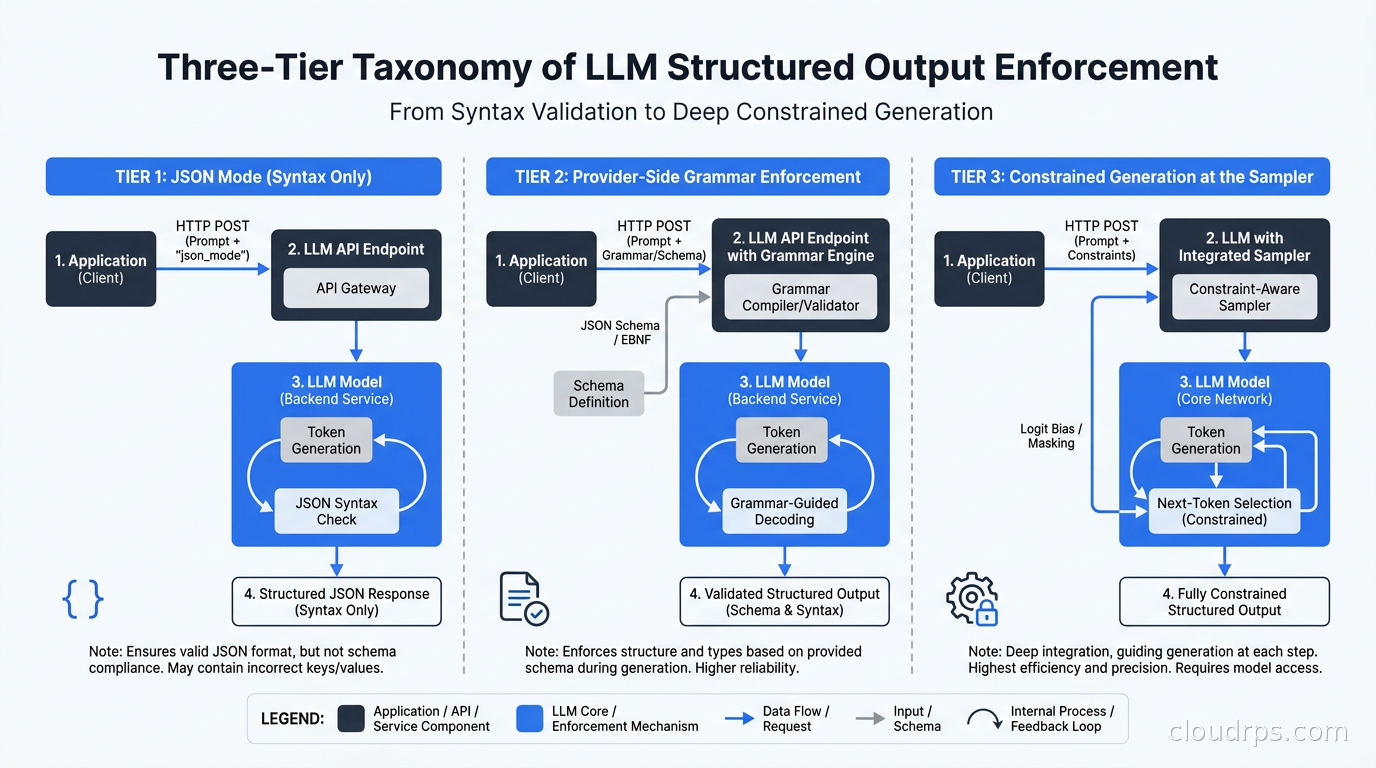
The structured output ecosystem has converged on three distinct approaches, each appropriate at a different layer of the stack.
The Three-Tier Taxonomy
Tier 1: JSON mode (syntax guarantee). The oldest approach. You tell the API to return valid JSON and nothing else. OpenAI calls this type: "json_object". Anthropic historically used prefill techniques, setting the first token of the assistant turn to { to nudge the model toward a JSON response. What you get is syntactically valid JSON. What you do not get is schema adherence. The model still decides which keys to include, what types to use, and whether required fields are present. As of mid-2026, OpenAI treats JSON mode as a legacy path and recommends against it for new applications.
Tier 2: Provider-side grammar enforcement. The current standard for API-based LLMs. You pass a JSON Schema to the provider. The provider compiles the schema into a grammar that constrains the token sampler at inference time. The model literally cannot emit a token that would violate the schema at that position. OpenAI calls this “Structured Outputs” with strict: true. Anthropic compiles your schema into a formal grammar on first request (with a noted latency cost on cold grammars, which are then cached for twenty-four hours, per the Anthropic platform documentation). Google Gemini provides equivalent functionality via response_schema. The result is guaranteed schema adherence, not probabilistic adherence.
Tier 3: Constrained generation on self-hosted models. When you run your own inference stack, typically with vLLM, SGLang, or similar, you can integrate a constrained generation library like Outlines or XGrammar directly into the sampling step. The schema constraint runs in the same process as the model. No API round-trip, no provider dependency. This is what hyperscalers and companies with serious inference infrastructure use when they need deterministic output from models they host themselves.
Instructor: The Production Standard for API-Based LLMs
Instructor has become the dominant library for structured outputs against provider APIs, with over three million monthly downloads and more than eleven thousand GitHub stars as of 2026. The repo now lives at 567-labs/instructor after moving from jxnl/instructor. The design philosophy is worth understanding because it is not magic: it is a thin wrapper that intercepts the provider response, runs Pydantic validation, and handles the retry loop with the validation error in a disciplined way.
The basic pattern looks like this. You define a Pydantic model for your expected output. You patch your provider client with instructor.from_openai(client) or the equivalent for Anthropic, Gemini, and a dozen other providers. You call client.chat.completions.create() with response_model=YourModel. Under the hood, Instructor converts your Pydantic model to a JSON Schema, passes it to the provider using that provider’s native structured output mechanism (Structured Outputs API for OpenAI, tool use for Anthropic, response_schema for Gemini), parses the response, validates it, and if validation fails, constructs a new message that includes the original response and the Pydantic validation error, then retries.
This retry-with-error-feedback loop is the key insight. Instead of sending a blank “try again” message, Instructor tells the model exactly what it got wrong. A response that had a due_date field formatted as a string like “next Tuesday” rather than an ISO-8601 datetime will receive a validation error explaining that due_date expects a datetime value. The model almost always corrects it on the retry.
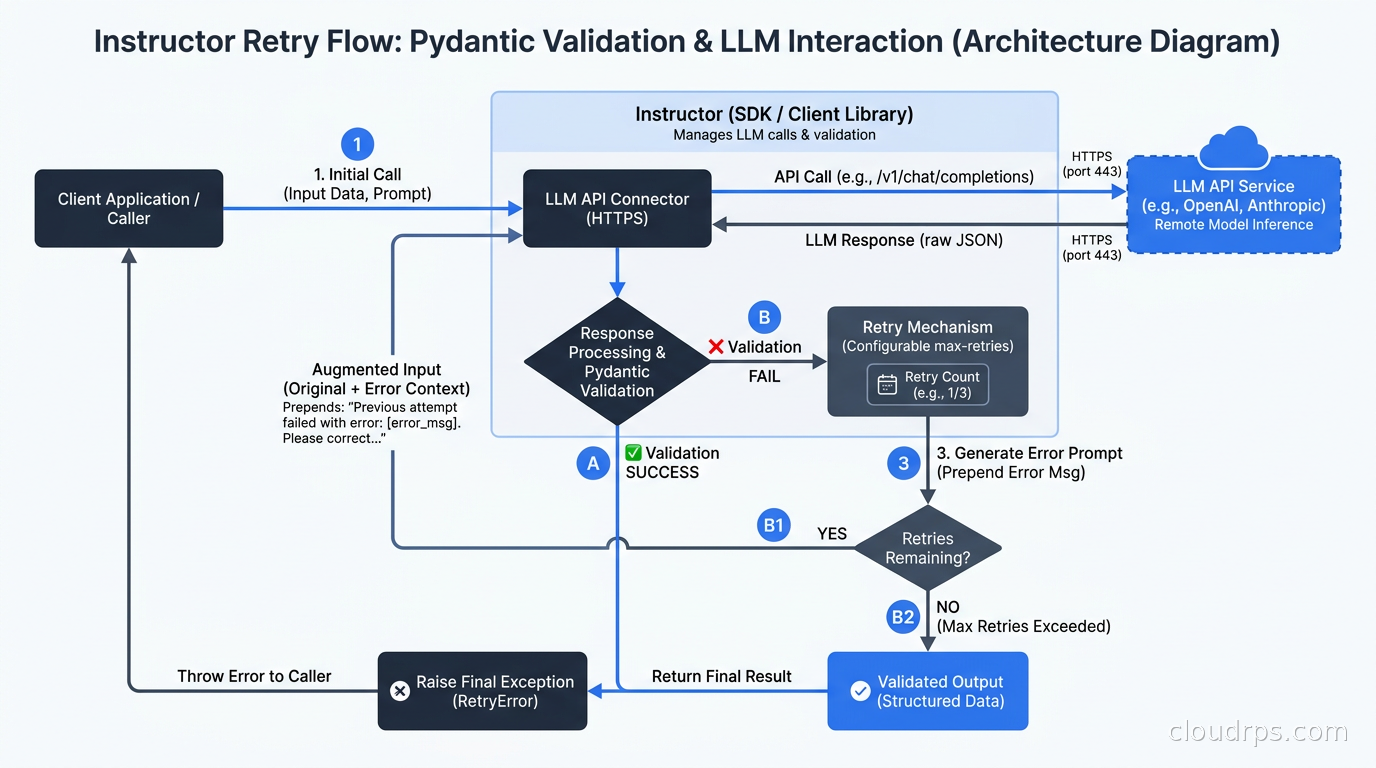
Instructor handles multi-provider support through mode switching. instructor.Mode.TOOLS uses function calling. instructor.Mode.JSON uses JSON mode. instructor.Mode.JSON_SCHEMA uses provider-native structured outputs where available. For Anthropic, instructor.Mode.ANTHROPIC_TOOLS wraps the schema in a tool definition that Claude treats as a structured response target. You pick the mode once at client initialization and the rest of the code is identical across providers.
Streaming support is also first-class. With response_model=Iterable[YourModel] you can stream a list of validated objects as they complete, which is the right pattern for extraction tasks that return multiple entities from a long document. The alternative, waiting for the full response before validating, adds unnecessary latency for long extractions.
For the RAG pipelines I build, Instructor has become the default glue between retrieval and the structured data my downstream services expect. A retriever returns a blob of text. Instructor ensures the extraction step produces a typed, validated object every time. What used to be a brittle parsing step is now a typed interface with automatic retry.
One practical note: Instructor versions the retry prompt in a way that can interact unexpectedly with provider-level prompt caching. If you are using Anthropic’s prompt caching or OpenAI’s cached prefixes to reduce cost, be aware that the retry variant of the call will be a cache miss because the validation error is new content. This is expected behavior but worth factoring into your cost model.
Outlines: Constrained Generation for Self-Hosted Models
For teams running their own inference infrastructure, Outlines takes the constraint enforcement down to the sampler level. The library compiles your JSON Schema or regex pattern into a finite-state machine. At each generation step, the FSM rejects any token that would put the output into an invalid state. There is no post-hoc validation, no retry, and no possibility of schema violations. The model physically cannot generate an invalid response.
The vLLM integration is the most common deployment path. Outlines hooks into vLLM’s logits processing layer, and the pairing has been considered production-stable since vLLM 0.6.0 and Outlines 0.1.0. You pass your schema as a guided_json parameter on the vLLM generate call. SGLang has equivalent support via its own constrained decoding backend. If you are building on the vLLM and SGLang inference infrastructure patterns, Outlines drops in without major surgery to your serving stack.
The latency cost of constrained generation is real but bounded. Research from the XGrammar paper (arXiv:2411.15100) and production benchmarks in the Outlines community point to overhead in the range of roughly five to fifteen percent compared to unconstrained generation, depending on schema complexity and sequence length. A deeply nested schema with many optional fields is more expensive to enforce than a flat schema with five required string fields. This is a structural property of FSM-based enforcement: more possible schema paths means a more complex automaton.
XGrammar is worth mentioning here because it represents the current state of the art for constrained generation performance. It uses a context-free grammar engine with a compilation strategy that pre-computes most of the per-token work offline, so the online overhead during generation is significantly lower than older FSM approaches. vLLM has been integrating XGrammar as an optional backend for structured generation. If you are benchmarking constrained generation overhead on a high-throughput inference cluster, XGrammar is where I would start.
One real limitation: constrained generation enforces the structural schema but not semantic validity. A JSON Schema can mandate that invoice_total is a number and line_items is a non-empty array, but it cannot mandate that the sum of line_items equals invoice_total. Those business rules need to live in a Pydantic validator that runs after parsing. This boundary between structural and semantic validation is the most common misconception I see in teams adopting constrained generation. The tool does not make your model smarter; it makes its output structurally correct, every time.
Schema Design Patterns That Survive Production
The schema you define has a much larger impact on output quality than most engineers expect. Poorly designed schemas increase the model’s cognitive load, reduce output quality on the non-schema aspects of the task, and create validation failures that look like model failures.
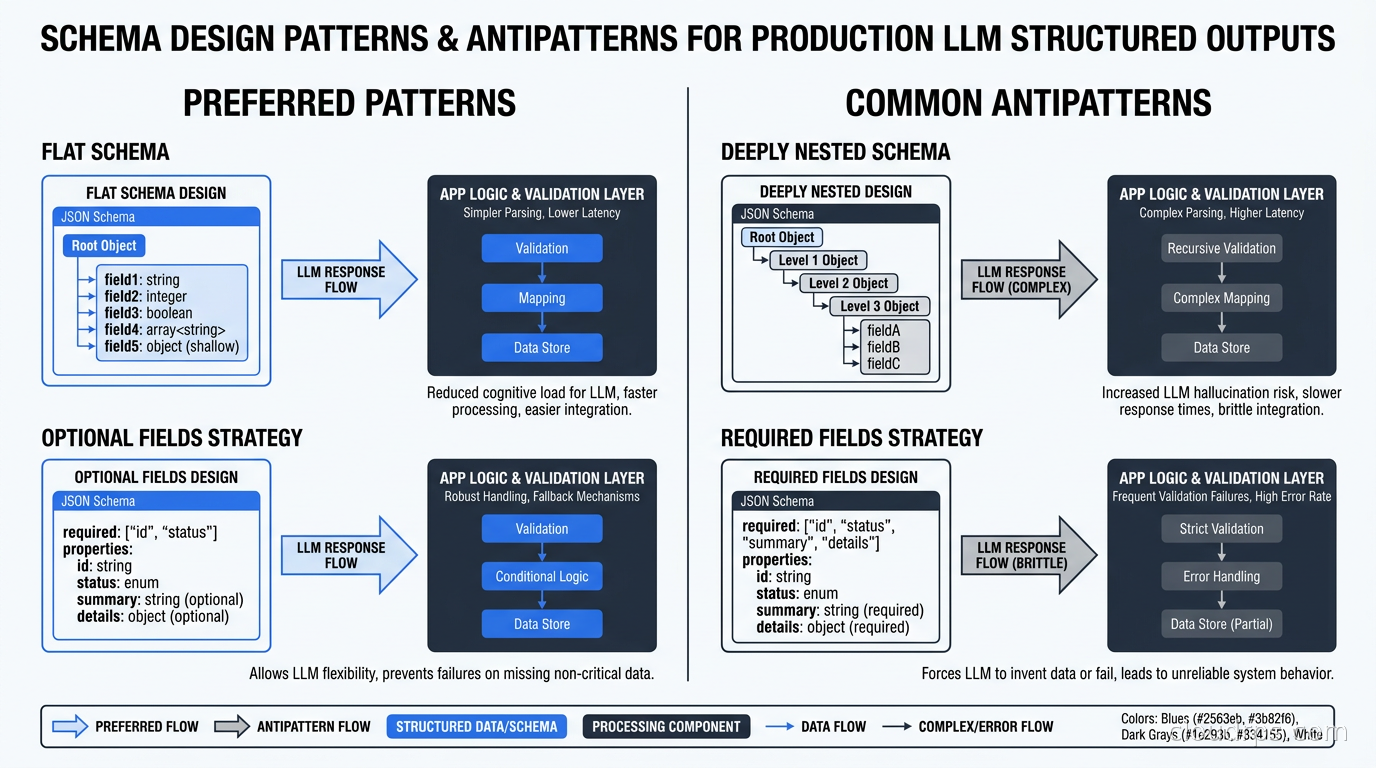
Several patterns consistently work well. Keep schemas flat where possible. A model that has to construct a three-level deeply nested object with optional fields at each level will make more mistakes than one filling in a flat record with clear field descriptions. If you need complex nested structures, consider returning a flat extraction and constructing the nested object in application code.
Use field descriptions aggressively. JSON Schema supports a description property on each field. Pydantic V2 supports Field(description="..."). These descriptions flow into the system prompt that the provider or Instructor constructs. A field named status with possible values pending, approved, rejected will produce far better output if the description says “Approval status. One of: pending (awaiting review), approved (cleared for payment), rejected (blocked with reason).”
Avoid union types where you can. Union[str, int, None] is technically valid JSON Schema but creates ambiguity at generation time. If a field can be null, declare it explicitly as optional with a concrete type rather than a union. If you need multiple possible shapes, consider a discriminated union with a clear discriminator field.
Be careful with recursive schemas. A schema for a tree node that contains a list of child nodes of the same type can cause issues with certain provider implementations and FSM-based constrained generation. Bounded recursion (max depth 3 or 4) usually works; unbounded recursion does not.
For agentic systems, structured outputs also enforce the contract between the LLM and the tool-calling layer. The frameworks I use for AI agent orchestration increasingly treat tool arguments as structured output schemas, which means the same enforcement machinery handles both extraction tasks and agent actions.
Production Architecture: Monitoring, Versioning, and Fallbacks
Getting a single call to return structured output correctly is the easy part. Running it reliably at scale across tens of thousands of calls per hour, surviving schema evolution, and knowing when things go wrong, that is where the architecture work lives.
Instrument your retry rate. Every time Instructor fires a retry due to a validation failure, that is a signal worth counting. A retry rate under a few percent on a stable schema is expected background noise from edge cases. A retry rate that climbs over time, or spikes after a model version change, is a leading indicator that your schema is starting to break against new model behavior. Without instrumentation, you will not see it until it turns into an elevated error rate. Your LLM observability stack should include a counter for structured output validation attempts, validation failures, and retries broken down by schema name.
Version your schemas like you version APIs. A v1 extraction schema that returns five fields and a v2 that adds three more should be treated as different interfaces with different compatibility rules. If you are storing extracted data in a database and you add a new required field to the schema, you now have a migration problem. The expand-and-contract pattern works here: add the field as optional first, run it in production to confirm the model returns it reliably, then make it required and backfill or migrate existing records.
For applications that cannot tolerate any latency from retries, you can take a layered fallback approach. Try Structured Outputs mode first. If that fails (provider error, schema too complex for the provider’s grammar compiler), fall back to JSON mode and Pydantic validation. If that fails, return a partial result or a default value and log the failure for offline reprocessing. The AI gateway layer is the right place to implement provider-level fallbacks when the primary provider rejects your schema.
For high-throughput pipelines where you are extracting structured data from many documents, batch your calls rather than serializing them. Instructor supports async clients natively, and running extractions with asyncio.gather() over a batch of documents is dramatically more efficient than sequential calls. Combine this with LLM prompt caching for the system prompt and schema description, which can be a significant fraction of total prompt tokens on extraction tasks with long static instructions.
A Production Story Worth Sharing
About a year ago I was working with a team building a document processing pipeline. They extracted structured fields from insurance claim forms, around ten fields per document, and stored results in PostgreSQL for downstream underwriting logic. The initial implementation used JSON mode with a manual retry loop.
The retry loop worked fine in testing. In production, the team started seeing subtle data quality issues. Claims were occasionally being routed to the wrong queue. The root cause took two weeks to find: one enum field, claim_type, was sometimes coming back with a value like "AUTO " (with a trailing space) or "auto" (lowercase) instead of the canonical "AUTO" from the defined set. The retry logic was not catching this because the JSON was syntactically valid and the validation code was doing a case-insensitive contains check rather than strict enum validation. The model was not wrong in any obvious way. The schema enforcement was just too loose.
The fix was straightforward: move to Structured Outputs with strict mode enabled on the provider side, tighten the Pydantic model to use a Python Enum type (which Instructor converts to a proper JSON Schema enum), and add a Pydantic validator for whitespace normalization as a belt-and-suspenders measure. The invalid enum values disappeared entirely. What had been a subtle data corruption issue that required forensic database analysis to find became a visible validation failure on the rare occasions it occurred, rather than a silent bad write.
That is the broader point about structured outputs: they do not just make your AI application more reliable. They make failures visible, retryable, and monitorable. A silent bad write to a database is far worse than a logged retry with a validation error.
Choosing Your Approach
The decision tree is simpler than it looks. If you are calling provider APIs and do not run your own models, use Instructor with the provider’s native structured output mode. The multi-provider abstraction pays for itself the first time you want to route between OpenAI and Anthropic for cost or capability reasons. Pair it with instrumentation on validation failures and you have a production-grade extraction layer.
If you run self-hosted inference with vLLM, add constrained generation via Outlines or XGrammar. The latency overhead is modest, the schema adherence guarantee is absolute, and you remove the retry-and-validation complexity from your application code entirely. Make sure your schema is not unnecessarily complex, keep field descriptions in the schema, and test with the distribution of inputs you expect in production rather than just clean examples.
In both cases, think about schema evolution from day one. Version your schemas. Monitor retry rates as a health signal. Treat a schema validation failure as a first-class error with a trace ID, not a silent retry. The tooling exists to make structured outputs reliable; the operational practice around them is what most teams are still building.
The agentic AI systems I build today depend on structured outputs at multiple layers: tool call arguments, intermediate agent state, final extraction results. Getting that layer right, with proper enforcement, observability, and schema governance, is the difference between a demo that impresses and a system that runs without babysitting at three in the morning.
Get Cloud Architecture Insights
Practical deep dives on infrastructure, security, and scaling. No spam, no fluff.
By subscribing, you agree to receive emails. Unsubscribe anytime.