
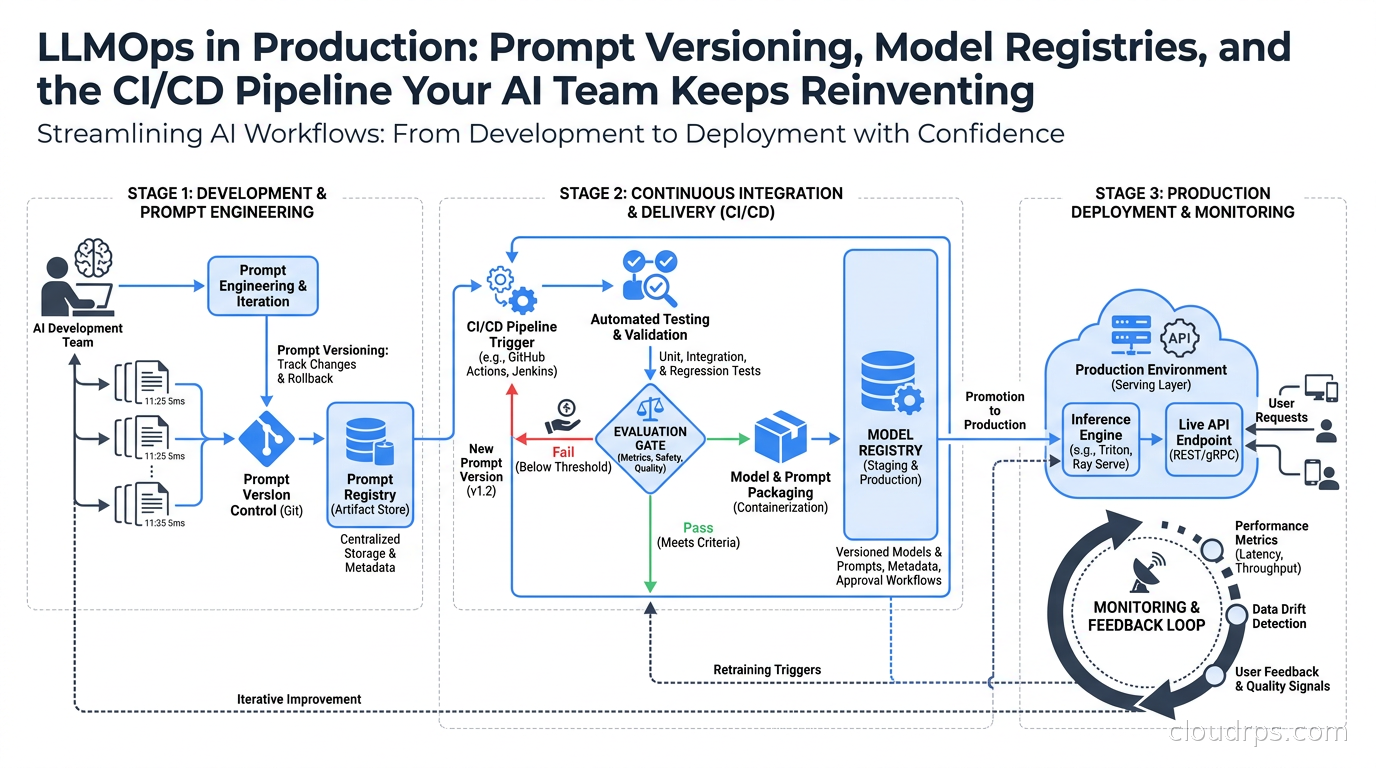
I spent most of my career optimizing how software gets built and shipped. Twenty years in, I thought I understood deployment pipelines. Then I started running LLMs in production, and I realized that most of what I knew about MLOps was either wrong or structurally mismatched when applied to large language models.
The teams I see struggling most in 2026 are not the ones that failed to adopt AI. They are the ones that successfully adopted it and are now buried in operational debt. They have a dozen LLM-powered features in production, no systematic way to version their prompts, no automated gates before prompt changes ship, and zero visibility into why their outputs degraded after they switched model providers. Every team has reinvented the same broken approaches independently, and every team has hit the same wall.
LLMOps is the operational discipline that fixes this. But if you apply traditional MLOps patterns to LLM applications, you will end up with a framework that is structurally mismatched to how these systems actually fail. The differences matter, and I want to be specific about them.
Why MLOps Falls Apart for LLMs
I have written before about MLOps in practice. The traditional MLOps lifecycle centers on training pipelines, feature engineering, model evaluation on held-out datasets, and monitoring for input distribution drift. It assumes you have a clear mapping between inputs and expected outputs, and that “the model” is a single artifact you train, version, and deploy.
LLM applications break every one of those assumptions.
First, the model itself is usually not something you train. You are calling a hosted API from Anthropic, OpenAI, Google, or a self-hosted open-weight model. The “model” in your system is actually a combination of: the base model and its version, the system prompt, the few-shot examples, the retrieval configuration if you are using RAG, the temperature and sampling parameters, and the post-processing logic. All of these change independently. All of them affect output quality. Almost none of them get versioned consistently in teams that have not explicitly built LLMOps practices.
Second, evaluation is fundamentally harder. A traditional classifier has ground truth labels. An LLM application produces open-ended text. “Is this response correct?” requires human judgment or another LLM acting as judge. You cannot write unit tests that assert exact string equality. The signal is noisier, evaluation takes longer, and the cost of running evals at scale is real.
Third, the failure modes are different. Traditional ML models fail in ways that metrics can catch: accuracy drops, precision decreases, the input distribution drifts. LLMs fail by producing plausible-sounding nonsense, leaking information from context windows, generating factually wrong but grammatically confident responses, or subtly changing behavior after a provider updates their model in a silent rollout.
This is why LLMOps needs its own patterns.
The Prompt Is Code
The most important shift in LLMOps thinking is treating prompts as first-class software artifacts. I have watched teams keep their prompts in spreadsheets, in database rows, in string literals inside application code, in Notion documents. In every case, they eventually hit the same wall: something broke in production, nobody knows which prompt change caused it, and rolling back is manual and error-prone.
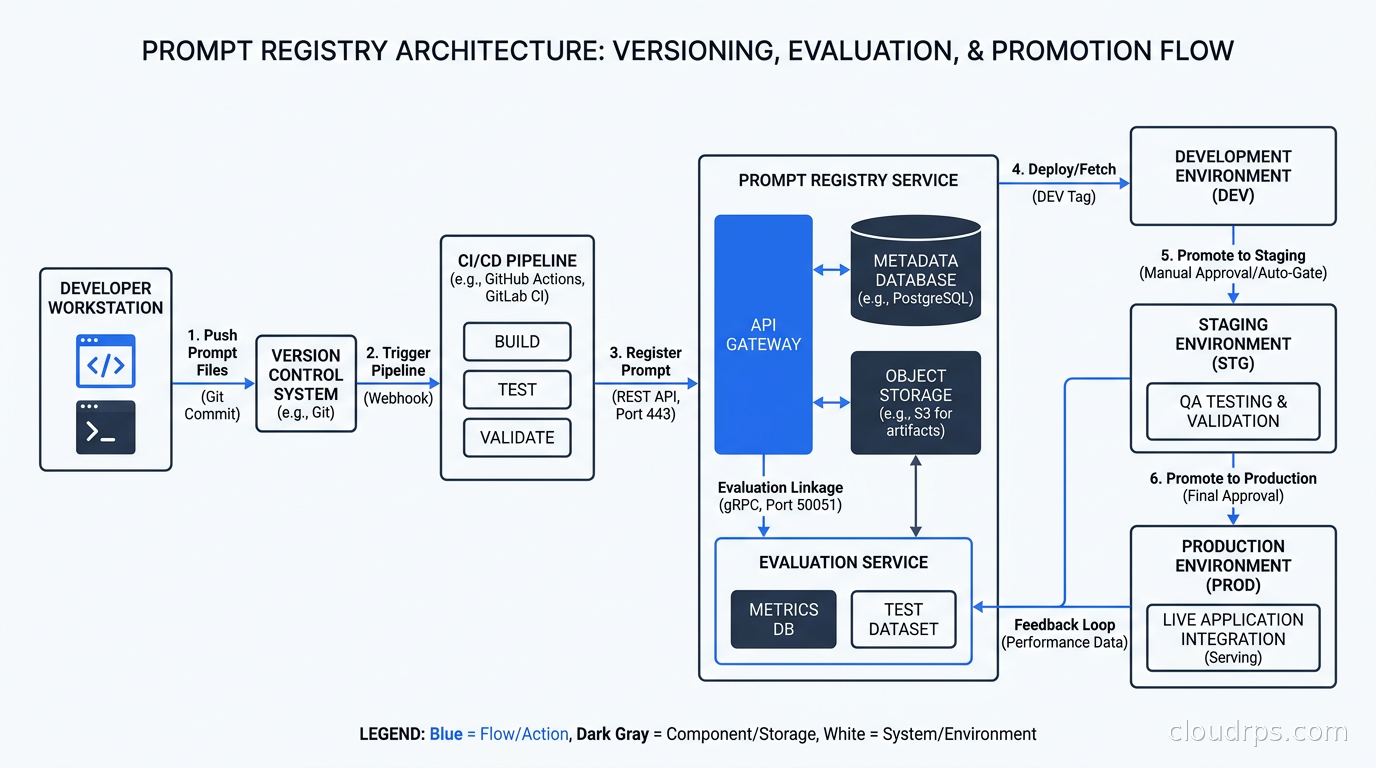
Your prompts need version control. Not just “save it in Git somewhere,” but a proper prompt registry with semantic versioning, metadata, and linkage to evaluation results.
A mature prompt registry looks like this: each prompt has a name, a semantic version (1.2.0, not just a commit hash), a creation timestamp, the author, the target model and provider, and the evaluation scores that were measured against a test dataset when this version was created. When you promote a prompt version to production, you record which version it is. When outputs degrade, you look up the prompt version that was active during the degradation window and diff it against the previous version.
Tools like MLflow 3.0’s prompt tracking, LangSmith’s prompt hub, and Langfuse’s prompt management all support variants of this pattern. The specific tool matters less than the discipline: nothing that affects LLM output should be unversioned.
The same principle extends beyond prompts. Your retrieval configuration in a RAG system, specifically the chunk size, overlap, embedding model, similarity threshold, and number of retrieved chunks, is as impactful as the prompt itself. I have seen retrieval config changes that degraded output quality by 30% in production with no rollback path because the config lived in an environment variable that nobody tracked. That is an entirely avoidable incident if you treat RAG configuration the same way you treat code.
Eval Gates in CI
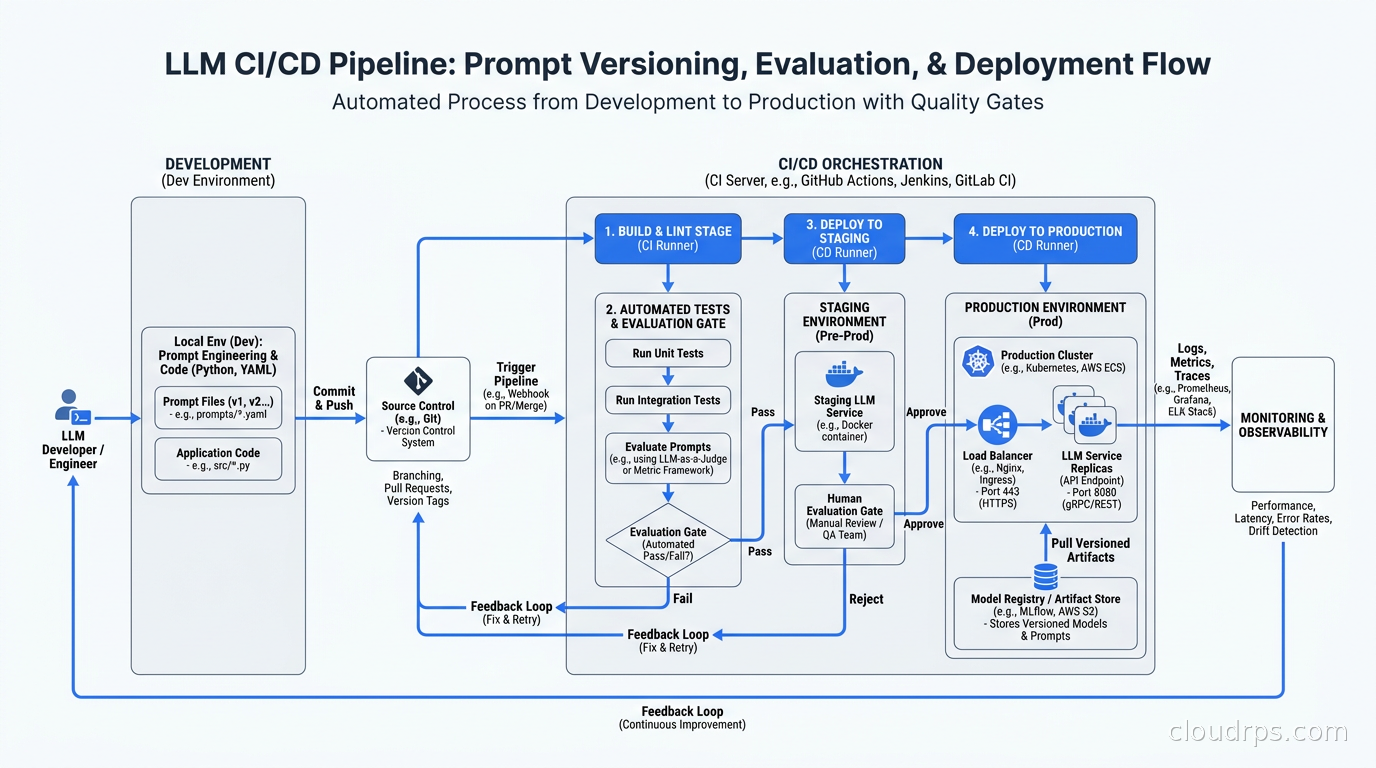
If there is one practice that separates mature LLMOps teams from everyone still improvising, it is this: nothing ships without passing automated evaluation. Your CI pipeline for an LLM application needs eval gates the same way a traditional software pipeline needs unit tests. This is not aspirational; it is table stakes for running LLMs responsibly in 2026.
Here is what a practical eval gate looks like. You maintain a golden dataset: a set of input/output pairs that represent known-good behavior for your application. This dataset lives in version control alongside your prompts. When a prompt change is proposed, your CI pipeline runs the new prompt against the golden dataset and computes quality metrics: RAGAS scores if you are running RAG, LLM-as-judge ratings for open-ended quality, factual accuracy on verifiable claims, and business-specific metrics like task completion rate.
If the eval scores drop below thresholds you have defined, the PR fails. No human has to manually review outputs before the gate catches the regression.
The practical challenge is that LLM evals are expensive. Running a 500-sample eval dataset against a hosted model API can cost $5 to $50 per CI run depending on the model and the complexity of the evaluation. At high PR velocity this adds up fast. The mitigation strategies I use: run a smaller smoke eval set of 50 samples on every PR, run the full eval set only on merges to main, and cache eval results for identical prompt versions. The caching approach in LLM prompt caching applies directly here: if the prompt version has not changed, the cached eval result is still valid.
For the eval framework, LLM evaluation in production covers the tooling options in depth. The architectural point for LLMOps is that your eval framework must be integrated into CI, not run manually by whoever remembered to do it before deploying. Manual eval gates fail under deadline pressure every time.
The LLM Model Registry
Traditional ML model registries, MLflow, SageMaker Model Registry, Vertex AI Model Registry, track trained model artifacts: the weights, training metadata, and evaluation metrics at training time. They assume you own the model.
LLM applications mostly do not own the model. You are consuming an API. But you still need a model registry, and what you are tracking is fundamentally different.
Your LLM model registry tracks configurations, not artifacts. A “model” entry in your registry is a combination of: the provider (Anthropic, OpenAI, Google, self-hosted), the model family and version (claude-opus-5, gpt-4.5, gemini-3-ultra), the prompt version it was evaluated with, the retrieval config version, the sampling parameters, and the evaluation scores measured for this specific combination.
This matters because providers update their models without changing the model identifier. I have been caught by this more than once. A model that behaved one way in January behaves differently in June because the provider silently pushed an update. If you do not track which model version you evaluated against and when, you have no way to attribute behavioral changes to model updates versus prompt changes.
The mitigation is to pin model versions explicitly when providers allow it (Anthropic’s API supports version-pinned identifiers, for example), run your eval suite on a schedule against production prompts even without code changes to catch silent model updates, and alert when eval scores drift outside a historical baseline. That scheduled eval run is your early warning system for provider-side changes.
For teams self-hosting open-weight models like Llama 4, Qwen 3, or Mistral variants, the registry problem looks closer to traditional MLOps: you need to version the model weights, the quantization format and level, the inference engine version, and the deployment configuration. The LLM inference engines comparison covers the serving-side details. For LLMOps purposes, the principle is the same: every component that affects output quality must be tracked and versioned together as a coherent configuration unit.
Deployment Strategies for Model Changes
Software deployment patterns like blue/green and canary releases translate to LLM model deployment, but with important differences. LLM output quality changes are not binary. A code bug either breaks or it does not. A model change might make 10% of responses slightly worse while improving 20%. You need different criteria for deciding whether to roll forward or roll back.
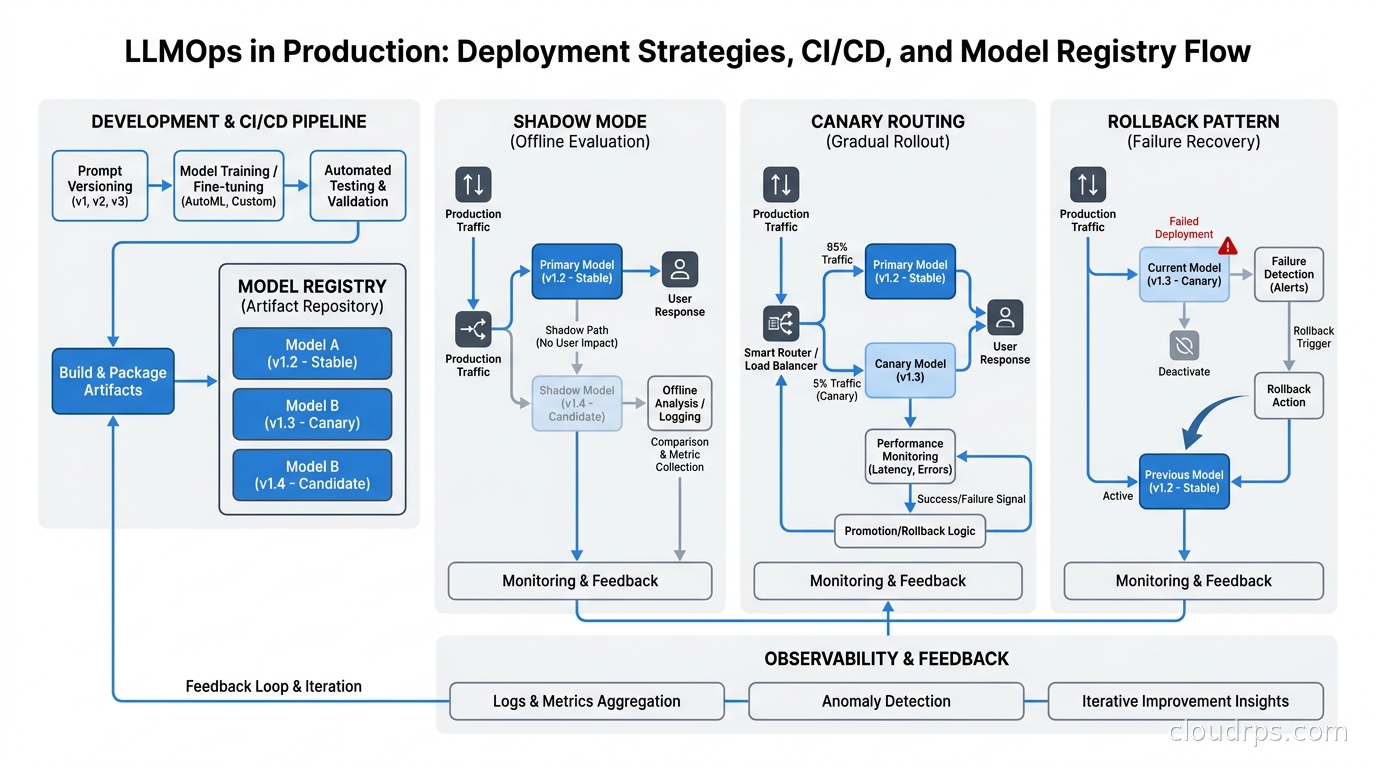
Shadow mode deployment is the safest first step when switching models or making significant prompt changes. You run the new configuration in parallel with the existing one, serving production traffic with the old config but also running the new config against the same inputs and logging the outputs. You do not serve the new config’s outputs to users yet. After 24 to 48 hours of shadow traffic, you run your eval suite against the logged outputs and compare quality distributions.
This is expensive because you are running two inference calls per production request, but for high-stakes applications the cost is worth it. For AI coding agent infrastructure, shadow mode is almost mandatory when changing the underlying model for autonomous code generation or other high-consequence tasks. The blast radius of a degraded model in an agentic context is much larger than in a simple request/response application.
Canary deployment for LLMs works by routing a percentage of traffic to the new model configuration and measuring user feedback signals alongside automated eval metrics. The signals you monitor: task completion rates, user correction rates (did the user have to retry or rephrase?), explicit thumbs up/down if your UI exposes that, and your automated LLM-as-judge scores on the canary sample.
Feature flags are how you control the traffic split. Feature flags and progressive delivery patterns apply directly here. You implement model routing through the same LaunchDarkly or Flagsmith setup you would use for feature rollouts, with the flag value determining which model configuration the application calls. This gives you instant rollback: flip the flag, all traffic goes back to the previous config.
One thing that catches teams: LLM responses can be stateful in ways that make simple canary analysis misleading. If a user has a conversation with the new model in the first few requests (the canary 10%), and then the flag routes them back to the old model, the conversation context they built up may produce incoherent results. For stateless request/response LLM applications this does not matter. For conversational agents and multi-turn workflows, you need to either maintain model affinity per session or accept that during the canary period some conversations will degrade.
Cost Governance as an Ops Discipline
Token costs are the silent budget killer in LLM applications. A single prompt that becomes slightly more verbose in production, multiplied across millions of daily requests, can add tens of thousands of dollars to your monthly bill before anyone notices.
The AI FinOps discipline covers strategic cost management. For LLMOps, the operational layer means building cost monitoring into your application lifecycle from day one.
Track cost per request as a first-class metric alongside latency and quality. Your observability stack should emit the input token count, output token count, and dollar cost for every LLM call. Aggregate this by feature, by user segment, by model, and by prompt version. When you deploy a new prompt version in CI, compare its average cost per request against the previous version as part of the eval gate. A prompt that achieves the same quality at 20% fewer input tokens is a strictly better prompt, and your CI pipeline should surface that fact automatically.
Set cost budgets at the application level and enforce them programmatically. If a particular feature is budgeted at $50 per day and starts approaching that threshold, either route to a cheaper model tier or degrade gracefully. The routing logic can live in your AI gateway layer; this is one of the primary use cases for the AI gateway architecture pattern. A gateway that can route by model, apply rate limits, and enforce cost budgets per feature flag or user segment gives you the control surface you need.
Model routing by complexity is a major cost lever. Not every request needs your most capable and expensive model. A classification task that a Haiku-class model handles correctly costs roughly one-tenth what it costs on an Opus-class model. Build a routing layer that sends simple requests to cheaper models and escalates to more powerful models only when confidence is low or the task complexity warrants it. I have seen this single optimization cut inference costs by 40 to 60% with no user-visible quality impact.
Prompt compression is another underused lever. Techniques like LLMLingua can reduce input token counts by 30 to 60% with minimal quality impact by identifying and removing low-information tokens from context. For applications where context windows are large but not all context is equally relevant, this is worth implementing as a pre-processing step in your request pipeline.
Observability and Incident Response
Production LLM systems fail in ways that traditional monitoring does not catch. Your P99 latency might be fine. Your error rate might be zero. And your users might be getting responses that are quietly wrong in ways that slowly erode their trust.
LLM observability covers the tracing and monitoring tooling. For LLMOps, the incident response side needs specific attention. When a production incident occurs because of model behavior (not infrastructure), your runbook should include: check which prompt version is currently active in each environment, compare it against the last known-good version, pull a sample of recent request/response pairs and run them through your eval suite, check whether the model provider posted any status updates or silent model changes in the relevant window, and if the issue is prompt-related, prepare a hotfix prompt and push it through your eval gates before deploying.
This sounds obvious, but I have watched teams spend two hours in an incident bridge unable to answer the question “what prompt is currently running in production?” because their prompts lived in database rows that nobody versioned. The entire premise of LLMOps is that you should be able to answer that question in under five minutes, at 2 AM, when your on-call rotation gets paged.
Alert on quality degradation, not just errors. The LLM observability tools I use in production emit LLM-as-judge scores on a sample of production traffic, and I set alerts when the rolling one-hour average drops below a threshold. This catches the class of failures that no traditional infrastructure monitoring will surface: the model started producing shorter, less helpful responses; factual accuracy on a particular topic degraded; the tone shifted from the intended persona.
Organizational Patterns That Actually Work
The technical patterns are the easy part. The hard part is the organizational structure that keeps LLMOps practices alive as teams grow.
The teams I have seen succeed have designated “LLM reliability” ownership: someone who is responsible for the eval dataset, the prompt registry, the eval gate configuration, and the cost monitoring dashboards. In organizations with a mature platform engineering function, these responsibilities often consolidate under a dedicated AI platform sub-team; the platform engineering in the AI era guide covers the organizational patterns and the full governance stack platform teams are building around LLMOps tooling. This does not have to be a dedicated role at small scale; it can be a rotating responsibility among the AI engineering team. But it has to be someone’s explicit job, or the golden dataset will drift, the eval thresholds will become cargo-culted without adjustment, and the prompt registry will quietly stop being updated as deadline pressure mounts.
Treat the golden eval dataset as a product. It needs curation, it needs to grow as your application grows, and it needs to be updated when you identify failure modes it does not cover. Every time you have a production incident driven by LLM behavior, that incident’s inputs and the expected correct output should be added to the golden dataset after the incident is resolved. Over time, your eval suite becomes a living documentation of every failure mode you have encountered and corrected. This is one of the most valuable artifacts an AI engineering team builds.
Separate concerns between application code changes and LLM configuration changes. A prompt change or model switch is not the same as a code change, and they should go through different review and approval processes. A prompt change that improves quality metrics and reduces cost should be deployable without a full engineering review cycle. A model provider switch that might have subtle behavioral implications should get more scrutiny. Build your deployment tooling to support this separation.
Budget for eval costs explicitly. Teams that treat eval infrastructure as overhead will underinvest in it and skip eval gates under deadline pressure. Eval costs belong in the same budget line as inference costs for your AI application. If you are paying $10,000 per month in inference costs for a feature, budgeting $500 per month for eval infrastructure is 5% of your AI spend and almost certainly the highest-ROI reliability investment you can make.
The State of the Tooling
The LLMOps tooling ecosystem matured considerably in 2025 and into 2026. MLflow 3.0 added native prompt tracking and LLM-as-judge evaluation, making it a viable single platform for teams already using MLflow for traditional ML. LangSmith has the most mature prompt hub with deployment staging and CI integration. Langfuse is the strong open-source alternative with hosted and self-hosted options, which I prefer when data residency requirements make SaaS tools complicated.
For model deployment orchestration and routing, the AI gateway pattern using Kong AI Gateway, Portkey, or custom-built routing layers gives you the traffic splitting and model routing capabilities LLMOps needs. These integrate with feature flag systems to give you the canary deployment control surface.
The gap that most teams still fill with custom tooling is the integration between their eval pipeline and their CI system. The tools that do this well are Braintrust (strong CI integration, eval-as-code approach) and Arize Phoenix (strong for RAG-specific evaluation). For teams with specific needs, writing a thin eval harness in Python that calls your eval provider’s API and fails the CI job on regression is still a perfectly reasonable approach. The goal is the gate, not the specific tool.
Where to Start
If you are running LLMs in production and your operational practices are ad hoc, prioritize in this order.
Start with the prompt registry. Even a simple Git directory with prompt templates, a version number in the filename, and a changelog is better than having prompts scattered across your codebase. This alone makes incident response measurably better.
Then build your golden dataset. Pick your twenty most representative inputs, define what a good output looks like for each, and store this in version control. This is the foundation for everything else.
Then add an eval gate to your CI pipeline. Run your golden dataset against the new prompt version on every PR. Set a quality threshold. Watch your team’s deployment confidence increase.
The model registry, cost governance, and shadow mode deployment strategies come after you have the foundation in place. But the foundation is what I wish every team had before they shipped their first LLM feature, rather than scrambling to add it after they have accumulated operational debt they cannot easily untangle.
Twenty years of building production systems has taught me that operational discipline is always easier to install before you have traffic than after. With LLMs, the window between “we have this working” and “we are buried in operational debt” is shorter than any other class of software I have shipped. The stakes of getting this wrong are real, and the tooling to get it right has never been more accessible.
Get Cloud Architecture Insights
Practical deep dives on infrastructure, security, and scaling. No spam, no fluff.
By subscribing, you agree to receive emails. Unsubscribe anytime.