Every database vendor will tell you their technology is the universal answer. After twenty years building distributed systems across retail, fintech, and enterprise SaaS, I can tell you that is nonsense. Different data problems require different tools, and the microservices era has made this truth unavoidable.
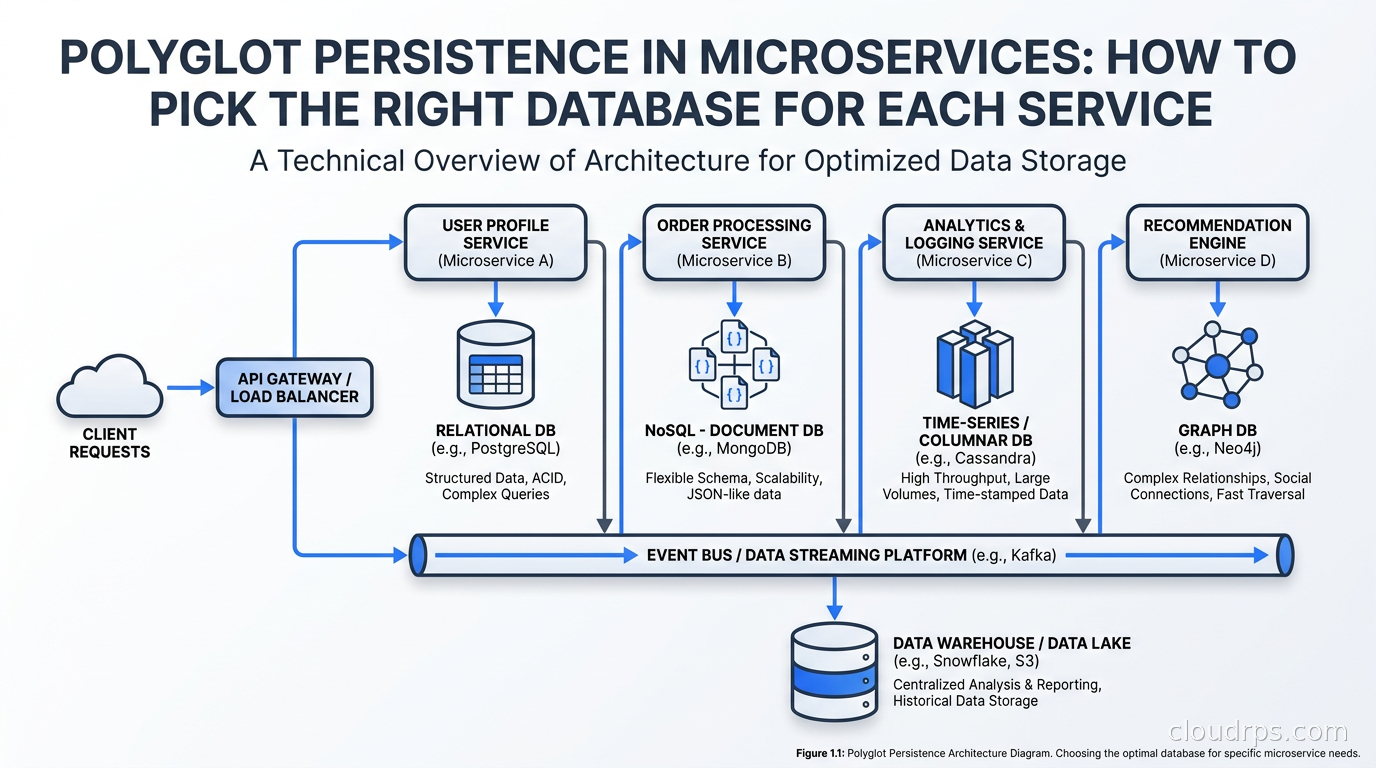
Polyglot persistence is the practice of using multiple different database technologies within a single application, each chosen to match the data access patterns of a specific service. Your user authentication service might use PostgreSQL for its ACID guarantees. Your session storage runs on Redis for microsecond lookups. Your product catalog uses Elasticsearch to power faceted search. Your recommendation engine stores embedding vectors in pgvector. None of these databases are wrong. They are each the right tool for their specific job.
I want to be clear about something from the start: polyglot persistence is not an excuse to collect technologies like trading cards. Every database you add to your stack multiplies your operational burden. The decision to use a specialized data store should always come from a concrete requirement that your current database cannot satisfy without significant complexity or cost, not from excitement about a new tool.
Why Microservices Make Database Choice Harder
In a monolithic application, you typically end up with one database that everything connects to. The team knows it, the operations team knows it, the backup strategy covers that one system. This simplicity is real and valuable.
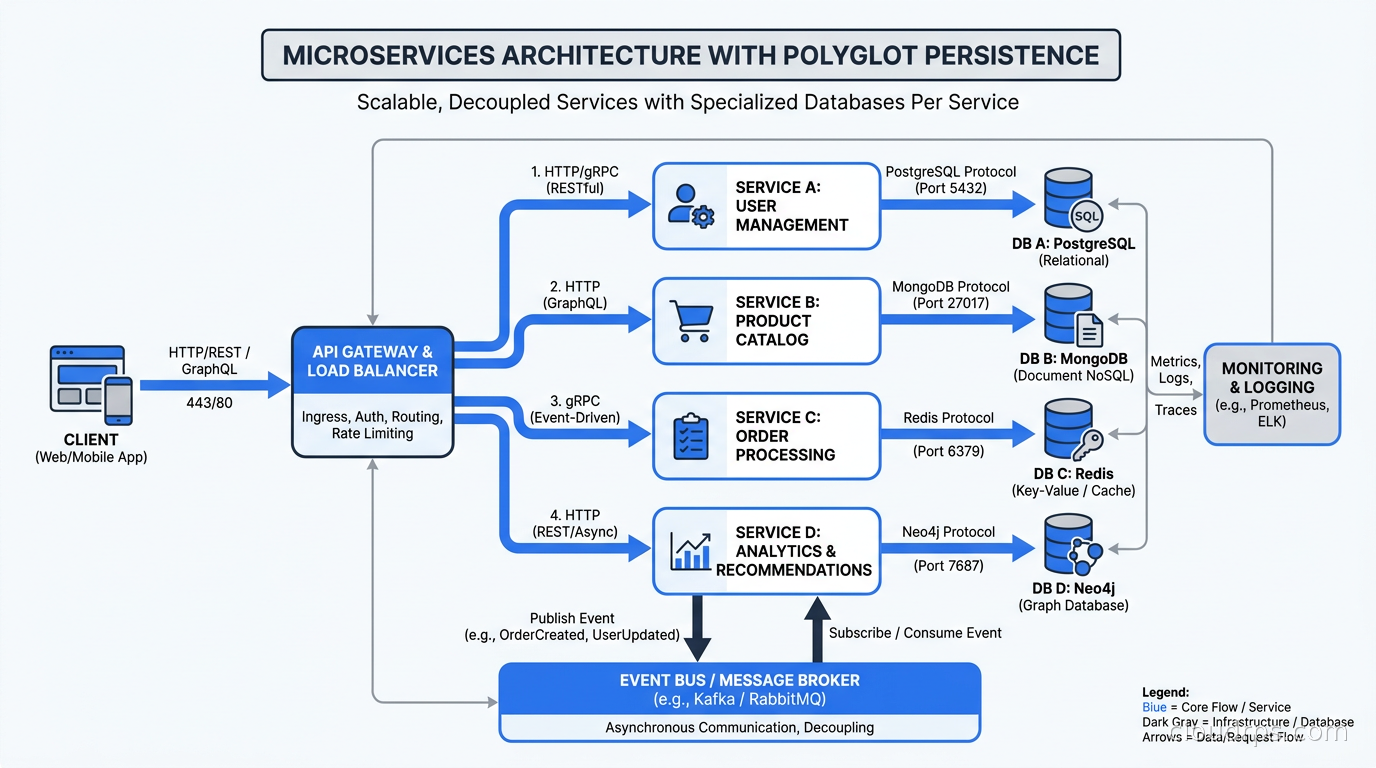
When you decompose into microservices, each service owns its data. This is the database-per-service pattern, and it is fundamental to true service independence. If two services share a database schema, they are coupled at the storage layer. One team cannot change its schema without coordinating with the other. One service’s heavy queries can starve the other’s. You have built a distributed monolith with extra networking overhead.
The flip side is that when each service owns its database, you have to choose a database for each service. And those choices compound: a system with thirty microservices could theoretically use thirty different databases. No sane team does that, but the question of how many technologies is the right number, and which technologies to choose, is one of the central architectural decisions in any serious microservices system.
I worked on a platform that started as a Rails monolith with a single PostgreSQL database. Over three years, we extracted services and made database choices as we went. By the time I moved on, we had PostgreSQL for core transactional data, Redis for sessions and rate limiting, Elasticsearch for search and audit logs, InfluxDB for metrics, and DynamoDB for one high-throughput service that needed single-digit millisecond reads at scale. Five different database technologies was not part of any master plan. Each choice happened incrementally as specific requirements drove specific decisions.
That story is typical. The question is not “should we do polyglot persistence” but “how do we make good choices and keep the operational overhead manageable.”
Mapping Data Access Patterns to Database Types
The core principle is to match the database to the data access pattern. Before choosing a database for a new service, I ask three questions: how is this data written, how is it read, and what guarantees do we need when things go wrong?
Relational Databases: The Default You Should Reach for First
For most business data, PostgreSQL is your starting point. Understanding ACID properties matters here: if your service handles money, inventory, or any data where partial updates would leave the system in an inconsistent state, you want full transactional semantics. Relational databases give you those guarantees with decades of production hardening behind them.
PostgreSQL specifically has become remarkably capable. Its indexing strategies cover most read optimization needs. Its JSONB column type handles semi-structured data without forcing you to a document database. Its replication story is mature, and managed options from Amazon Aurora to Google AlloyDB make operations manageable.
My rule: start with PostgreSQL. Move to something else only when you can articulate the specific constraint you are hitting and why the alternative solves it. Most teams that say “PostgreSQL won’t scale for this” have not yet explored proper indexing, partitioning, connection pooling, or read replicas.
Document Stores: Flexible Schema When You Actually Need It
MongoDB, CouchDB, and similar document stores shine when your data structure is genuinely variable across records and when you primarily read and write entire documents rather than performing complex multi-table joins.
The canonical example is a product catalog for an e-commerce platform. A laptop has different attributes than a t-shirt. You could model this in PostgreSQL with an entity-attribute-value table, but querying it becomes painful. A document store lets each product be a self-contained JSON document with its own structure.
Where I see document stores misused: teams choose them to avoid learning relational modeling. “Schema flexibility” becomes a crutch that produces an inconsistent, unmaintainable mess where one document has user_id, another has userId, and a third has userID. If your data actually has consistent structure and you need transactions across it, PostgreSQL beats MongoDB on every axis.
Key-Value Stores: Speed Above All
Redis, DynamoDB in key-value mode, and similar stores optimize for one thing: getting and setting a value by a known key, fast. Consistent single-digit millisecond latency, horizontal scaling, no complex queries.
The right uses are narrow but common: session storage, rate limiting counters, feature flags, ephemeral caches, leaderboards, pub/sub messaging. If your service’s core data access pattern is “give me the thing for this key,” a key-value store is the right choice.
One thing I want to emphasize: distributed caching with Redis is not a replacement for your primary database. I have seen teams try to build their entire data layer on Redis and then discover, during an outage, that their “cache” was actually the system of record. Redis’s default configuration is not durable. If the data matters when Redis restarts, it needs a durable primary store.
Search Engines: When Full-Text and Faceted Search Are Core
Elasticsearch and OpenSearch exist because relational databases are terrible at full-text search at scale. If your service needs to support free-text queries with relevance ranking, faceted filtering across many dimensions, or log aggregation with structured queries, a search engine is the right tool.
What Elasticsearch and OpenSearch give you: inverted indexes for fast text search, aggregations for faceted counts, and horizontal sharding for data volumes that would choke a relational database. What they do not give you: ACID transactions, foreign keys, or the query flexibility of SQL.
The typical pattern is to use Elasticsearch as a secondary index, not the primary store. Your canonical data lives in PostgreSQL. You sync it to Elasticsearch via change data capture or event publishing. This gives you full-text search without sacrificing data integrity guarantees for your writes.
Time Series Databases: Metrics and Sensor Data
Time series data, such as readings from sensors, application metrics, stock prices, has a specific access pattern: you write sequentially by timestamp, and you read windows of time with aggregations. Standard relational databases handle this poorly because they are not optimized for sequential time-ordered inserts or time-based queries.
TimescaleDB, InfluxDB, and QuestDB all handle these patterns far more efficiently. They compress sequential data, automatically partition by time, and provide time-window aggregation functions that would be awkward to express in standard SQL.
When does this matter? If you are ingesting telemetry from devices, storing application performance metrics at high cardinality, or building any system where “show me the average value for this metric over the last hour, broken into five-minute buckets” is a core query, you want a time series database.
Graph Databases: When Relationships Are the Data
Graph databases like Neo4j and Amazon Neptune shine when the relationships between entities are as important as the entities themselves, and when you need to traverse those relationships many hops deep.
Social networks, permission systems, fraud detection, supply chain analysis. The query “find all users who share two or more connections with this flagged user” is natural in a graph database and requires multiple self-joins in SQL. Graph databases excel here.
The caveat: most business data is not fundamentally graph-shaped. Do not reach for a graph database because your data has relationships. All relational data has relationships; that is what foreign keys are for. Graph databases are justified when the query is “traverse N hops across relationships” and N is variable or large.
Vector Databases: The AI-Era Addition
Vector databases and pgvector are the newest addition to most polyglot persistence stacks. If your service uses embedding-based similarity search, whether for RAG, recommendation systems, or semantic deduplication, you need efficient approximate nearest neighbor search.
The current decision is usually: start with pgvector in your existing PostgreSQL instance, and move to a dedicated vector store like Pinecone, Weaviate, or Qdrant if your embedding volumes and query latency requirements exceed what pgvector can handle. For most teams at most scales, pgvector is enough.
The Decision Framework
Choosing a database is a process, not a lookup table. But it helps to have a structured framework.
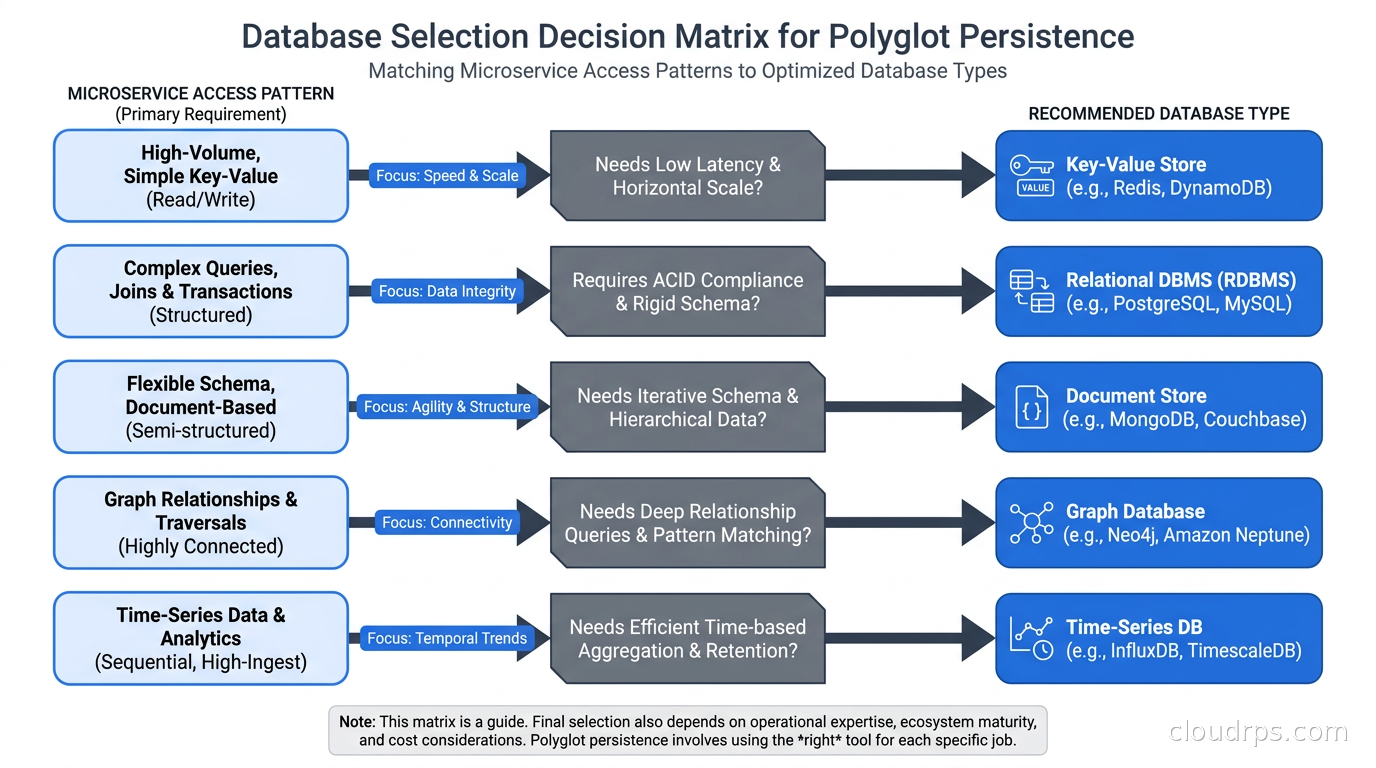
These are the questions I ask for any new service:
What is the primary read pattern? Lookup by ID, full-text search, time-range query, relationship traversal, or vector similarity? The answer often determines the technology.
What are the write characteristics? High-throughput sequential writes, transactional updates with rollback requirements, or flexible schema writes?
What consistency guarantees does the business require? Strong consistency for financial transactions, eventual consistency acceptable for recommendation features?
What is the query flexibility requirement? Ad-hoc analytical queries need a relational or columnar store. Predetermined access patterns can use simpler key-value stores.
What is the data volume and growth rate? PostgreSQL handles hundreds of gigabytes easily on a single machine with proper indexing. Petabytes of time series data need horizontal scale.
For most services I build, the answer is still PostgreSQL. Specialized databases earn their place by solving a specific, concrete constraint that PostgreSQL cannot address without architectural gymnastics.
The Hardest Part: Cross-Service Queries
Polyglot persistence creates a problem that is easy to underestimate: you cannot join across databases. In a monolith, querying orders with customer names is one SQL join. In a microservices world, the orders service has one database and the customer service has another.
There are two main patterns for handling this.
API Composition: to answer “get orders with customer names,” the API gateway or a backend-for-frontend service calls both the orders service and the customer service, then joins the results in application code. This works well when the datasets involved are small, but it breaks down for large result sets and complex filtering.
CQRS with read models: CQRS and event sourcing let you build denormalized read models that combine data from multiple services. Each service publishes events when its data changes. A query service subscribes to those events and maintains a read-optimized view containing the joined data.
CQRS is more complex to build, but it is the right pattern for performance-sensitive cross-service queries. The read model is eventually consistent: it reflects the current state of the event stream, not necessarily an atomic point-in-time view. For most product search and listing features, this is acceptable. For financial calculations, it usually is not.
Distributed Transactions: The Pain Point Nobody Warns You About Enough
When a single business operation spans multiple services, each with its own database, you cannot use database transactions to ensure atomicity. This is the hardest operational problem in microservices, and it catches teams off guard every time.
The Saga pattern is the standard solution. A saga is a sequence of local transactions, each of which publishes an event or message to trigger the next step. If any step fails, the saga executes compensating transactions to undo the previous steps.
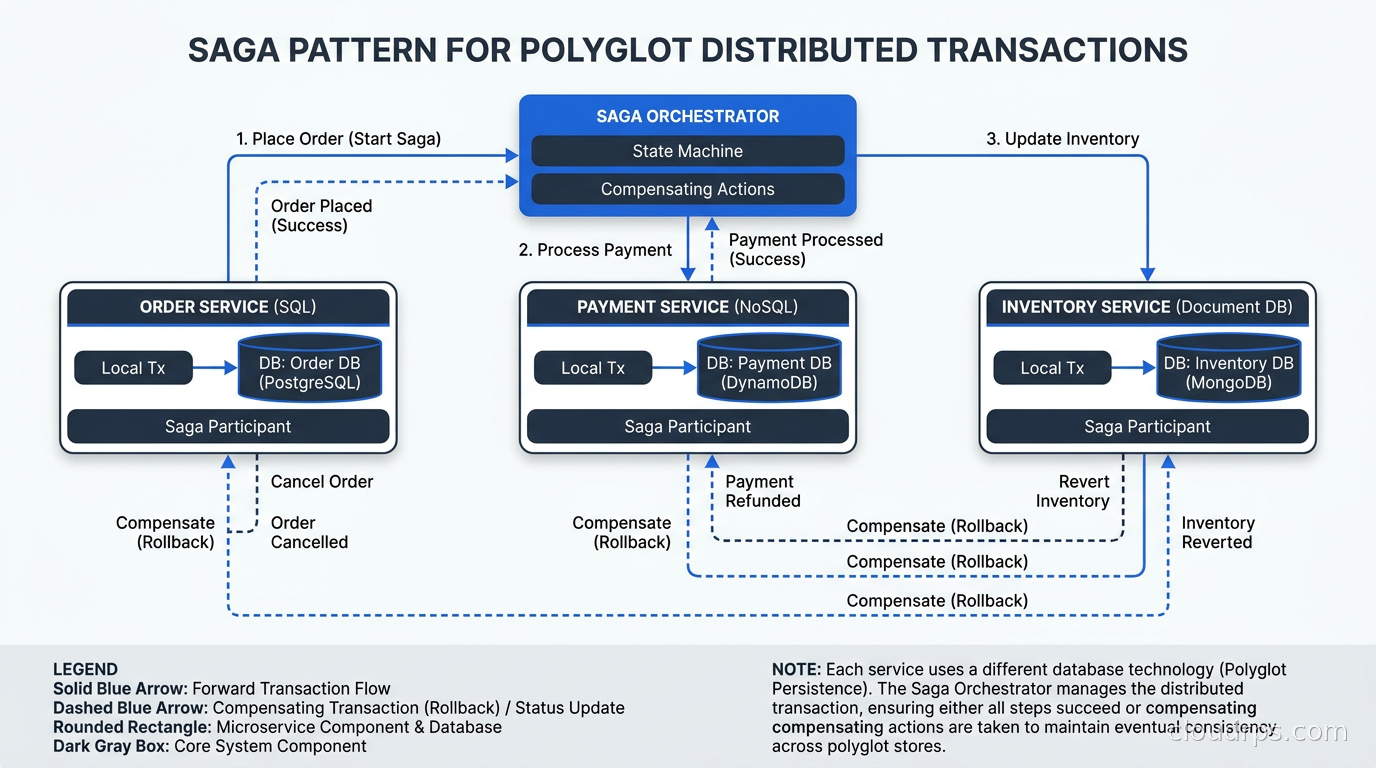
In practice, saga orchestration requires significant infrastructure. You need reliable message delivery, idempotent transaction handlers, compensating transaction logic for every possible failure mode, and observability into saga state. Change data capture with Debezium is commonly used alongside the transactional outbox pattern, where database writes and event publications are atomic within a single service’s database, eliminating the dual-write problem.
I have built saga-based workflows that span four services. The happy path business logic is clear and elegant. The failure handling code is more complex than the happy path by a wide margin. Before you choose polyglot persistence for a service that participates in distributed transactions, make sure you understand what you are committing to.
The Operational Reality
Here is what nobody shows you in the architecture diagrams: every database technology you add multiplies your operational surface area. Different backup strategies, different monitoring metrics, different tuning knobs, different upgrade procedures, different on-call runbooks.
PostgreSQL, Redis, and Elasticsearch in a production environment means your team needs to be competent at three different operations stories. Add InfluxDB and MongoDB and you have five. The learning curve is real. The on-call cost is real.
My guidance: prefer managed database services wherever possible. Amazon RDS and Aurora for PostgreSQL, ElastiCache for Redis, Amazon OpenSearch Service for Elasticsearch. You are paying the cloud provider to handle the operational complexity so your team can focus on application concerns.
This does not eliminate the complexity entirely. You still need to understand the database to operate it well: capacity planning, index management, query performance tuning. But it removes the lowest-level operational burden of managing servers, replication topology, and backup infrastructure.
The second piece of advice: audit your database usage regularly. I have seen organizations accumulate databases through years of well-intentioned individual decisions. Each choice was reasonable in isolation. The aggregate was a sprawling, expensive, fragile system that required multiple specialists to maintain. Every year or two, it is worth asking which of your data stores are genuinely earning their keep and whether some could be consolidated. The answer sometimes surprises you.
A Practical Migration Path
If you are migrating a monolith to microservices, do not try to solve the database problem all at once. The strangler fig approach applies to data as much as to code.
Start by keeping the existing database and sharing it temporarily across extracted services. Yes, this creates coupling. It is a deliberate, time-limited coupling while you understand the access patterns of each service in production. Rushing database separation before you understand the patterns is how you end up with the wrong schema boundaries.
As you gain confidence in the service boundaries, begin separating the data. Services with the least cross-service transaction requirements are the easiest to migrate first. Database migrations with zero downtime are essential throughout this process: you cannot take a production system offline to copy data.
Once a service’s data is isolated in its own relational database, evaluate whether you actually need to migrate to a different database technology at all. Often the answer is no. PostgreSQL is a remarkably capable general-purpose database, and the overhead of running a separate database server and acquiring operational expertise is only justified by a concrete capability or scale requirement.
When you do introduce a new database technology, run it alongside your existing stack for a period before committing any critical data paths to it. Understand its operational characteristics in your specific environment before it becomes load-bearing infrastructure.
When Polyglot Persistence is the Wrong Answer
I want to be honest about the cases where polyglot persistence is the wrong call.
Small teams without database expertise should resist the urge to adopt exotic databases. A five-person startup does not need Redis, Elasticsearch, MongoDB, and PostgreSQL. Start with PostgreSQL and add complexity only when PostgreSQL genuinely cannot serve a requirement.
Premature optimization is the enemy. “This service might need fast key-value lookups someday” is not a reason to add Redis. “This service is currently handling tens of thousands of key-value reads per second and PostgreSQL latency is causing user-visible delays” is a reason.
Regulatory environments often constrain your choices. Compliance requirements around data residency, encryption key management, and access controls vary by database technology. Adding a new database means auditing its compliance posture, adjusting documentation, and potentially involving your legal and security teams. The operational cost includes the compliance cost.
Social proof is not a technical requirement. “Company X uses Cassandra and they are very successful” is not evidence that Cassandra is right for your access patterns. Cargo-culting database choices is how teams end up running Cassandra for a workload that has three hundred rows.
Putting It Together
Polyglot persistence is not a pattern to adopt wholesale. It is a principle that guides individual decisions: choose the store that best matches each service’s data access patterns, and accept the operational overhead only when the benefits justify it.
In practice, most services benefit from starting with PostgreSQL. Redis earns its place for caching and session storage when low-latency key-value access is a genuine requirement. Search engines earn their place when full-text or faceted search is core to the user experience. Specialized databases earn their place when a specific access pattern cannot be served efficiently by your existing stack.
The teams that do this well tend to have a small set of approved database technologies with deep operational expertise in each, rather than a different technology for every service. They treat the addition of a new database type as an architectural decision requiring justification, not a default choice.
The teams that struggle either resist polyglot persistence entirely, forcing square pegs into round holes and building indexes and materialized views to compensate for the wrong database choice, or embrace it too enthusiastically, accumulating databases without clear justification until the operational burden exceeds the capacity of the team.
Your services deserve databases that fit their access patterns. But your operations team deserves a manageable portfolio of technologies they can actually master. Balancing those two needs is the real work of polyglot persistence.
Get Cloud Architecture Insights
Practical deep dives on infrastructure, security, and scaling. No spam, no fluff.
By subscribing, you agree to receive emails. Unsubscribe anytime.