
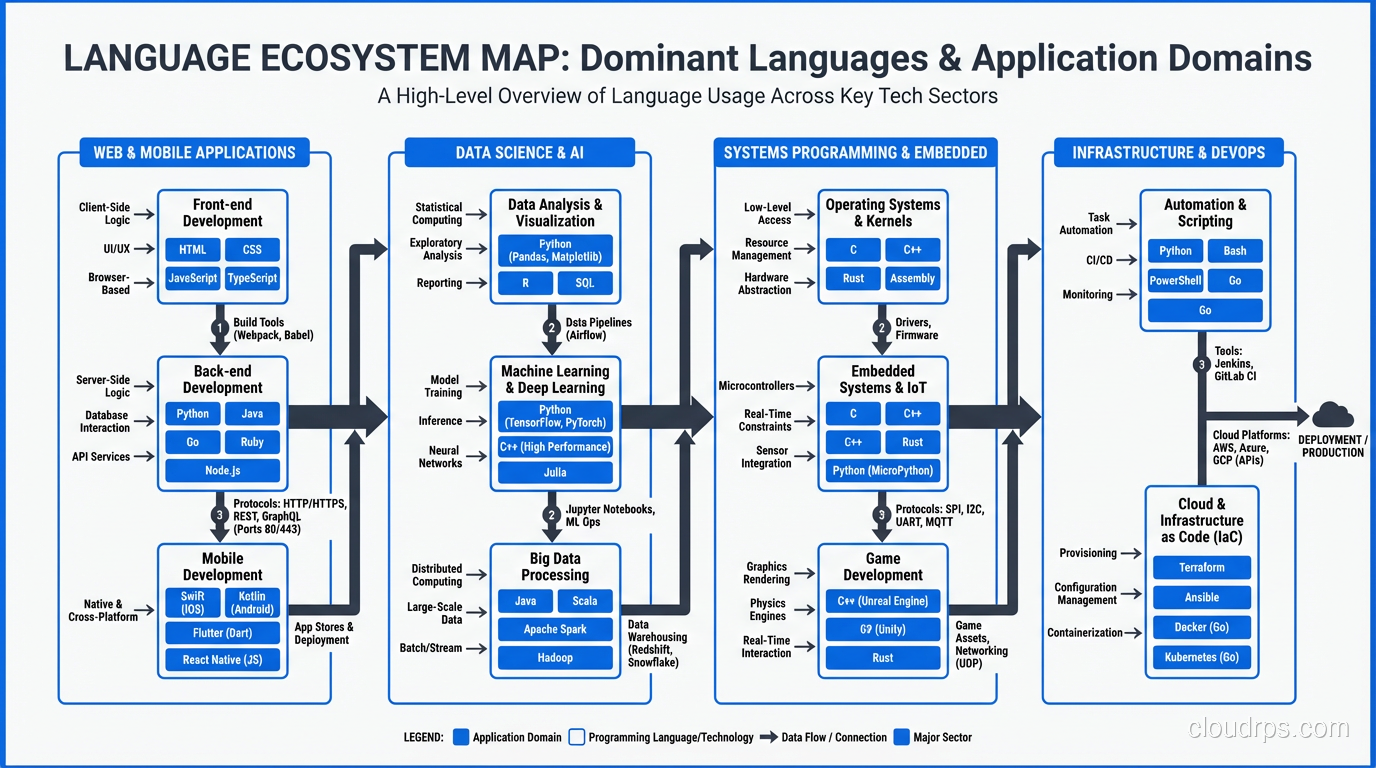
I’ve written production code in at least fifteen languages over my career. COBOL on mainframes, C on embedded systems, Perl for the web (forgive me), Java for enterprise services, Python for everything, Go for infrastructure tooling, and Rust for the things that need to be fast and correct. Each time I pick up a new language, the first question isn’t about syntax. It’s about the fundamental execution model. Is this interpreted or compiled? And that distinction shapes everything downstream: performance characteristics, deployment model, development speed, and where the language fits in the stack.
The scripting vs compiled distinction gets oversimplified in most discussions. It’s not a binary; it’s a spectrum, and modern languages have blurred the lines significantly. But understanding the core differences is essential for making informed technology choices.
The Fundamental Distinction
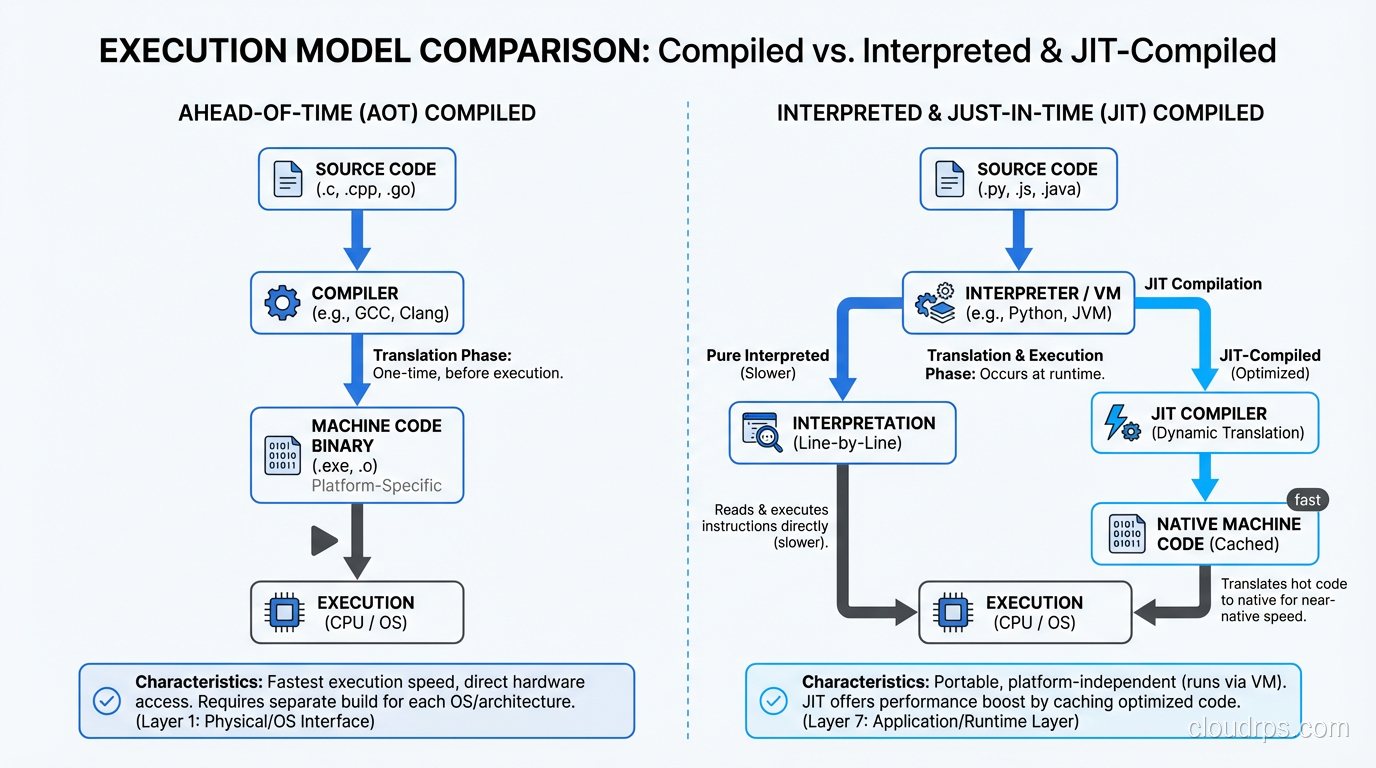
A compiled language translates source code into machine code (or sometimes bytecode) before execution. You run a compiler, it produces an executable binary, and that binary runs directly on the hardware (or virtual machine). C, C++, Go, Rust, and Swift are compiled languages.
A scripting (interpreted) language is executed by an interpreter at runtime. The source code is read, parsed, and executed line by line (or in small chunks) without a separate compilation step. Python, Ruby, JavaScript (traditionally), Perl, and Bash are scripting languages.
The distinction isn’t just academic. It drives fundamental differences in the development and deployment experience.
Compilation: What Actually Happens
When you compile a Go program, the compiler performs several passes:
- Lexical analysis: Breaks source code into tokens
- Parsing: Builds an abstract syntax tree (AST)
- Type checking: Verifies type correctness at compile time
- Optimization: Performs dead code elimination, inlining, loop optimization
- Code generation: Produces machine code for the target architecture
The result is a binary that contains machine instructions for your CPU. No interpreter needed at runtime. The program talks directly to the operating system.
The compilation step catches entire categories of errors before the code ever runs: type mismatches, undeclared variables, unreachable code. This is the core advantage of compiled languages: errors surface early, during development, not in production.
Interpretation: What Actually Happens
When you run a Python script, the CPython interpreter:
- Parses the source code into an AST
- Compiles the AST to Python bytecode (stored in .pyc files)
- Executes the bytecode on the Python virtual machine, one instruction at a time
Wait, Python compiles to bytecode? Yes. Most “interpreted” languages actually compile to an intermediate representation before executing. The key difference from a compiled language is that this happens at runtime, transparently, and the bytecode runs on a virtual machine rather than directly on the hardware.
JavaScript has gone even further. Modern JavaScript engines (V8, SpiderMonkey) use Just-In-Time (JIT) compilation to translate hot code paths into optimized machine code at runtime. This means JavaScript is simultaneously interpreted and compiled, and its performance characteristics are surprisingly close to compiled languages for some workloads.
The Blurry Middle Ground
The binary distinction is increasingly artificial. Let me map out where popular languages actually sit:
Fully compiled to native code: C, C++, Rust, Go, Swift
Compiled to bytecode, then JIT-compiled: Java (JVM), C# (.NET CLR), Kotlin
Interpreted with JIT compilation: JavaScript (V8), Lua (LuaJIT), Julia
Interpreted (with optional bytecode caching): Python (CPython), Ruby (MRI), PHP, Perl
Ahead-of-time compiled from traditionally interpreted languages: Python (Cython, PyPy, Mypyc), JavaScript (Bun, Deno compile)
Java sits in a fascinating middle ground. It compiles to bytecode (like a compiled language), runs on a virtual machine (like an interpreted language), and JIT-compiles hot paths to native machine code (like a compiled language again). Is Java compiled or interpreted? The honest answer is “both,” and that’s fine.
Performance: The Real Numbers
The performance gap between compiled and interpreted languages is real, but often overstated for typical application workloads.
CPU-Bound Tasks
For pure computation (number crunching, algorithmic processing, tight loops) compiled languages dominate. In my benchmarking:
- C/Rust: 1x (baseline)
- Go: 1.2-2x slower
- Java (after JIT warmup): 1.5-3x slower
- JavaScript (V8): 2-5x slower
- Python (CPython): 30-100x slower
That Python number isn’t a typo. CPython’s interpreter overhead is enormous for CPU-bound tasks. This is why NumPy, TensorFlow, and every serious Python numerical library is written in C/C++ under the hood. Python provides the interface, and compiled code does the heavy lifting.
I/O-Bound Tasks
For workloads dominated by I/O (web servers, database queries, API calls, file processing) the language’s execution speed often doesn’t matter because the program spends most of its time waiting for external systems.
A Python web server handling API requests that hit a database will perform within 20-30% of a Go web server for the same workload, because both are spending 90% of their time waiting for the database. The interpreter overhead is negligible compared to network and database latency.
This is the insight that many performance discussions miss. Most business applications are I/O-bound, which is why Python and JavaScript power enormous production systems despite their raw computation disadvantage.
Startup Time
Compiled languages win decisively on startup time. A Go binary starts in milliseconds. A Python application starts in hundreds of milliseconds to seconds (depending on import overhead). A Java application takes seconds to start and more time to reach peak performance as the JIT warms up.
This matters for serverless functions, CLI tools, and microservices that scale by starting new instances. It matters less for long-running server processes.
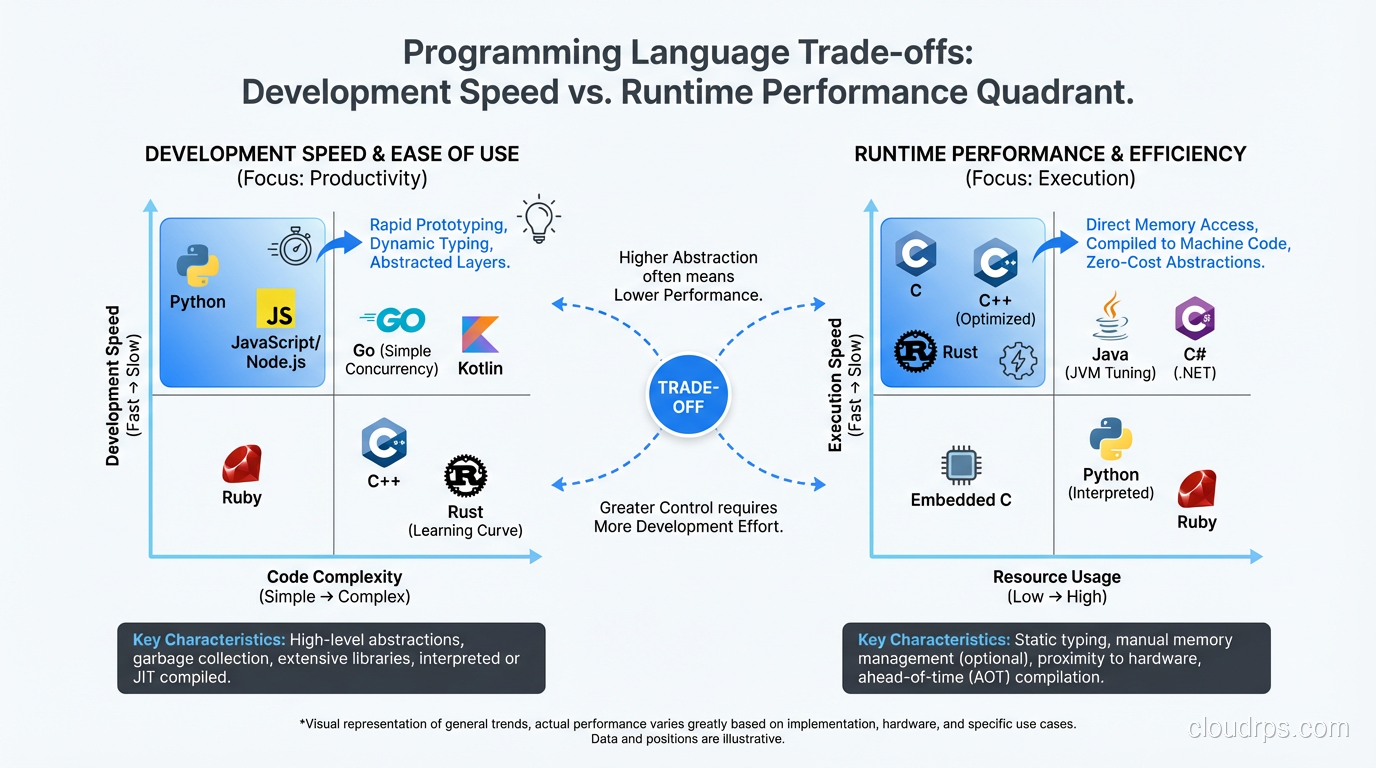
Development Speed vs Runtime Speed
Here’s the trade-off that actually drives most language decisions in practice: development velocity.
Scripting languages are faster to write. No compilation step means instant feedback. Dynamic typing means less boilerplate. Rich standard libraries and package ecosystems mean less reinventing the wheel. Python lets me prototype a data pipeline in a day that would take a week in Go.
But that velocity has a cost:
Errors surface later: In a compiled language, type errors are caught at compile time. In Python, you might not discover a TypeError until that specific code path executes in production.
Refactoring is riskier: Renaming a function in Go? The compiler tells you every call site that needs to change. Renaming a function in Python? You’re relying on grep and hoping you caught them all (or you’re using mypy, which helps but doesn’t cover everything).
Performance ceilings are lower: If your Python prototype needs to handle 10x the load, you might hit a performance wall that requires rewriting in a faster language. If you started in Go, you have more headroom.
When to Use Each: My Decision Framework
After decades of choosing languages for projects, here’s my practical framework.
Use a Scripting Language (Python, Ruby, JavaScript) When:
- Prototyping and exploration: When you’re figuring out the problem, not optimizing the solution
- Data analysis and data engineering: Python with pandas, PySpark, dbt (the ecosystem is unmatched)
- Automation and scripting: Glue code, deployment scripts, data processing pipelines
- Web application development: Django, Rails, Express, all well-trodden paths with huge ecosystems
- Machine learning: Python is the lingua franca, period
- The performance requirement is modest: If you need to process 100 requests/second, Python is fine
Scripting languages integrate naturally into CI/CD pipelines for deployment scripts, test automation, and infrastructure tooling. The fast iteration cycle matches the DevOps mindset.
Use a Compiled Language (Go, Rust, C++) When:
- Performance is critical: Sub-millisecond latency, high throughput, CPU-bound computation
- The program is long-lived and maintained by a large team: Type safety and compile-time checks prevent entire categories of production bugs
- You’re building infrastructure: Databases, proxies, orchestrators, container runtimes
- Deployment simplicity matters: Go produces a single static binary with no runtime dependencies, no virtual environment, no dependency hell
- Resource constraints exist: Embedded systems, edge computing, IoT devices where memory and CPU are limited
- You need predictable performance: No GC pauses (Rust), no JIT warmup (Go), no interpreter overhead
For database and application performance tuning, understanding the language runtime’s behavior (garbage collection, memory allocation, thread scheduling) is essential. Compiled languages give you more control over these factors.
The Hybrid Approach
The most effective architecture often uses both. Python for the orchestration layer, business logic, and data processing. Go or Rust for the performance-critical components. This is exactly what the Python ecosystem does with NumPy (C), TensorFlow (C++), and uvloop (Cython).
I’ve built systems where Python handles API routing and business logic, calls a Go microservice for high-throughput data processing, and shells out to a Rust CLI tool for cryptographic operations. Each language does what it does best.
Type Systems: The Hidden Differentiator
The scripting vs compiled distinction often correlates with static vs dynamic typing, and the type system arguably matters more than the execution model for large-scale software development.
Static typing (Go, Rust, Java, TypeScript): Types are checked at compile time. The compiler catches type errors before execution. Refactoring is safer. IDE support (auto-completion, inline documentation) is better because the tools know the types.
Dynamic typing (Python, Ruby, JavaScript): Types are checked at runtime. More flexibility, less boilerplate, faster initial development. But type errors only surface when the code runs, which means testing burden increases.
The trend is toward convergence. Python added type hints (and mypy for static analysis). TypeScript added static types to JavaScript. Gradual typing lets you start dynamic and add types as the codebase matures. This is a pragmatic evolution that I’ve fully embraced. I write Python with type hints everywhere, and mypy catches real bugs in every project.
The Language Ecosystem Matters More Than the Language
I’ll close with the observation that the language itself is often less important than its ecosystem. Python isn’t chosen for data science because it’s a great language for numerical computing (it objectively isn’t). It’s chosen because pandas, scikit-learn, PyTorch, and Jupyter exist. Go isn’t chosen for cloud infrastructure because of its type system. It’s chosen because Docker, Kubernetes, Terraform, and Prometheus were written in it.
When choosing between scripting and compiled languages, look at:
- What existing libraries and frameworks solve your problem?
- What does your team already know?
- What does the community around this language look like?
- What are similar companies using for similar problems?
The “best” language is the one that lets your team deliver value most effectively, which usually means the one they already know, in the ecosystem that already has the tools they need.
Get Cloud Architecture Insights
Practical deep dives on infrastructure, security, and scaling. No spam, no fluff.
By subscribing, you agree to receive emails. Unsubscribe anytime.