
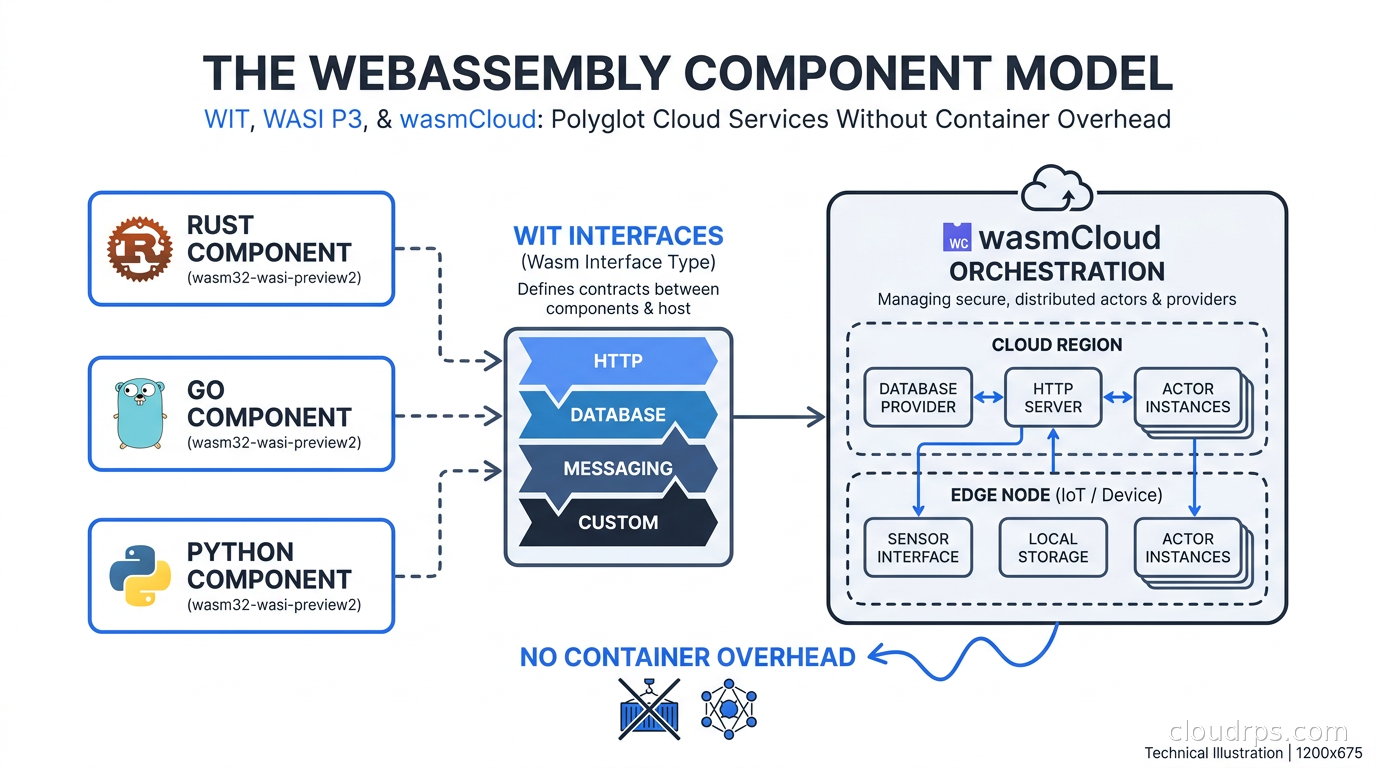
I spent a good chunk of time in 2023 and 2024 watching the WebAssembly component model conversation from a distance. The hype cycle was in full swing, the tooling was rough, and every demo I saw required fighting the compiler for two hours to get a “hello world” component working across language boundaries. So I waited.
In 2026 I stopped waiting. The component model has crossed a threshold that matters for production engineering. WASI 0.2 stabilized in early 2024 and WASI 0.3 dropped in February 2026 with native async I/O. wasmCloud reached CNCF incubator status with a 2.5 release shipping WASI P3 on by default. Akamai acquired Fermyon and deployed Spin across its edge network. SpinKube joined the CNCF Sandbox, making Wasm workloads schedulable directly via Kubernetes. American Express built an internal FaaS platform on wasmCloud. The “almost ready” phase is over for a meaningful slice of workloads.
This is not a replacement for containers. I want to be clear about that from the start. What the component model is, is a better answer to a specific problem containers never actually solved: true polyglot service composition where different language runtimes can call each other through typed interfaces, with the same security boundary you get from a VM, at microsecond startup latency instead of seconds. If that problem matters in your architecture, read on.
The Problem Containers Don’t Solve
When you run a Python microservice and a Go microservice in containers, those two services interact through HTTP. You define a REST or gRPC interface, each service speaks the wire protocol, and the network is the seam between them. That works fine. It’s what most of us do every day.
But that network seam has costs. You pay for serialization and deserialization on both sides. You pay for context switches into and out of the kernel. You pay for TLS if you’re doing it right (and you should be, as I covered in the service mesh explained article). For high-frequency, low-latency inter-service calls, this overhead adds up. More importantly, the interface definition between those services is informal: an OpenAPI spec that may or may not match the actual implementation, a gRPC proto file that both sides agree to compile against, or in the worst case, a shared Postman collection in Confluence that nobody updates.
The component model says: what if the interface was formal, language-agnostic, and enforced at the composition layer rather than at the network layer? What if a Rust component and a Python component could call each other directly through a typed interface, with zero network overhead, running in the same process, each isolated from the other in its own sandbox?
That’s the promise. In 2026, it’s sufficiently real to evaluate seriously.
What WIT Actually Is
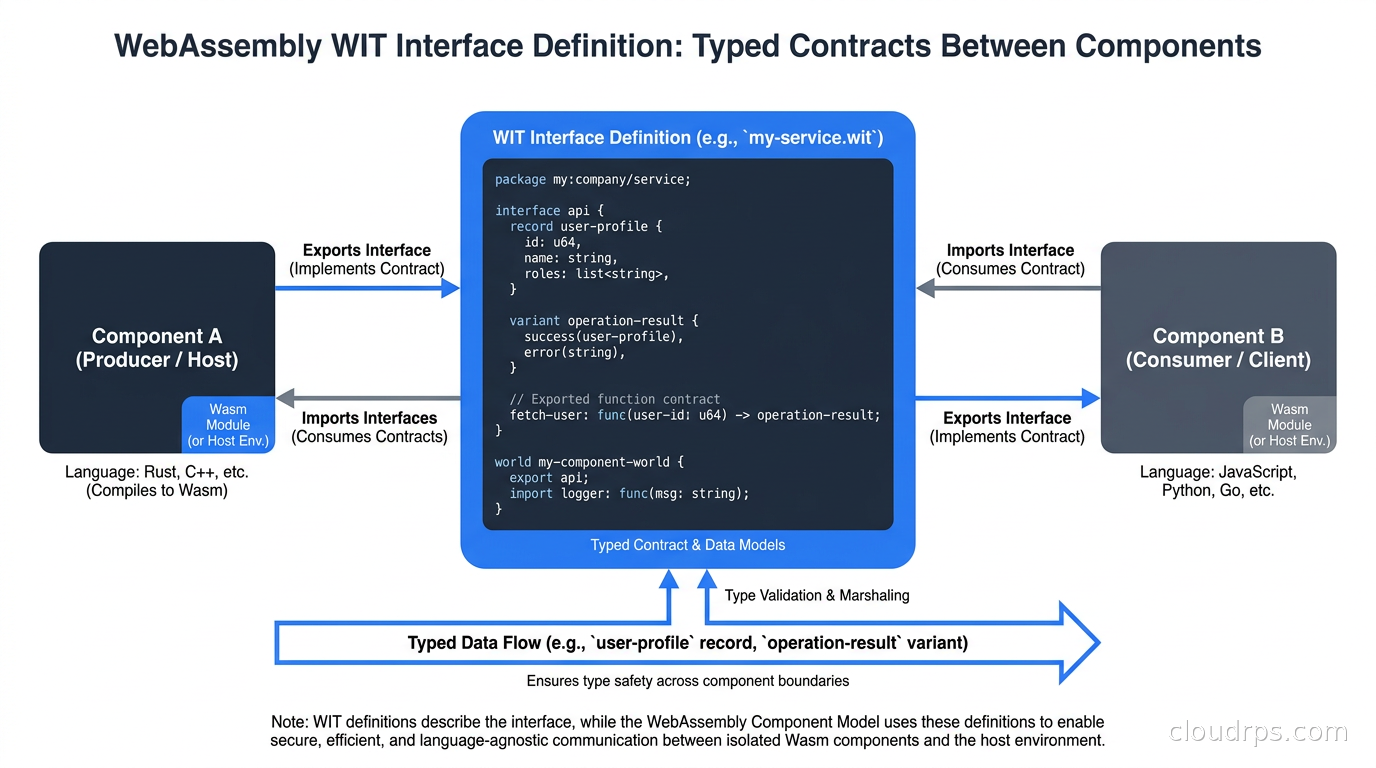
WIT stands for WebAssembly Interface Types. It’s an interface definition language, roughly analogous to protobuf for gRPC or WSDL for SOAP, but designed specifically for the component model’s composition model.
A WIT interface looks like this:
package my-org:image-processing;

interface resizer {
    resize: func(input: list<u8>, width: u32, height: u32) -> result<list<u8>, string>;
}

world image-service {
    export resizer;
    import wasi:http/incoming-handler;
}
This is a contract. Any component that exports the resizer interface is saying: “I accept an input byte array, target dimensions, and return either a resized byte array or an error string.” Any component that imports resizer can call it without knowing the implementation language. The component model runtime handles the memory layout and type marshaling at composition time.
The world declaration is important. It describes what a component offers to the outside world (exports) and what it needs from the outside world (imports). A component’s world is its full surface area. You can compose two components if one exports what the other imports. If the types don’t match, the composition fails at build time, not at 3 AM when your on-call engineer discovers a serialization mismatch.
This is type safety across language boundaries, enforced by the toolchain. After twenty years of building distributed systems, I cannot overstate how much cleaner this is than discovering a breaking API change through a production incident.
WASI P3: Why Async Matters
WASI 0.3, stabilized in February 2026, added native concurrency support to the component model. This was the feature that made async-heavy workloads viable. WASI 0.2 had synchronous I/O, which was fine for CPU-bound transforms but awkward for anything that needed to wait on a database query, an HTTP request, or a message queue.
WASI P3 introduces async functions, stream types, and future types as first-class WIT concepts. An interface can now declare:
interface storage {
    get-records: async func(query: string) -> stream<record>;
}
The stream<record> return type means the component produces a stream of records that the caller can consume incrementally. This is real async backpressure, defined in the interface contract, not bolted on as an HTTP chunked transfer encoding hack.
wasmCloud 2.5, released in July 2026, ships WASI P3 on by default with Wasmtime 46. The project demonstrated cross-component streaming at scale with a real workload: a Whisper speech-to-text component processing a long audio stream, with incremental transcript records flowing out as a WASI P3 stream to a downstream component for post-processing. The demo ran on wasmCloud’s lattice, orchestrated across multiple nodes, with OpenTelemetry traces stitching together the full call graph. That’s the production story I had been waiting for.
wasmCloud 2.5: The Production Platform
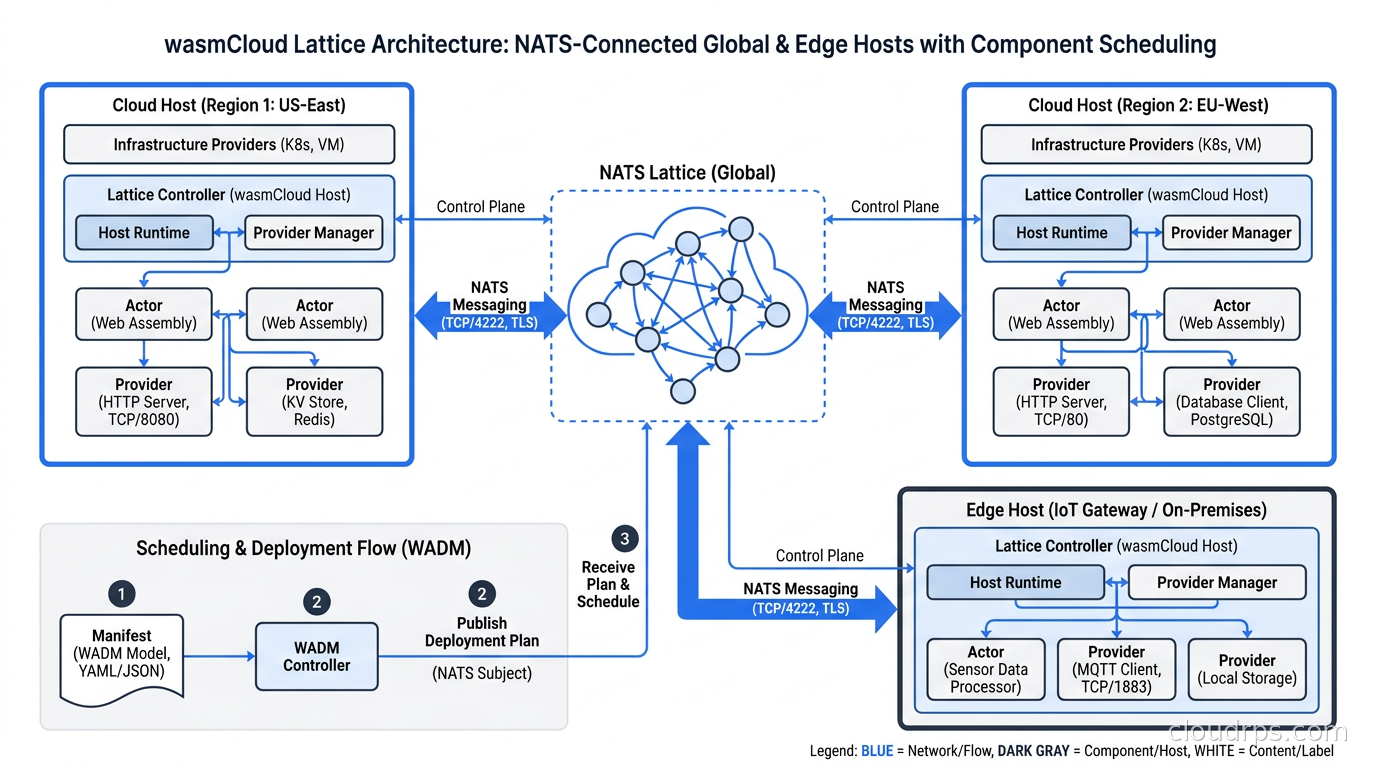
wasmCloud is a CNCF incubating project, built by Cosmonic, that provides the orchestration layer for Wasm components in distributed environments. Think of it as a Kubernetes for Wasm workloads, but with the component model’s composition semantics built in rather than bolted on.
The core concept in wasmCloud is the lattice: a flat, distributed network of wasmCloud hosts connected via NATS. Components running anywhere on the lattice can call components running anywhere else, and the lattice handles routing transparently. A component running on a wasmCloud host in an AWS availability zone can import a capability provided by a component on an edge node in Frankfurt, and the call goes through NATS with no code change. The interface contract in WIT is the only thing that has to match.
Capability providers are a key abstraction. When a component imports wasi:keyvalue/store, wasmCloud wires it up to a capability provider that implements that interface against a real backend (Redis, DynamoDB, Valkey). The component itself has no Redis client library, no connection pool, no retry logic. All of that lives in the capability provider. You can swap the backend by changing the wasmCloud configuration without touching the component code.
The 2.5 release added the component model implements feature: a single component can now multiplex several backend implementations behind a single named interface. This is useful when you have multiple tenants with different storage backends or when you are migrating from one backend to another with a gradual cutover.
For observability, wasmCloud emits OpenTelemetry traces, metrics, and logs natively. Every component invocation produces a span. You can plug this into any OTel-compatible backend without adding instrumentation code to the components themselves.
SpinKube: Wasm on Kubernetes
If your platform is Kubernetes (and for most of us, it is), SpinKube is the integration layer worth knowing. Fermyon contributed SpinKube to the CNCF Sandbox, giving Wasm workloads a first-class scheduling path via Kubernetes with a containerd-shim-spin that runs Spin components directly in the containerd lifecycle alongside regular container workloads.
SpinKube lets you write a Kubernetes manifest for a SpinApp resource:
apiVersion: core.spinkube.dev/v1alpha1
kind: SpinApp
metadata:
  name: image-processor
spec:
  image: oci://registry.example.com/image-processor:latest
  replicas: 3
  executor: containerd-shim-spin
This looks familiar to anyone who has written a Kubernetes Deployment, but the “container” here is a Wasm component packaged as an OCI artifact. The containerd-shim-spin executes it without a full container runtime. No OCI container image with a base OS layer, no process namespace overhead. The component starts in milliseconds because it’s loading a small binary, not spinning up a Linux process tree.
Fermyon, after the Akamai acquisition in late 2025, deploys Spin at edge scale across Akamai’s global network. The component model’s OCI packaging is what enables this: a Wasm component is a small, portable artifact that the same toolchain can deploy to a Kubernetes cluster or to an edge node. The underlying workload code doesn’t care about the target environment, because the WIT interfaces are the same everywhere.
For teams running on EKS, GKE, or AKS, SpinKube integrates via Helm chart. Node pools need the containerd-shim-spin installed, which is handled by a DaemonSet. You end up with a mixed cluster where some nodes run regular container workloads and some run Wasm workloads, and Kubernetes scheduling routes SpinApp pods to the right nodes via tolerations.
The Workloads That Fit
The component model shines for a specific profile: stateless, I/O-bound handlers with polyglot composition requirements.
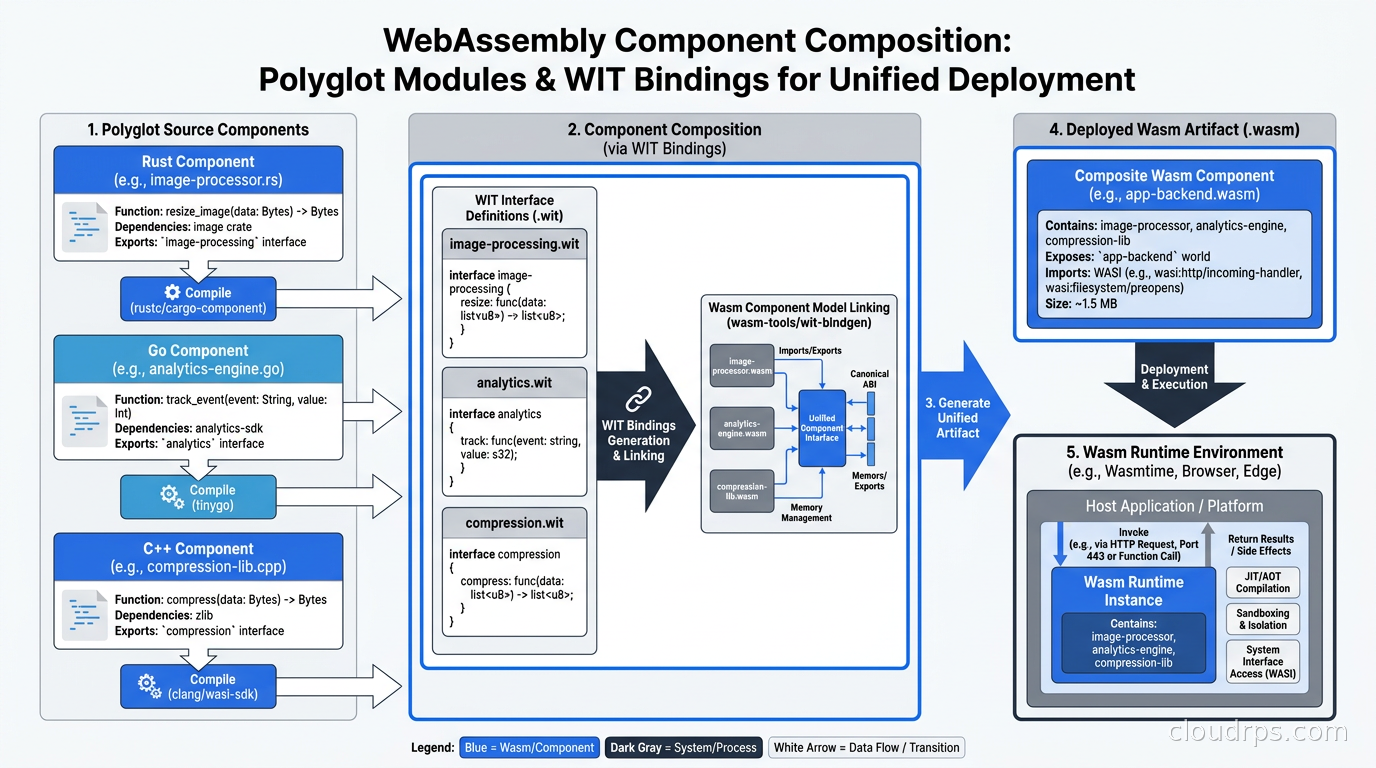
API gateway logic is a natural fit. You want to write your authentication component in Rust for performance, your rate limiting component in Go because your team knows Go well, and your business logic in Python because your data scientists own it. With gRPC you run three separate services with network hops between them. With the component model you compose three components into a single linked component that handles the full request path in-process, with zero network overhead between the composed pieces.
Data processing pipelines benefit from the async streaming additions in WASI P3. A pipeline where each stage is a Wasm component consuming from an upstream stream and producing to a downstream stream composes naturally in wasmCloud’s lattice. The backpressure semantics are defined in the WIT interfaces, not in whatever message queue you happened to wire together.
Edge workloads are the strongest use case today. The combination of sub-millisecond cold starts, small binary size (a typical component is hundreds of kilobytes, not hundreds of megabytes), and WASI’s security model (deny-by-default capabilities) maps well to edge computing’s constraints. After Akamai acquired Fermyon, Spin-based components are running on Akamai edge nodes globally. If you are building applications where computation needs to run physically close to users with minimal footprint, this is worth serious evaluation.
The security model deserves mention. A Wasm component can only access resources explicitly granted through its WASI imports. It cannot make arbitrary syscalls. It cannot access the filesystem unless a file descriptor is explicitly handed to it. This is a stronger isolation guarantee than a container, which ultimately shares the host kernel. For multi-tenant environments where you run code from different customers, the component model’s sandboxing is genuinely interesting. This is zero-trust applied to the compute layer.
The Workloads That Don’t Fit
I try to give honest assessments. The component model is not the right answer for stateful services with complex runtime dependencies, workloads that need shared memory between components, anything that requires POSIX features not yet exposed through WASI, or services with heavy CPU parallelism patterns that depend on OS thread management.
Language support is still uneven. Rust has excellent toolchain support: cargo component builds components, wit-bindgen generates bindings from WIT definitions, and the ergonomics are genuinely good. Go support has improved substantially, but the toolchain is more manual. Python support via componentize-py works but produces larger binaries than Rust. Java via TinyGo and the wasmCloud community’s Endive project is functional but still maturing. If your team writes primarily Java or C#, the component model is a more significant workflow change.
The debugging story is also not as mature as container debugging. You have OpenTelemetry traces and logs, but the interactive debugging experience (attaching a debugger, stepping through code) is harder. wasmCloud is working on this, but it is not at parity with what you get from a standard container runtime today.
Composition in Practice
Here is what the development workflow actually looks like. You write a WIT interface file defining the contracts between components. You implement each component in whatever language has the best support for that domain. You use wac (the WebAssembly Composition tool from the Bytecode Alliance) to link components together, or you let wasmCloud handle the dynamic wiring at runtime. The composed component is a single Wasm binary that embeds all the linked components.
Testing is at the WIT boundary. You can test a component in isolation by mocking its imports. You don’t need a full container stack to test an individual component’s behavior. This is similar to the benefit you get from clean dependency injection in traditional services, but enforced by the type system.
Deploying to wasmCloud is wash app deploy. Deploying to a SpinKube cluster is kubectl apply. The OCI packaging is the same in both cases: wash build produces an OCI artifact, which you push to any OCI registry and reference in your deployment manifest.
How This Fits in Your Architecture
I would not recommend replacing your existing container-based microservices with Wasm components. The migration cost is not worth it for workloads that are working fine, and the component model is not going to solve problems you don’t have.
What I would recommend: identify your highest-frequency inter-service call paths, the ones where latency and serialization overhead are measurable. Evaluate whether those services have the workload profile (stateless, I/O-bound, no exotic POSIX dependencies) that the component model handles well. If they do, a pilot makes sense.
I would also look at any new edge or function-as-a-service workloads you are starting from scratch. When you are not migrating existing code, the component model’s ergonomics (especially with Rust or Go) are competitive with traditional FaaS frameworks. The security model, the cold start latency, and the OCI packaging story are genuinely better for a narrow but important class of workloads.
The Cloudflare Workers model has been proving out edge-hosted Wasm for years. The component model standardizes what Cloudflare did proprietary in a way that’s portable across platforms. That’s worth paying attention to.
For teams running on serverless containers today, SpinKube on your existing Kubernetes cluster lets you adopt Wasm components incrementally without a separate infrastructure path. The scheduler sees SpinApp resources and container-based Deployments as equal citizens.
Where This Goes
The Bytecode Alliance, the standards body behind the component model, includes Fastly, Microsoft, Google, Intel, and Mozilla among its members. The CNCF hosts wasmCloud (incubating) and SpinKube (sandbox). WASI 0.3 stabilized in February 2026. These are not small signals.
The parallel I keep drawing is to the early days of Linux containers. In 2012, nobody was running containers in production at scale. By 2016, Docker and Kubernetes had changed how we built and deployed software. The component model is not going to move that fast (the toolchain maturity gap is real), but the trajectory is similar: a technically sound primitive is accumulating the platform layer that makes it operationally viable.
Twenty years ago, I watched the industry go through a similar cycle with Java applets promising “write once, run anywhere” and delivering “write once, debug everywhere.” The component model is a fundamentally different proposition because the sandboxing is at the runtime level, the type system is the contract, and the ecosystem is genuinely cross-language rather than one runtime wrapped in portability theater.
The workloads I am watching most closely are data plane logic in service meshes, API gateway request processing, and multi-tenant FaaS platforms where the isolation model matters. In all three of these, the component model has concrete advantages over the current state of the art. That’s enough to warrant keeping this technology on your architecture radar in 2026, even if you are not deploying it today.
Getting Started
The practical starting point is the Bytecode Alliance’s component model documentation, which covers WIT, component tooling, and the WASI interface catalog. If you want to run something, install wasmCloud and wash via the wasmCloud quick start, write a simple Rust component using cargo component, and deploy it with wash app deploy. The whole loop takes an afternoon.
For Kubernetes integration, the SpinKube Helm chart documentation covers node pool setup and SpinApp resources. If you already have an EKS or GKE cluster with extra capacity, you can run a SpinKube pilot alongside your existing workloads in a few hours.
The tooling is good enough that I no longer spend most of my evaluation time fighting the build system. That’s the inflection point. When the tooling stops being the story, the technology gets to be the story.
Get Cloud Architecture Insights
Practical deep dives on infrastructure, security, and scaling. No spam, no fluff.
By subscribing, you agree to receive emails. Unsubscribe anytime.